

How Clubbed Thumb “Moves Fast and Builds Things” for Summer’s Strangest Party
After three decades of producing must-see downtown plays, artistic director Maria Striar continues leaning into new work that defies categorization.
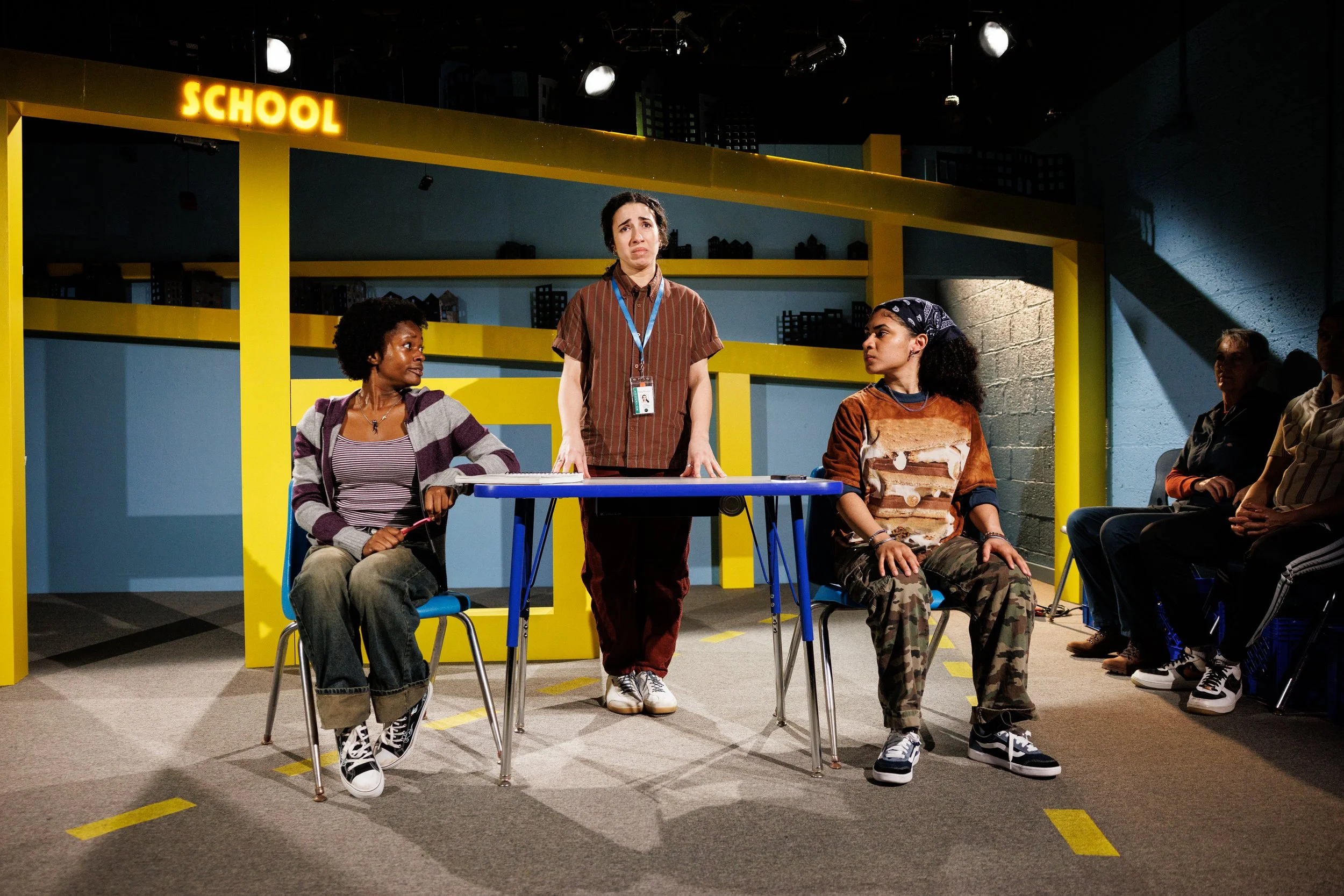
Megan Lomax, Layan Elwazani, and Marvelyn Ramirez in Jesse Jae Hoon’s Titans, directed by Tara Elliott, part of Clubbed Thumb’s Summerworks 2026. Photo: Maria Baranova.
When Clubbed Thumb reveals its Summerworks roster each year, you may be unfamiliar with the playwrights and their idiosyncratic work. Three things, however, are sure. All the plays will be weird. Also rather silly. And they might rile you up.
These aren’t random descriptors. “Funny, strange, and provocative” has been Clubbed Thumb’s curatorial motto since the company’s birth on the Lower East Side thirty years ago. Founded by actor-friends Maria Striar and Meg MacCary when they stopped waiting to be cast and self-produced a month of shows in the legendary House of Candles on Ludlow Street, the small but mighty Clubbed Thumb has already begun its 29th season. The race to land tickets for each mini-run at the 89-seat Wild Project is on.
In fact, the first world premiere came and went: Titans, by Jesse Jae Hoon, depicted an ad hoc coalition of alarmed citizens using tech savvy and multicultural pluck to stop (unseen) ICE thugs from abducting anyone deemed an “illegal” — i.e., a person of color. Jae Hoon’s piece (which closed May 26) adopted a screwball-comedy tone for a heavy topic, tracking a dozen or so folk heroes through a barrage of short scenes. It was an urban underdog adventure told with fast-cutting manga velocity. And oodles of liberating queer desire.
“It’s true,” admits Striar over Zoom. “Everyone in Jesse’s play seems to be a lesbian.”
Jae Hoon’s play pairs nicely with Nadja Leonhard-Hooper’s Derangements (June 1–12). In this surreal comic thriller, women experience cognitive dissonance brought on by predatory male sexuality and patriarchy in general. Sample sequence: a flasher exposes himself outside a restaurant where two women are dining and instead of genitals, they see a blinding light that appears to fracture reality itself. One woman who interprets quotidian social interactions as brazenly sexual finds herself miraculously pregnant.
The final Summerworks entry is The Family Dog (June 18–30), in which thirtysomething Winona Everett-Cohen returns to her family home in suburban Colorado, where a beloved, ailing pooch may be headed for the rainbow bridge. Turns out the two-legged creatures of the household are faring even worse. Through bickering, bonding, and sibling meltdowns, playwright Bailey Williams reveals that the real crisis is not the canine’s health but the Everett clan’s inability to communicate about aging, politics, sexuality, and addiction. If only the family listened to their dog. In stage directions, Williams writes that the titular pet should be played like he’s a rock star, aged “in the impossible way very famous rock musicians from the ’70s have aged.”
A hyper-relevant antifa farce; a hallucinatory satire on sexual panic; and a dysfunctional family reunion centered around an anthropomorphized pet. Is there anything — thematically or aesthetically — that links this year’s Summerworks? Striar ponders the question.
“I think of Bailey’s play as being about family,” the wry and casually cool artistic director suggests. “Nadja’s play is about the world, especially the world as experienced by women, and Jesse’s play is about America itself and what the country is going through.”
Striar continues. “With The Family Dog, it’s about going home to your Trump-supporting family, and with Derangements, it’s a world where patriarchy drives people literally insane. All the plays were written within the last six months, so they’re emerging directly out of the present moment — just through different filters and apertures.”

Suzzy Roche, Grace McLean, Alana Raquel Bowers, and Nina Ross in Ro Reddick’s play with music Cold War Choir Practice, directed by Knud Adams, which ran at MCC in 2026 after premiering at Summerworks in 2025. Photo: Maria Baranova.
While most nonprofit theaters move painfully slowly when responding to new currents in politics and technology, or they mire new works in development hell, Striar and her team have made a virtue of impetuosity. Summerworks is mounted as quickly and frugally as possible, in keeping with Striar’s directive to “move fast and build things.” All artists accept modest compensation in return for working on scripts that take wild risks, and a schedule that allows for flexible rehearsals and limited two-week runs. Whether you have a child at home or want to keep your calendar open for TV and film gigs, Striar finds a way to get the best actors.
And this summer, the downtown stars are out. Featured among the Derangements cast are Hannah Cabell, Crystal Finn, and Danny Wolohan — three beloved veterans of theatrical Weird. The Family Dog’s ensemble includes Andrew Garman, Talene Monahon, Tom Pecinka, and Sarah Steele. Garman appeared opposite Paul Giamatti in Alexander Payne’s The Holdovers. Monahon is not just a slyly charming performer, but she recently wowed audiences with her play Meet the Cartozians (a Pulitzer Prize finalist). Pecinka rocked out as the control-freak Peter in Stereophonic, and after racking up a score of stage credits, Steele has appeared in various TV series, such as Dangerous Minds and others.
Clubbed Thumb started small, and while it offers a reading series on nights the Wild Project is dark, as well as a directing fellowship, a biennial play commission, and an early career writers’ group, the core company remains tight and nimble. The annual $2 million budget covers six employees — five full-time, one part-time. Each Summerworks title costs around $200,000 to mount. Clubbed Thumb doesn’t have the burden of maintaining a physical space and operates out of offices on Lafayette Street through an arrangement with Playwrights Horizons.
Just surviving is notable these days. Multivenue heritage institutions such as the Signature Theatre or the Public Theater have had to trim their seasons or lay off staff. Over the past five years, incubators of new writing have been closing at an alarming rate: The Lark, Sundance Theater Lab, and the Humana Festival all vanished from the landscape. Staff at the Eugene O’Neill Theater Center’s National Playwrights Conference described their status in a 2025 New York Times article as “stable-ish.”
Which makes Clubbed Thumb more noteworthy, especially when a play lives past its sneeze-and-you’ve-missed-it premiere on East 3rd Street. Starting in 2016 with a remount of Jaclyn Backhaus’s Men in Boats at Playwrights Horizons, there has been a steady drip of revivals, some co-produced with bigger institutions: Will Arbery’s Plano and Ethan Lipton’s Tumacho got second runs at the Connelly Theater before the pandemic; Adrian Einspanier’s Lunch Bunch was co-produced with PlayCo in 2023; Liza Birkenmeier’s Grief Hotel and Abe Koogler’s Deep Blue Sound both returned at the Public Theater. Most recently, Ro Reddick’s ’80s-style musical satire (and winner of the Susan Smith Blackburn Prize) Cold War Choir Practice enjoyed a high-profile reprise co-produced with Page 73 at MCC Theater earlier this year.
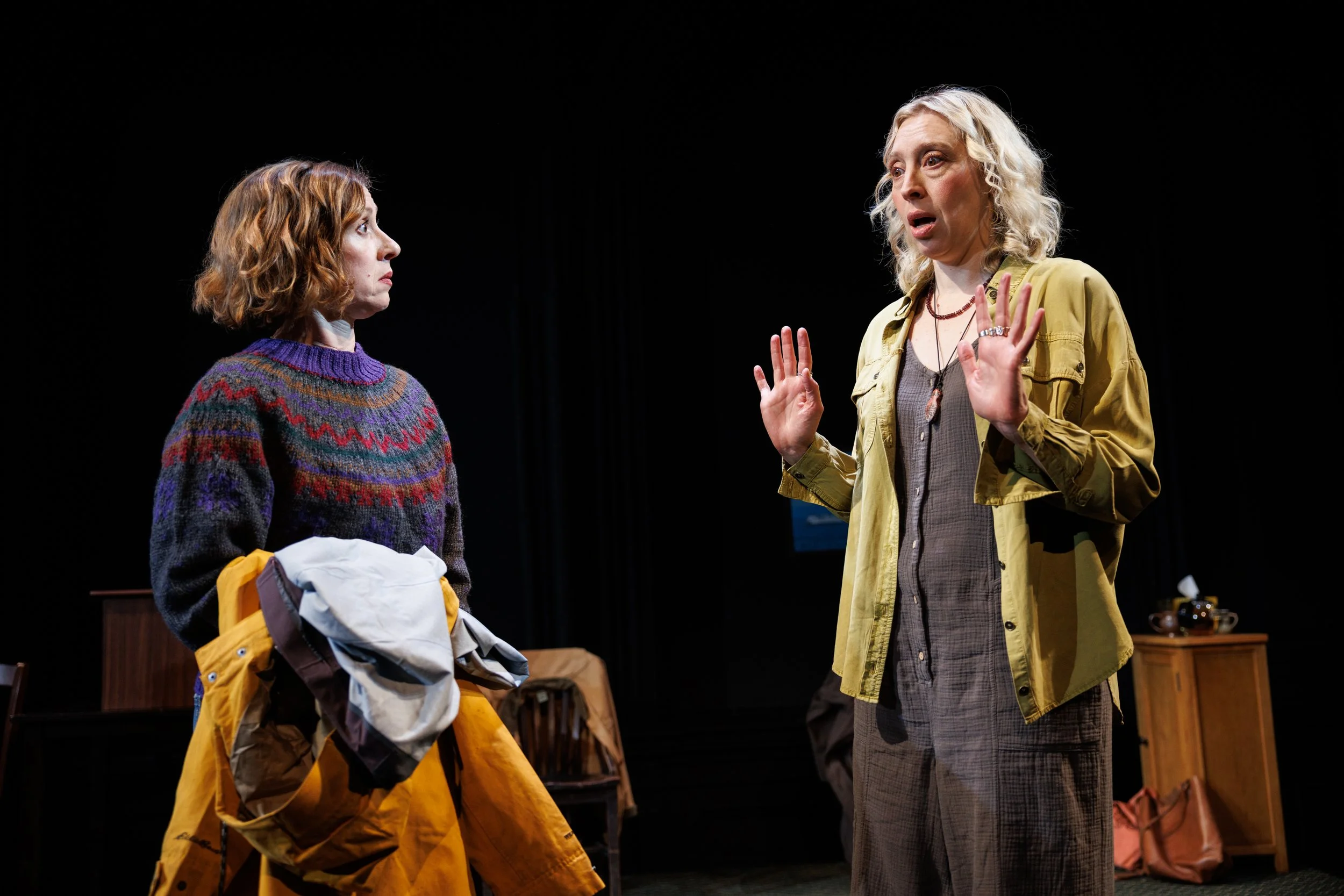
Miriam Silverman and Crystal Finn in the acclaimed Public Theater run of Abe Koogler’s Deep Blue Sound, directed by Arin Arbus, a Summerworks 2023 standout. Photo: Maria Baranova.
Striar notes that post-pandemic budgetary woes and dwindling audiences can, paradoxically, benefit Clubbed Thumb’s artists. “As larger institutions become more financially unwieldy, fissures open in the system,” she observes. “Opportunities emerge inside those fissures. Sometimes smaller companies can make work more flexibly because they don’t carry the same contractual burdens.”
But, she adds, it’s not like a partnership with the Public or MCC means a big payday or a swift climb further up the (short) theatrical ladder. “Once you move into larger Off-Broadway spaces, the economics change dramatically,” Striar says. “Cold War Choir Practice was very expensive even though we only paid a portion of the cost. It didn’t come close to recouping financially, but more than ten thousand people saw it. That’s far more than anything else we’ve done.”
So what did MCC get out of it? “They had material for their subscribers, and they received part of the box-office revenue,” answers Striar. “Fundamentally, though, it was a curatorial choice: MCC loved the play and wanted it in their season.”
“It was probably a younger and poorer audience than they’re used to,” Striar adds with an irreverent chuckle. “Hopefully they’re excited about that: younger and poorer.”
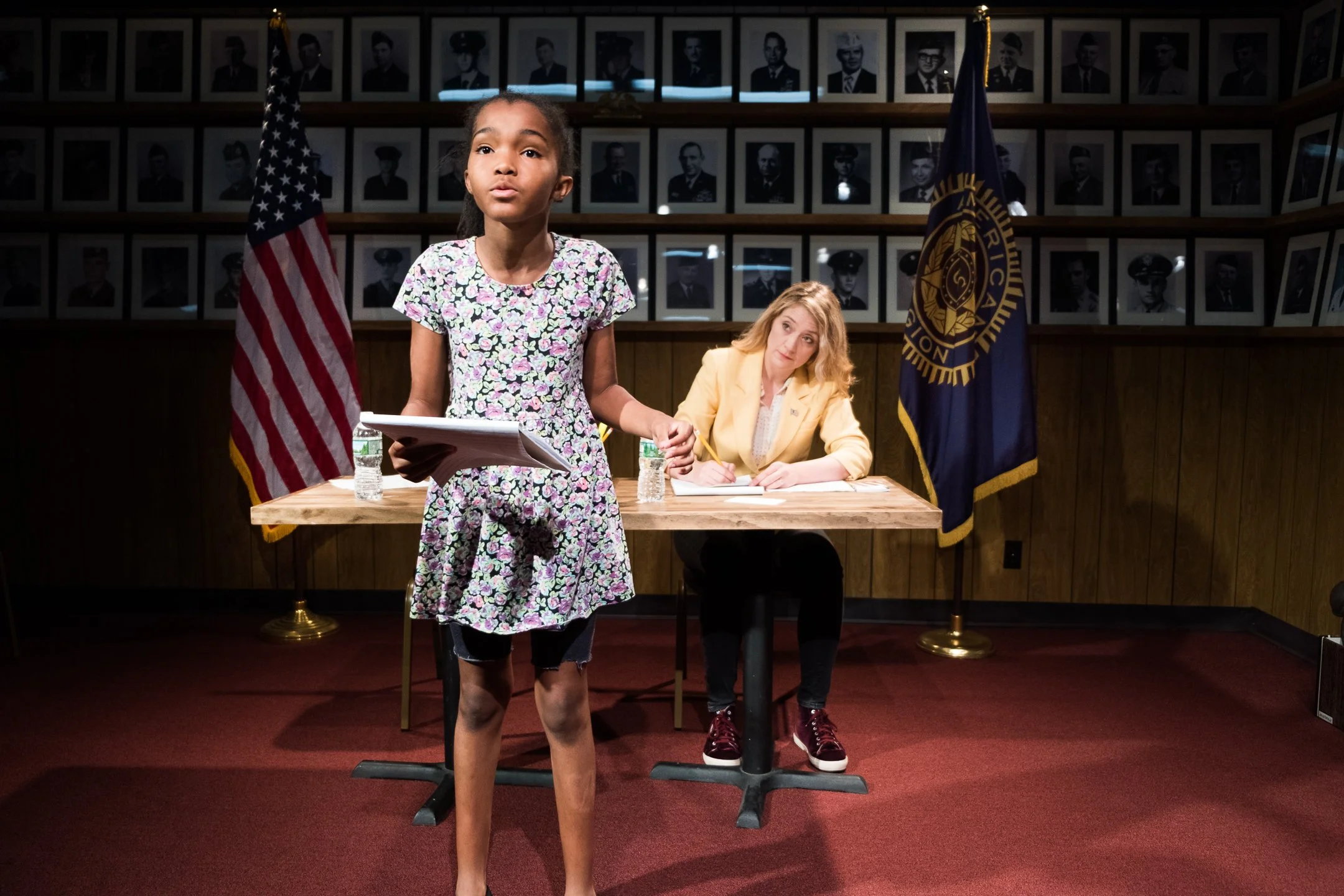
Rosdely Ciprian and Heidi Schreck in Schreck’s What the Constitution Means to Me, directed by Oliver Butler, here at Summerworks 2017. The play made its way to Broadway, via New York Theatre Workshop, two years later, and was a Pulitzer Prize finalist. Photo: Elke Young.
In terms of production dollars and audience size, the biggest success to come out of Clubbed Thumb has been Heidi Schreck’s What the Constitution Means to Me. Schreck’s painfully evergreen memory play about women’s bodies and Supreme Court “originalists” began life at the Wild Project in 2017. Two years later it had traveled from Off-Broadway, at New York Theatre Workshop, to Broadway, where it was captured on video for Amazon Prime. By the time Schreck was debating a rewrite of the Constitution with a teenager on the Hayes stage, Clubbed Thumb was one of many producers. “It was our production, but we didn’t have to do the heavy lifting,” Striar explains. “We sort of rejoined it on Broadway.”
Once Summerworks comes to a close, Clubbed Thumb will have produced 128 new plays over the past three decades (while commissioning and developing many more). That is a massive archive. Since Striar programs material no longer than 90 minutes, we’re talking around 192 hours (or eight full days) of perverse, cuckoo-bananas experiments. Given changing theatrical fashion and today’s increased awareness around race, gender, disability, and neurodivergence, one wonders about how many could, hypothetically, be revived. Is yesterday’s dark, offbeat farce a canceling offense today?
“I have three 26-year-olds working with me, and they sometimes gather to read old Clubbed Thumb plays aloud,” Striar reports with a smile. “According to them, they still live. They’re not horrified by them.”

The 2024 Public Theater production of Liza Birkenmeier’s Grief Hotel, directed by Tara Ahmadinejad, another wonderfully odd Summerworks play that found new life at one of the city’s major nonprofits. Photo: Maria Baranova.
This season there’s much on New York stages to prove Clubbed Thumb has long been ahead of the curve. Striar ticks them off: “Marjorie Prime was first read aloud in my living room. Lately, as an audience member, I’ve revisited Adam Bock, Gina Gionfriddo, Clare Barron — people whose early work we produced. I’m completely unobjective, but I think the plays still feel alive.”
Clubbed Thumb clearly has a devoted fan base, one that gets a particular itch scratched (funny, strange, and provocative — remember?). Striar attributes the brand loyalty to how she “Netflix-ized” the programming. “Streaming platforms succeed because they aggregate all the weird people into one audience,” she explains. “Theater is harder because people have to physically come to a space and buy a ticket. But we’ve always wanted to build a broader audience.”
She built it, and they come. During these sultry evenings in the East Village, ticketholders fill the sidewalk in front of the Wild Project, chatting excitedly about what they’ve seen, planning a post-show drink, catching up with friends or old collaborators. Everyone knows: year after year Clubbed Thumb catches lightning in a bottle with slippery, impossible plays.
Ever the practical captain, Striar pooh-poohs serendipity and insists that constraints are what form the pearls. “What makes New York special isn’t magic,” she says. “It’s density. Artists are constantly sharpening each other because there’s so much conversation and so much cultural activity all the time. The audience is part of that, too. They arrive curious and ready to engage.”