

Voir Dire: On the Civic Position of Queer Artists
What do we owe a democracy that often isn’t sure about us? Moving between a jury summons and a reading of The Normal Heart, playwright Else Went reflects on certainty, compromise, and belonging.
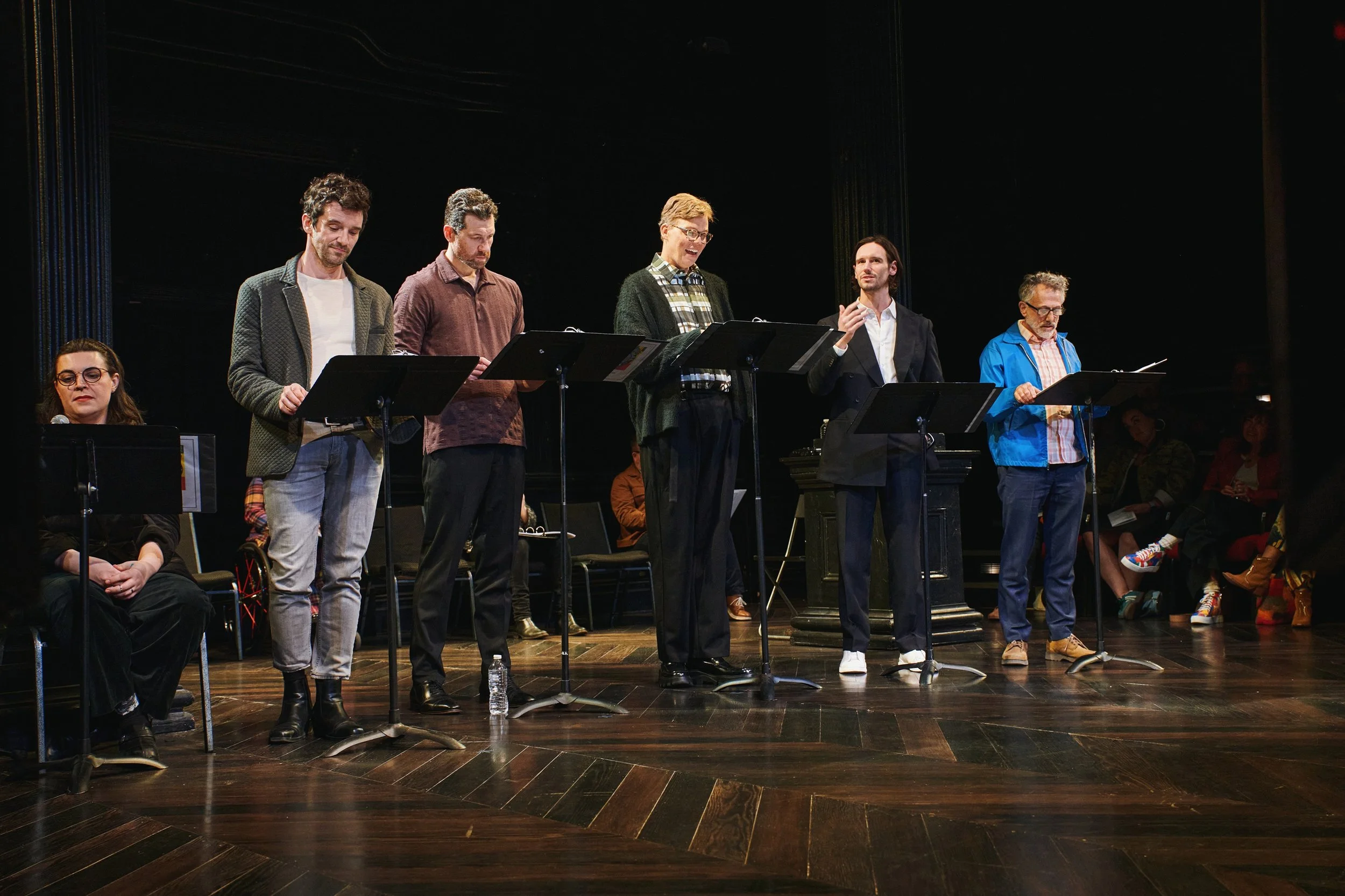
Else Went, Michael Urie, Billy Eichner, Jeff Hiller, Cory Michael Smith, and David Greenspan in the 40th anniversary benefit reading of The Normal Heart at the Public Theater. Photo: Valerie Terranova.
I’m sitting in the shadow of Brooklyn Borough Hall, my back to a fence circling a fountain. I look at the iron children taking refuge between the largest bowl and the basin, then up to the gilded feminine form of Justice high above, atop the cupola holding forth her sword and scales. I’m sharing lunch with my new friend Road, who has just asked if I want to serve. “You seem pretty keen.”
I tell him the jury system is my favorite of humanity’s optimisms, that believing reasonable strangers can be gathered together, given the facts of a situation, and discern the truth is core to my work as a playwright. “I mean the Oresteia, one of our foundational texts, is about the creation of the jury trial to put an end to vendetta justice. An audience is a jury.”
“Well, I don’t think you’re getting picked after that.”
He’s referring to something the defense attorney, representing a construction company whose driver allegedly caused an accident on the Brooklyn-Queens Expressway, said during the process of questioning jurors, known as voir dire, Old French for “to speak the truth.”
“You’re going to hear from experts supporting both sides,” he tells us, “and they’re going to contradict each other. Ultimately what we want is jurors who are good judges of character.” He proceeds to ask each of the jurors in turn why they fit that brief.
“Serving the government in a nonpolitical capacity, I have to be aware of the forces that might try to influence my work.”
“I interface with a lot of people through a nonprofit, and so I do have to know who is going to make good use of our aid.”
“As a lieutenant colonel in the Vietnam War, I commanded a platoon of soldiers, and it’s absolutely mandatory to know who you can count on.”
Et cetera down the line to me in the sixth chair. Counsel consults my juror survey, where the word “playwright” appears in the box labeled for my occupation, then lifts his eyes to meet mine. “And you. I’m not sure about you.”
I cannot mask my shock. I watch him realize that he has turned to the only trans woman in the room and made a negative statement of opinion, when he met every other potential instrument of justice with a question. Now he is as flustered as I am. He covers his ass with “aren’t writers alone in a room all day?”
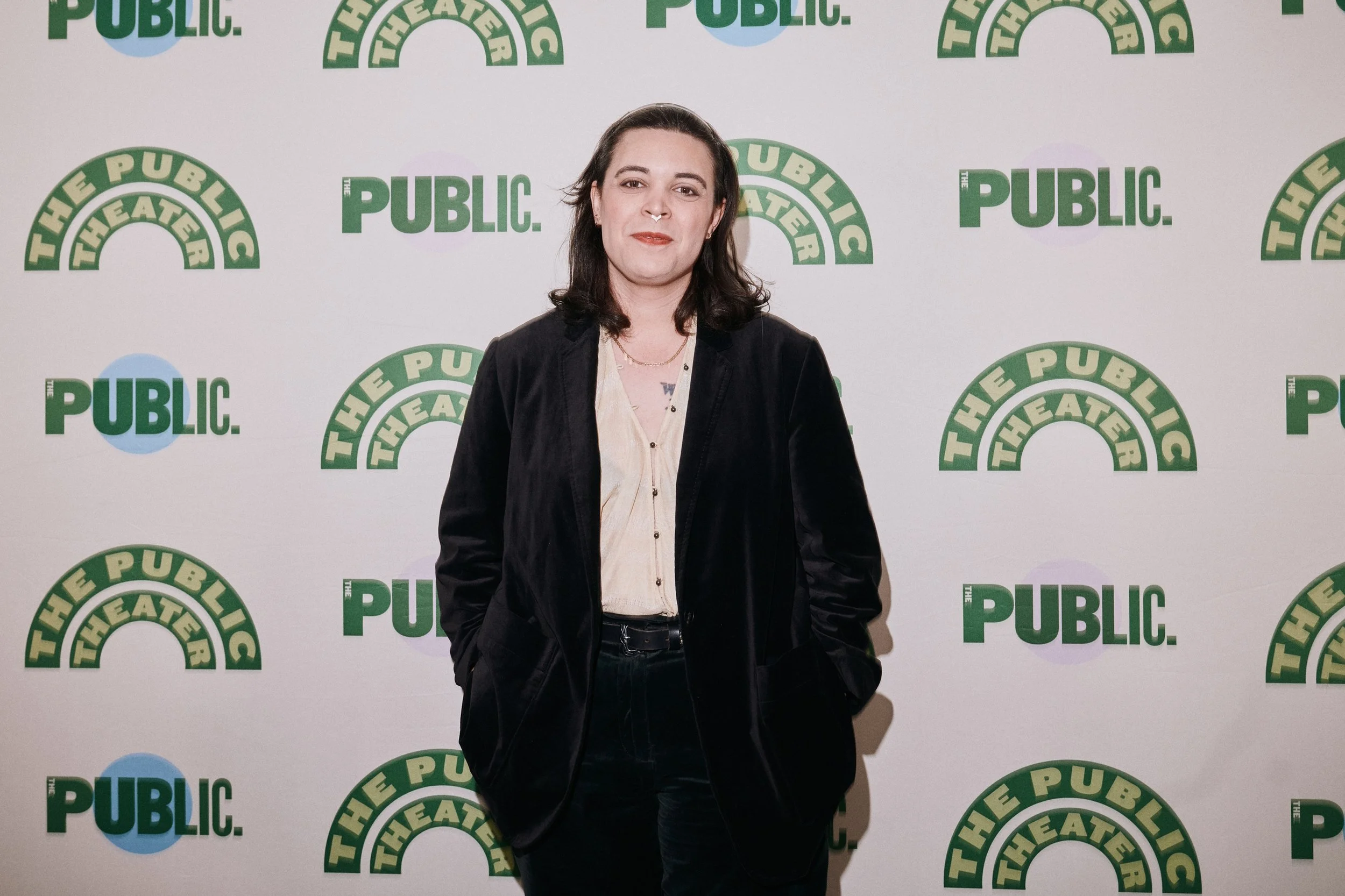
Playwright Else Went at the reading of The Normal Heart. Photo: Valerie Terranova.
I explain what I do so extremely well that when we break for lunch a woman stops me to say “I think you explained what you do extremely well.”
“Oh thanks; I should start applying for grants while I’m on a roll.”
Between bites of a vegan banh mi, Road tells me he thinks the courts don’t realize trans people are especially well suited to tell what’s in people’s hearts. With every new person we meet we have to decide whether they’re safe or not. I silently disagree. I have found that my vigilance can lead me to mistrust sooner than is justified. I am trying, these days, to doubt myself as an act of generosity to the world. We head back through the metal detector into the white box of jury empanelment, and are summarily dismissed.
While I am not chosen for service, three days later I am again seated in the sixth chair, now stage right of five music stands in the newly renamed Barbaralee Theater at the Public Theater introducing the cast performing Larry Kramer’s The Normal Heart for a one-night-only reading under the direction of Tony Kushner.
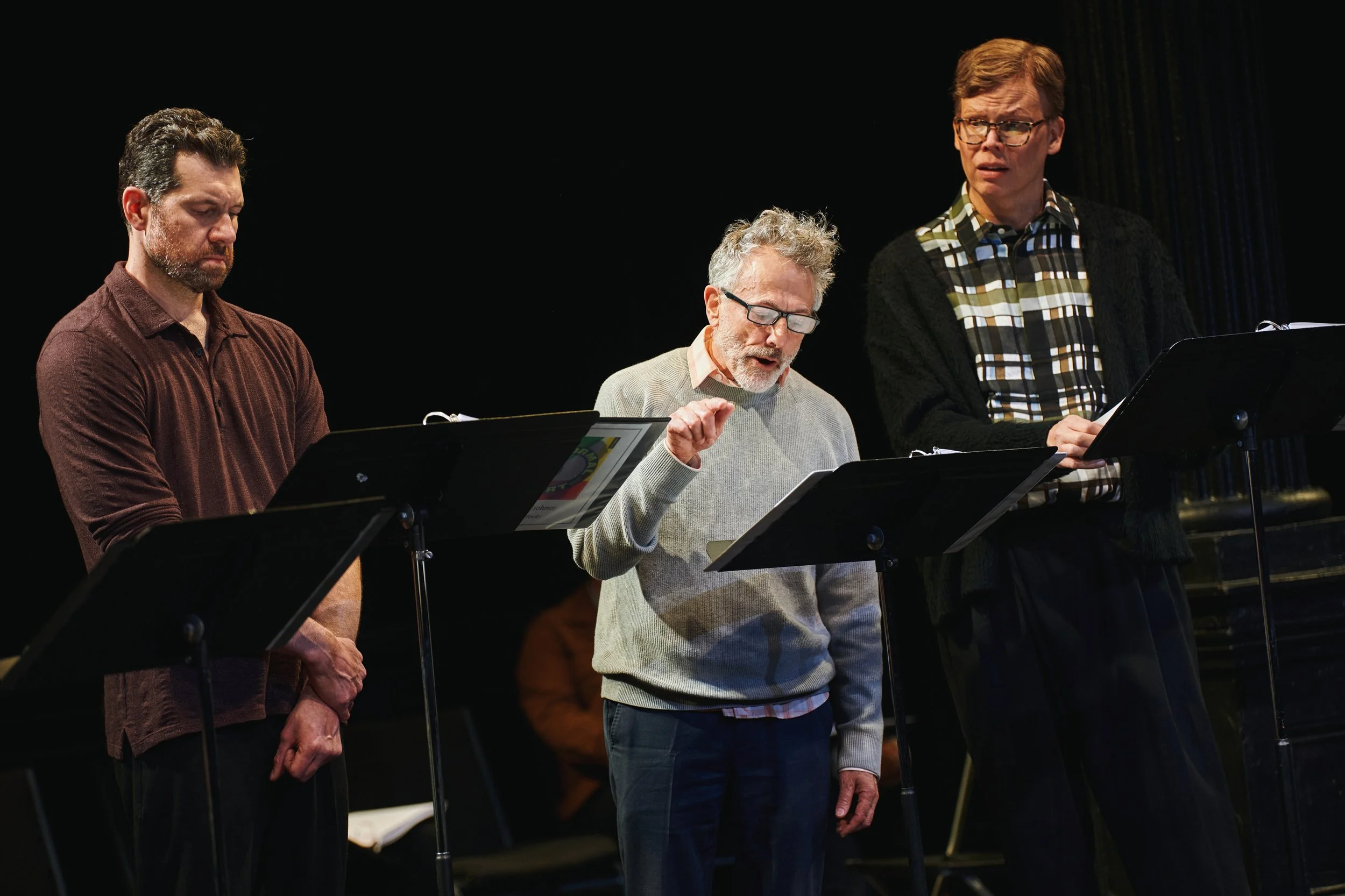
Billy Eichner, David Greenspan, and Jeff Hiller in the reading of The Normal Heart. Photo: Valerie Terranova.
The play deals with Kramer’s own work founding the Gay Men’s Health Crisis to raise awareness and prevent the spread of the as-then-unidentified disease killing gay men, and his ouster by that group for his extreme personality and moral stance against promiscuity. It is a brutal text, even now, but after our table read David Greenspan shares his experience of seeing the play when it opened in this very building 40 years ago, how in 1985 the play was different because there was still no answer to why gay men were dying in ever-increasing numbers; he recounts that the ending, in which the Kramer-stand-in’s boyfriend dies, was not painful within the context of history as it is today, but a scene that the gay men in the audience had either recently lived themselves, or knew they soon would. “We weren’t crying,” Greenspan said. “We were terrified.”
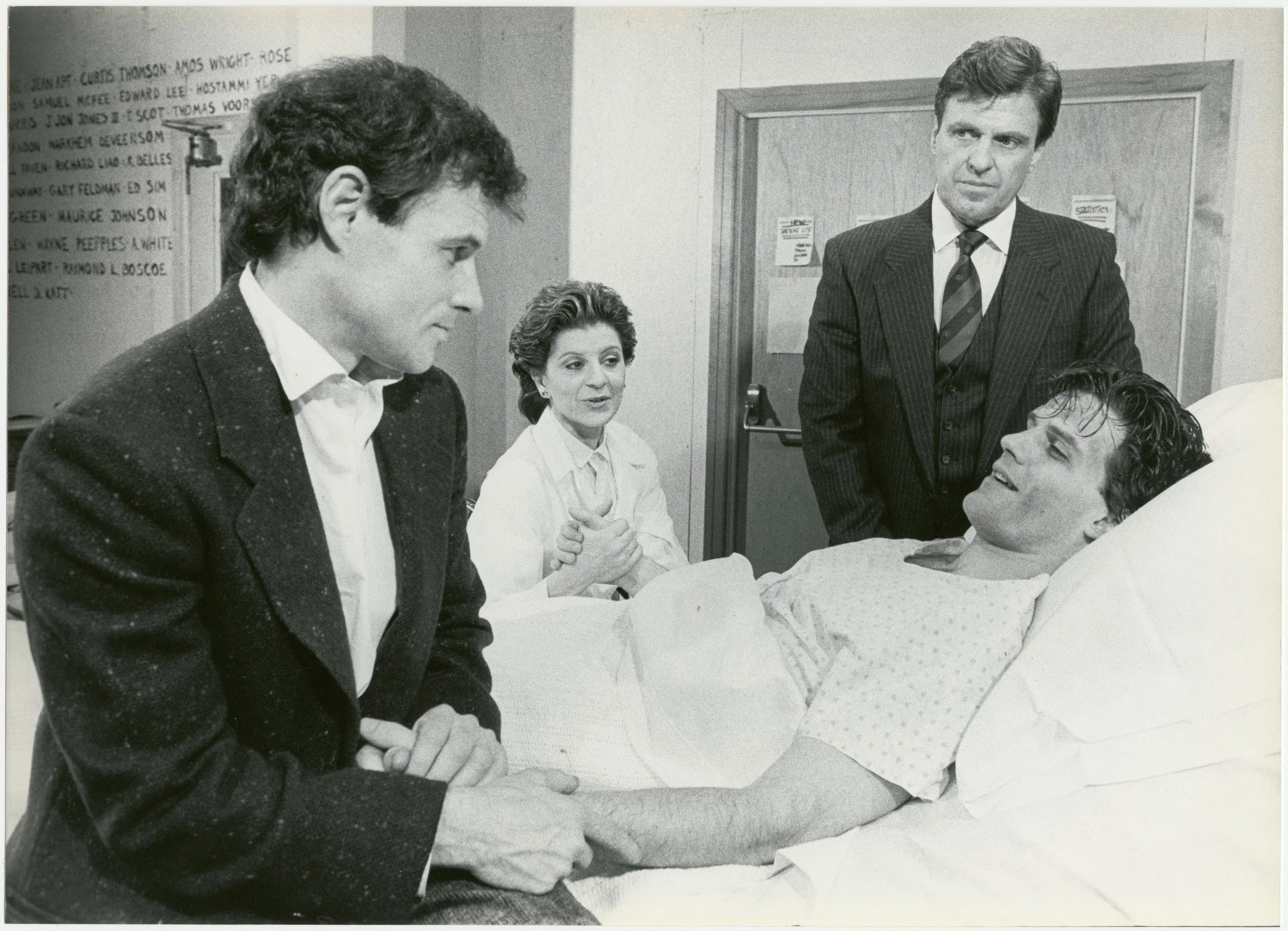
Brad Davis, D. W. Moffett, Concetta Tomei, and Phillip Richard Allen in the original production of The Normal Heart at the Public Theater. Photo: Martha Swope / New York Public Library.
Tony shares with me backstage that he and Larry had a great falling out over Kramer’s refusal to compromise on anything: his moral certainty, his personalization of the political, his inflammatory rhetoric and naked antagonism to anything but full belief in his goals and methods. I say he’d be big on Twitter. But Larry was a man without doubt, whose civic fervor was so powerful and prescient that he could admit his flaws and still know himself fit to lift the sword and scales.
And here is Tony Kushner, author of a morally indispensable body of work concerned with the dialectics of civic engagement. And here am I, telling one of my few living idols that my inclusion in tonight’s benefit reading is important to me not just because it means a trans woman gets to sit on stage and narrate a play that only glancingly references our offstage existence, and not just because it feels like I have been meaningfully included in the lineage of queer playwrights in a way I could never have dreamed.
It’s because I feel closer than ever to my uncle, who died from AIDS a few months before I was born, died at the age Tony was when Angels in America opened on Broadway, the same age I am now, coming off my recent Off-Broadway debut in this same building with Initiative, a five-hour play about coming-of-age in a culture of endemic homophobia and senseless war.
Stephen Went was a landscape architect in Toronto, where he designed the original Berczy Park, St. James Park, and a bathing pavilion near Sunnyside Beach, where a plaque installed by “his friends in the department of parks and recreation” commemorates “his artistry, love of life, and development of the green spaces of the city.” I learn this from a website and not from his family, who rarely mention him. I scroll down the page and am faced with a photograph of a fountain, a succession of bowls spilling their fullness into the next, at last into a wide basin. There is no great angel dipping her toe in the water to purify it and us. There are no children taking shelter from the blind stare of Justice dressed in gold. There is no iron fence. It’s a simple place, almost unremarkable, described by blogger Natalie The Explorer as a “blissful place to enjoy nature and stay cool.”
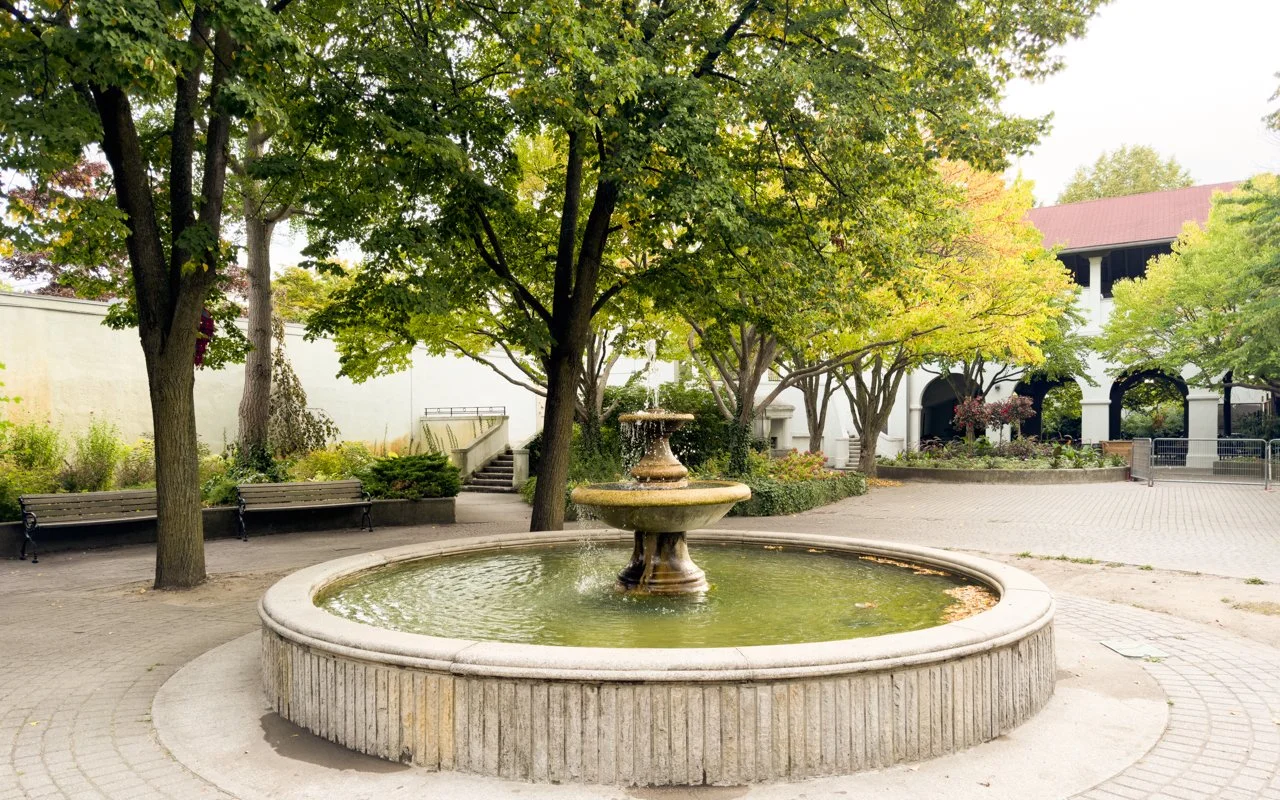
The fountain designed by Stephen Went in the courtyard of the Sunnyside Park Bathing Pavilion in Toronto. Photo: © City of Toronto.
I don’t know for certain what is the civic responsibility of a queer artist when we are still often met with some variation of “I’m not sure about you,” when we are named enemies of The State, when we can only find in art the epistemic authorship that we should have in democracy. Do we invest wholly, even recklessly, in certainty of our complete righteousness and speak the truth? Do we admit some degree of compromise in order to continue moving forward, asking for more life? Do we all but invisibly contribute our artistry to the benefit of our neighbors and fellow citizens, regardless of whether they love us or even know our names?
Or maybe each pours its fullness into the next, a cascade tributing a basin of great capacity, with no fence, into which we may all place our hands or feet and find relief.