

John J. Caswell, Jr. and Dustin Wills Dig Into “Jerome”
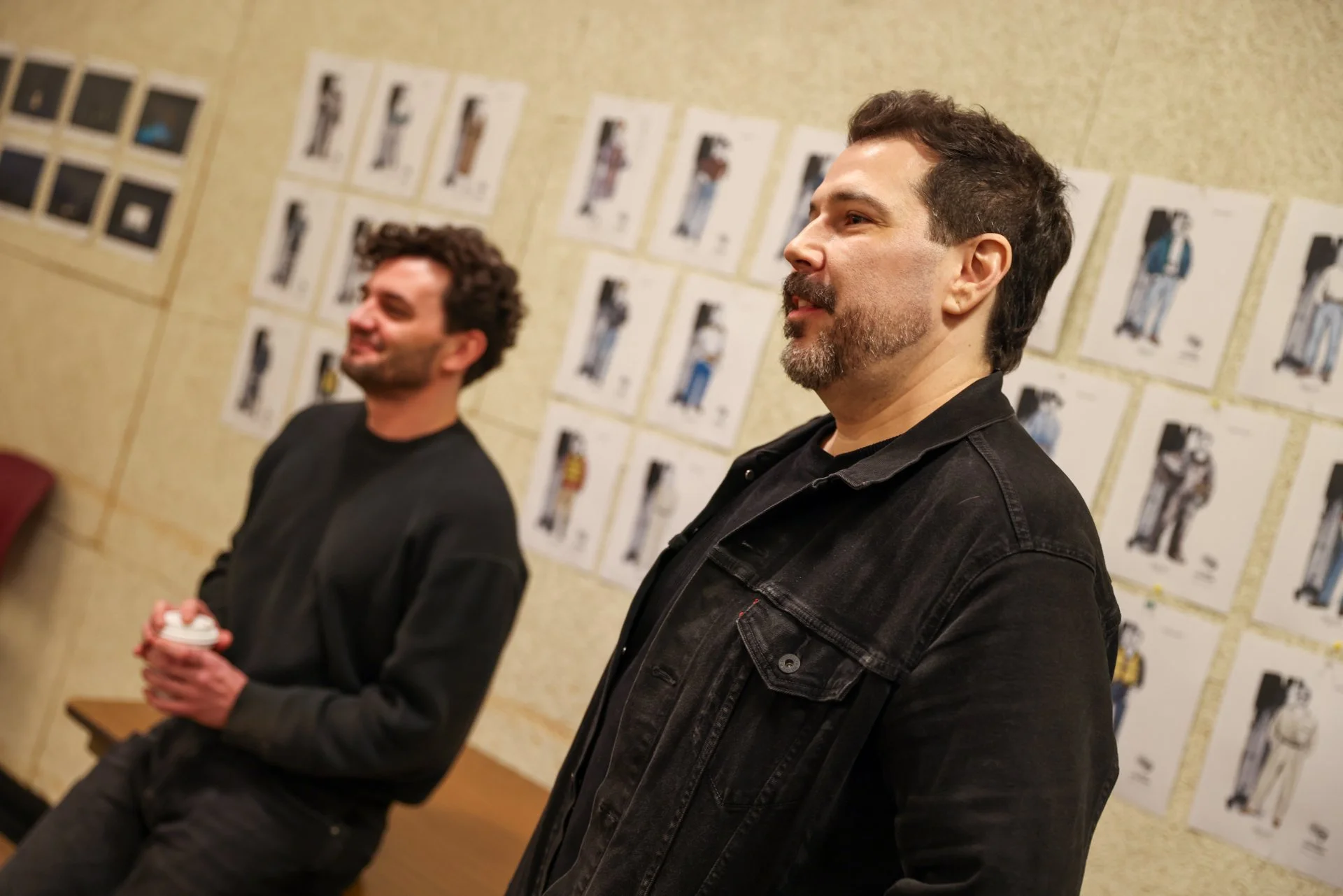
After collaborating on Wet Brain in 2023, director Dustin Wills and playwright John J. Caswell, Jr. reunite for Jerome at Playwrights Horizons. Photo: Jordan Best.
As a kid, playwright John J. Caswell, Jr. would cry when leaving the Verde Valley. There he would visit his great-grandmother in Camp Verde, Arizona, and explore the nearby towns. Though he was only a few hours drive from home, the Phoenix metropolitan area, he felt a world away in a place where, even as a child, he noticed he could be more himself.
“I remember when I would go there, I would feel less concerned with how I carried myself, and how I behaved,” Caswell says. “I think it’s because the environment surrounding you feels so otherworldly and queer; you walk into a crystals shop and there’s a menu on the wall of mediums sitting in the back waiting to have a reading with you. The whole place puts me at ease.”
Day trips would take him to places big and small: Flagstaff, Sedona, and — perhaps most significantly — Jerome, the subject and title of his newest play, premiering at Playwrights Horizons from May 14 to June 21.
Like many Western towns, Jerome had a mining heyday. A century ago, over 10,000 lived in the town thanks to its robust copper supply. Today, it is home to a couple hundred.
But that does not mean Jerome is a quiet or lugubrious play. Turning his eye to the titular town in the early 1990s, Caswell focuses on the sexual lives of two 60-something gay men, and the slightly younger one they meet, while the AIDS crisis rages in cities hundreds of miles away. Jerome offers something rare: an “AIDS play” not set in New York or San Francisco or any other metropolitan area. And perhaps more profoundly, it examines — poignantly and boisterously — aging, caretaking, and throbbing sexuality later in life.
The play is also a reunion: Dustin Wills, who magnificently staged Caswell’s Wet Brain in 2023, returns to Playwrights Horizons to direct the writer’s latest. Beyond sharing a deep reverence for the work and lives of queer foreparents, Caswell and Wills also embrace the flexibility of their medium that is, well, play. First conceived over a decade ago, Jerome has gone through multiple drafts, as did Wet Brain, which maximized its preview period at Playwrights Horizons and shaved a whopping half hour off its run time, by deeply listening to how audiences listened to the surreal family drama.
Below, in an interview conducted early in rehearsals, the two discuss their rigorous development approach and the world — seldom depicted on stage — they are bringing to audiences.
BILLY MCENTEE: John, your play examines the lives of two older gay men who have lived together for a while. Was queerness at all visible to you growing up in Arizona?
JOHN J. CASWELL, JR: Very little. I grew up in the Phoenix metropolitan area but primarily farming suburbs like Gilbert where I went to elementary, junior, and high school. It was very conservative. At the time, no one knew they would be future MAGAs, but they definitely are now. In high school there were only a few people we knew who were gay, and I was not one of them, I did not have the balls at the time to actually live in my truth so I watched those people from afar and studied and watched how they acted and carried themselves.
Dustin, I’m curious what your reactions were to reading the script?
DUSTIN WILLS: I read it in 2024 for preparation for that MTC workshop. Right, John?
CASWELL: I think so, and I said, “Don’t worry, I’ll make sure I write it good.” It was like a proof of concept.
WILLS: The scene I remember in particular, that really grabbed me, was that sex scene in the dark. There was something about the joy and the actual sexiness, and I thought, “Oh, I never get to see men of this age be overtly sexual,” which was really exciting. And it was so ambitious in its scale. Though it was just a three hander, it really went to all sorts of different places that excited me, because sometimes you can equate a small cast with a small theatrical universe, and I think John was going to take these men wherever they needed to go — and that’s still happening, so directorially I was excited. And this was after Wet Brain, so having gone through a process with John, when he says, “Don’t worry I’ll make it better,” he is a very skilled editor and rewriter, and really present in the room and flexible, which are qualities I look for in writers — that unpreciousness.
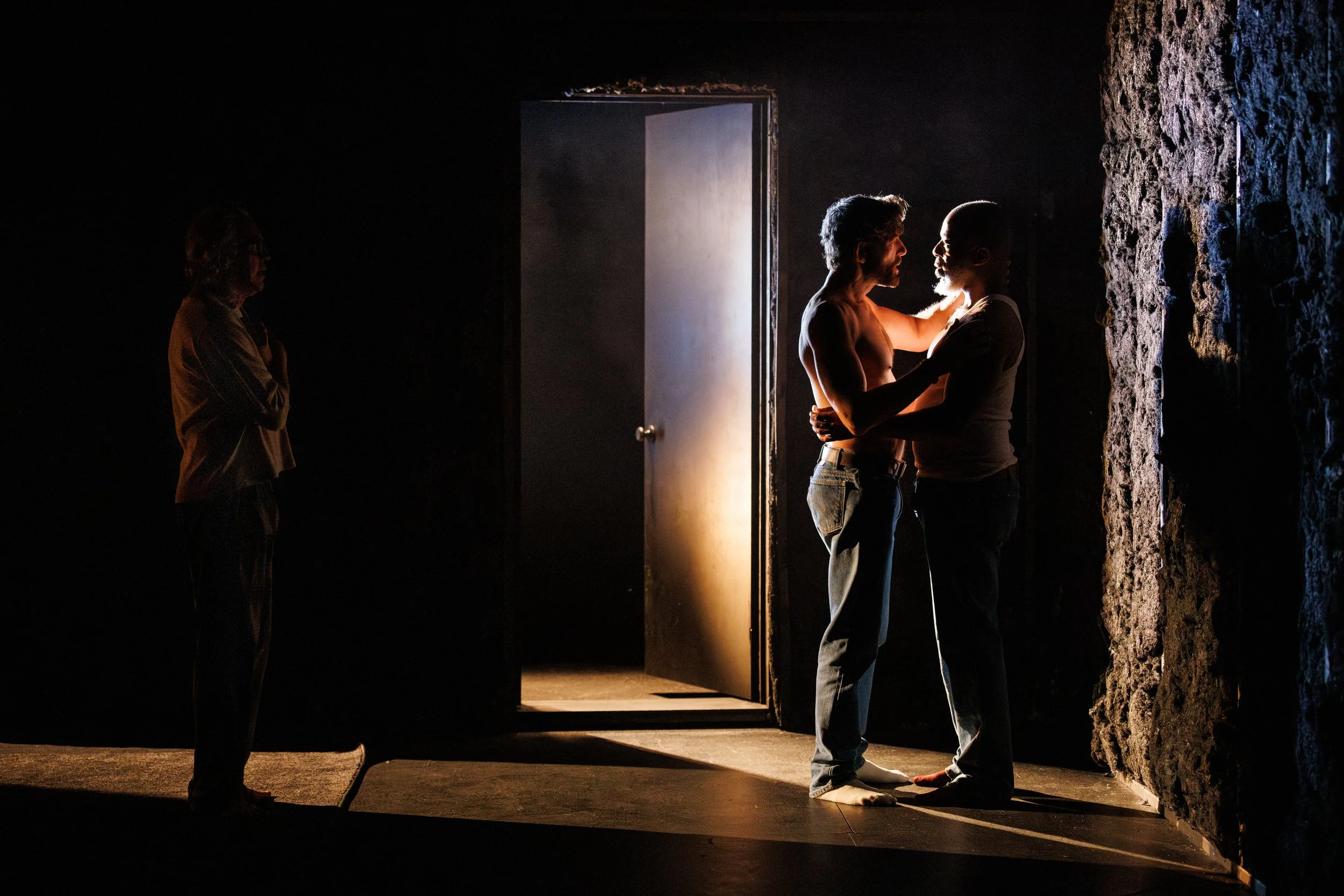
Jerome, featuring Stephen Spinella, Ken Barnett, and Jeorge Bennett Watson, examines aging, caretaking, and sexuality later in life. Photo: Maria Baranova.
I want to talk about that “unpreciousness” and Wet Brain: I saw the production, and some people I know saw it twice during previews and spoke about how wildly the production changed and how much time was shaved off.
WILLS: I think we went from two hours and twenty minutes to an hour forty.
CASWELL: It is really stressful but it’s also, like, what else do we do? Let your play go up when it’s not right? From my perspective, I really have to do that, otherwise what was it all for?
WILLS: I would also say there’s three relationships at any given time: the performer-to-performer relationship, which is rehearsed, and specific; and then there’s the performer-audience relationship, which is anticipated but you’re not quite sure what is going to happen, but there is an expectation that you understand the relationship; and then there’s the audience-audience relationship, which is always unrehearsed and deeply unknowable, and previews is the only time you have to work with that.
This play asks its audience for attention and to do a little work. It is not something that is shot at your face like a cannon while you sit docilely in your seats waiting to be filled by the brilliance of the artist. This is a reciprocal event and a reciprocal exchange of ideas.
I also want to name another specificity: this is, in some ways, an AIDS story that does not take place in a city.
CASWELL: Right, and it’s an AIDS story where no one in the play has AIDS. When I was growing up in Arizona and AIDS was raging as I was a closeted kid, I was first exposed to someone living with AIDS by watching The Real World and seeing Pedro [Zamora] on The Real World: San Francisco, and I realized everything I was seeing about AIDS was filtered through a big-city lens. So whenever I would go to more rural places, like Jerome, I would wonder what the queer people who potentially live here are experiencing, removed from the epicenters of the disease.
Mines are evoked throughout the play. They have a literal history in Jerome, but what did they present to you, geologically and theatrically?
CASWELL: We’ve been talking about the mines meaning potentially a lot of different things. We know during this period of time, when the AIDS crisis was raging, that a lot of people were essentially looking for hope in the dark — they were not able to find answers or anything they needed to survive or cope. So mines also represent hopelessness and trying to hold on to the small embers of love and hope that you possibly can in this perpetual darkness.
WILLS: The mines in this play are closed: there was this sense that the foundation under which this whole community is built upon is a lot of hollow space, which for me kind of makes it dangerous. I think a mine is also a dark place where you’re just feeling around in the dark, and isn’t that the AIDS epidemic? Maybe by 1992 we had more answers, but not many. A mine is also a place where you go searching for something: as much as it is a scary, dangerous place, it is also a place where you are hoping to find something. As a literal space and a metaphorical space, it’s a rich location, especially now that it is attached to a ghost town, so the layers you can read into it keep going.
CASWELL: Mines can convey death, despair, they can collapse on people and then they disappear—
(At that appropriate and ominous word, Caswell disappeared from the virtual interview. He popped back on a few moments later and the conversation pivoted.)
So much of the play offers a window into quotidian caretaking and aging, which are sometimes presented on stage, but rarely through the lens of a gay couple, let alone a throuple, or however the relationship in the play may define itself after coupled Doane and Con meet Bruin. What does it mean for each of you to explore these themes?
CASWELL: I’m at an age where I’m starting to think about what my life is going to look like in the future. And I’m in a very happy, stable monogamous relationship now, but there are always these questions: What happens when you get older and things are not working as well? And I mean that in all sorts of ways. So watching these actors experience the things I’ve written, even though the characters are so far removed from me, they do carry a lot of my voice and questions about existence and sexuality. So it is sort of like watching myself have these conversations about a lot of things I’ve been thinking about at my current stage in life.
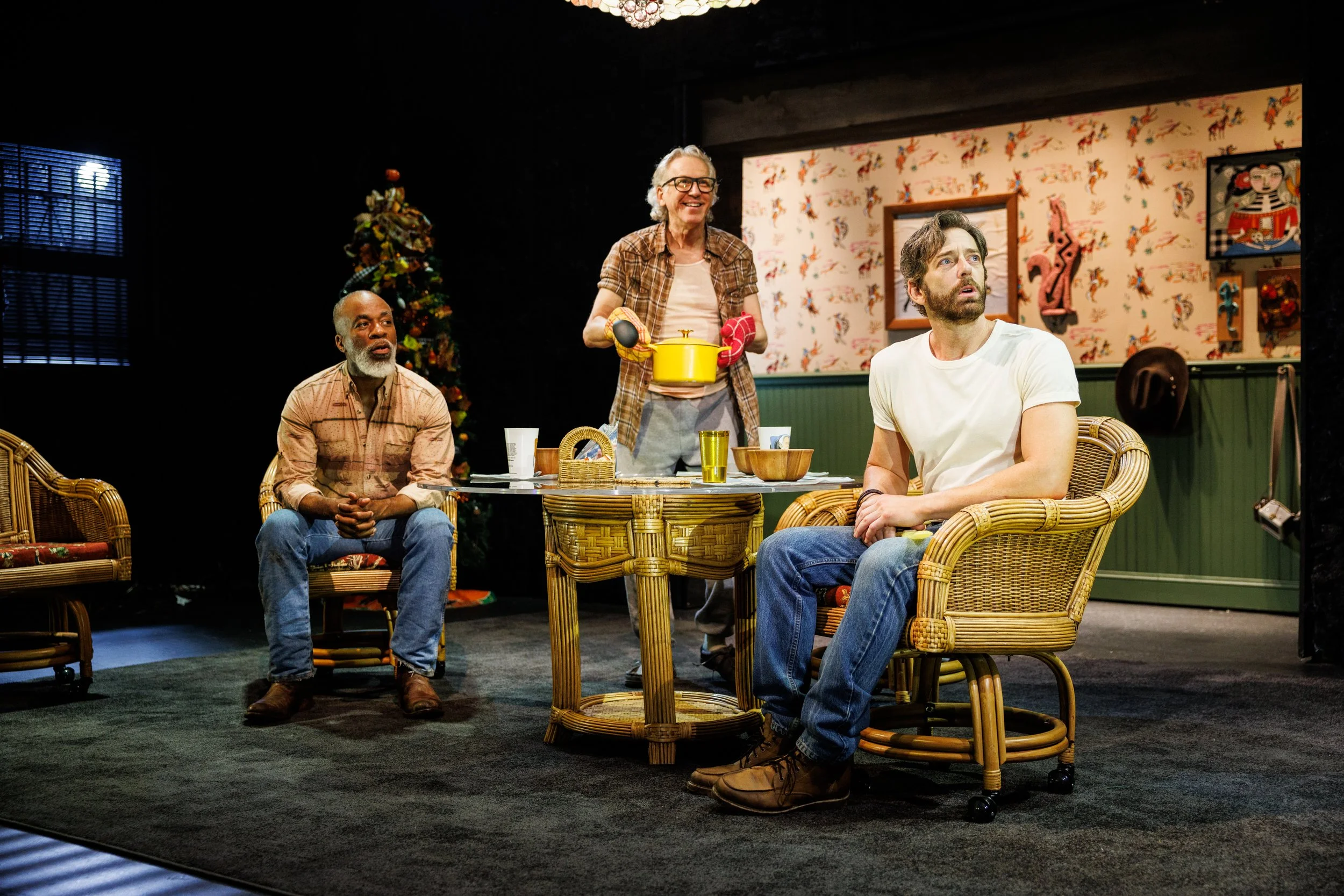
Jeorge Bennett Watson, Stephen Spinella, and Ken Barnett in Jerome. Photo: Maria Baranova.
WILLS: I’ve got [actors] who were very present, boots on the ground, during the epidemic. And so we can get right to the dogshit reality of everything — we don’t have to tiptoe around emotional mines that might exist if these people had not firsthand experienced the epidemic. Their own rich and devastating experience of the AIDS epidemic is, this sounds weird to say, but that’s in them, that’s not something we have to coax out. We can get to the nuts and bolts of building these rich histories for these men. And what are we trying to do here? These scenes on the page might read often as quotidian, as you say, but really what’s going on underneath here is these explosions in these mines, if you know what I mean.
Audiences don’t often get to see men in their 50s and 60s be overtly sexual — and queer. Is there anything else you want to say about the men in the play the audience will meet?
CASWELL: They have specific ways of doing things, but they are also flawed and damaged. These guys are really boisterous and really funny, and full of vim and vigor — and messy.
This interview has been edited and condensed.