

The Art of Paying Attention with Sarah Lunnie
The dramaturg trusted by some of theater’s most prolific artists on curiosity, collaboration—and helping writers discover what their plays want to become.
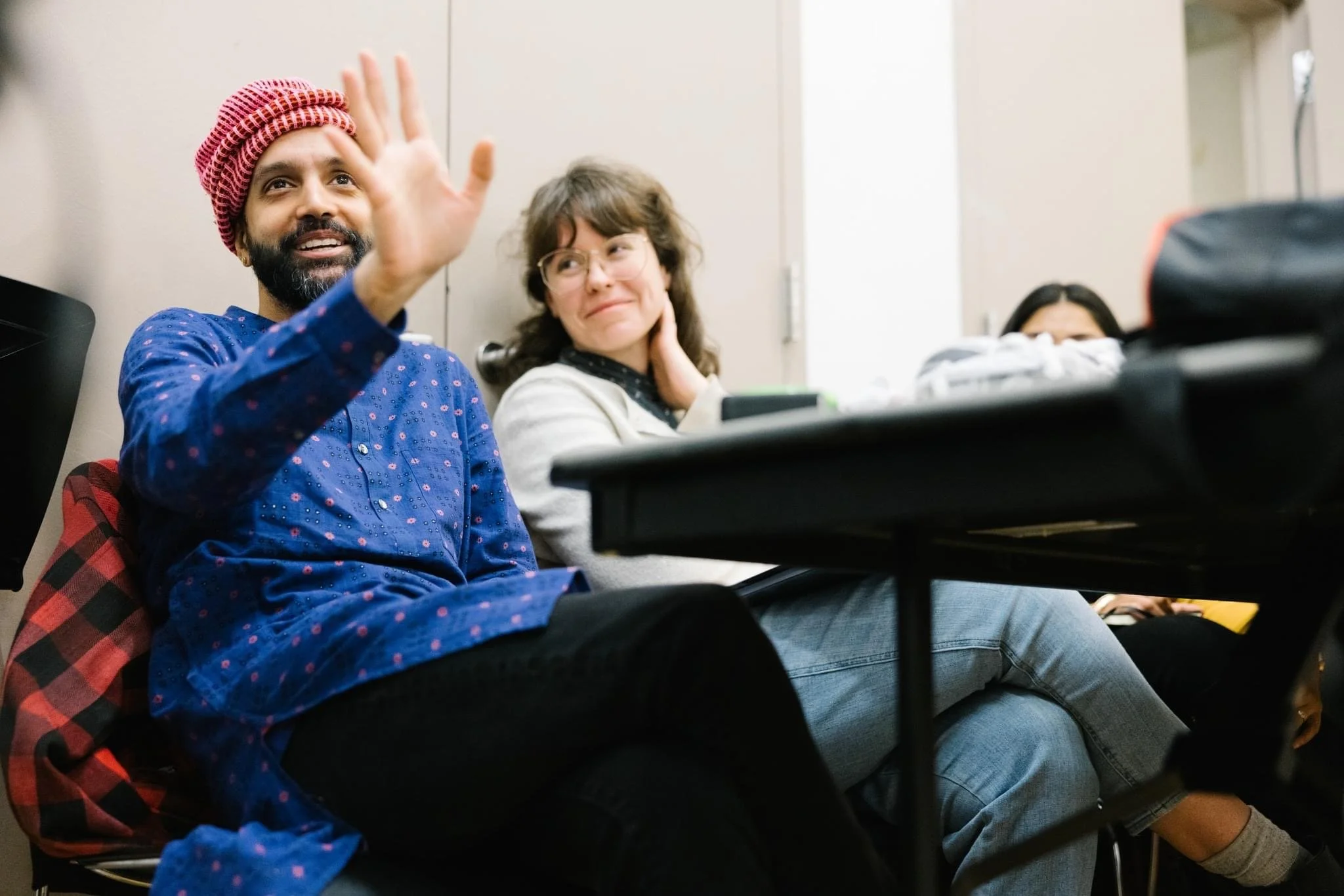
Playwright Misha Chowdhury and Sarah Lunnie at the first rehearsal for Public Obscenities at Soho Rep in 2023. Photo: Da Ping Luo.
Ask ten theater-makers what a dramaturg does, and you’ll most likely get ten different answers. Ask the theater-makers behind some of Off-Broadway’s most thrilling new plays about dramaturg Sarah Lunnie, and their answers all converge on the singular nature of someone who, from leading American institutions to freelance work, has helped shape plays from some of theater’s most preeminent playwrights.
This season, four shows dramaturged by Lunnie are opening: Else Went’s Degenerates at Playwrights Horizons, Ryan J. Haddad’s Good Time Charlie at the Public, Eliya Smith’s Two Girls at Cherry Lane, and the remount of The Mad Ones’ Miles for Mary at Signature early next year. Ahead of these productions, I spoke with Sarah and the creative teams behind some of these works to discuss the true meaning of “interested,” how time and financial scarcity impact the new play process, and how to stay present to the present.
“[A dramaturg is] one of your great companions, someone to literally hold your hand, or somebody like an editor every step of the way. They have such an impact in shaping the totality of a work. And when the collaboration is good and strong, the play will only become infinitely better by having a dramaturg in the room. My plays wouldn’t be what they are without these people, you know?”
—Ryan J. Haddad, playwright, Good Time Charlie
ETHAN EVA KARAS: There’s a quote on your website that I absolutely adore: “The scam of the whole thing is that I’m your student, and because you have to teach me, you have to learn it.” When you have to “teach” what dramaturgy is to somebody else, what do you say?
SARAH LUNNIE: When I say that I’m a dramaturg, the simplest expansion of that is I’m someone who’s interested in what’s happening. “Interested” meaning both the obvious—that I’m curious, I’m energized, I wanna know more—but also, crucially, that I don’t assume that I already know. That’s what it means to me to be interested. Something’s gonna happen, and I don’t assume that I already know what it is. But I believe that it is worth my attention to find out.
What we’re doing when we’re making a play is toggling back and forth between the articulation of an impulse and the attempt to execute it. So sometimes what’s happening teaches you something that you weren’t trying to learn. And if you’re not open to being surprised, you could really miss the actual miracle of the thing. My presence in trying to describe [the thing] creates the crisis of them having to also describe it, whether that’s to affirm what I’m saying or to repudiate what I’m saying.
“The dramaturgs I know who are really serious dramaturgs are always happy to create a casebook, but they always love to remind you that Google is free. [Laughs]”
—Emma Rosa Went, director, Degenerates
Do you find yourself grappling with certain assumptions about dramaturgy?
People often assume that if there’s a dramaturg in the room, you’re talking about somebody who’s going to do subject-area research to illuminate content in the play, and I haven’t done that in more than fifteen years.
My favorite collaborations are the ones where I can be in a rich, ongoing, iterative conversation, not only about text, but also about the languages of staging and performance and light and sound all together. All of these texts want to form an experience that you want to be cohesive, and I think there’s an opportunity to evoke something you couldn’t say in words. What happens on stage wants to be something you couldn’t say in words. My experience of the world is actually not one that forms in words, even though I can’t ever stop talking. [Laughs] So that’s a funny thing to learn.
“[Sarah] basically came into our rehearsal room and, by the end of the week, so clearly understood what the play was trying to do in a way that made all of us feel comfortable. It was amazing how deftly she was able to perceive what the play is trying to do.”
—Eliya Smith, playwright, Two Girls
Is this attention something you had to actively cultivate? Is there a secret to paying attention in today’s distracted age?
I find my experience of the world is one of enormous distraction, competing bids for my attention, not only from industry and corporations, but also from people I really love and am committed to and want to give attention to. I find it very difficult to sit still, actually. I find it very difficult to do only one thing. Being in rehearsal, and the opportunity to be in one place, and to be fully present in the encounter of what is happening in front of me is an enormous relief.
When I was starting out, I literally didn’t understand what my job was, which is not a joke. I graduated in 2008 to do a season-long fellowship at Actors Theatre of Louisville. An apprentice company of young actors was embedded in the theater, and I was assigned to be the dramaturg for one [of their devised projects] with [Miles for Mary director and co-founder of The Mad Ones] Lila Neugebauer, who was doing her directing internship as the director.
I literally didn’t know what I was supposed to do because there was no script, and I had been told in school to research an existing thing that had a production history and come in with all of this information I could deploy. And I didn’t want to say that I didn’t know what to do, so I thought, “I hope it will become apparent to me what it is that I am supposed to do.” And they didn’t know what it meant, but they didn’t want to say that because they didn’t want to insult me. So we were kind of in this game of chicken together: nobody knew what I was there to do, but we were all hoping we would figure it out without having to say we didn’t know what I was there to do.
And that is how I came to understand that the thing I could do that was useful was to just pay attention and trust that I would figure it out, and that kind of is still what I do.
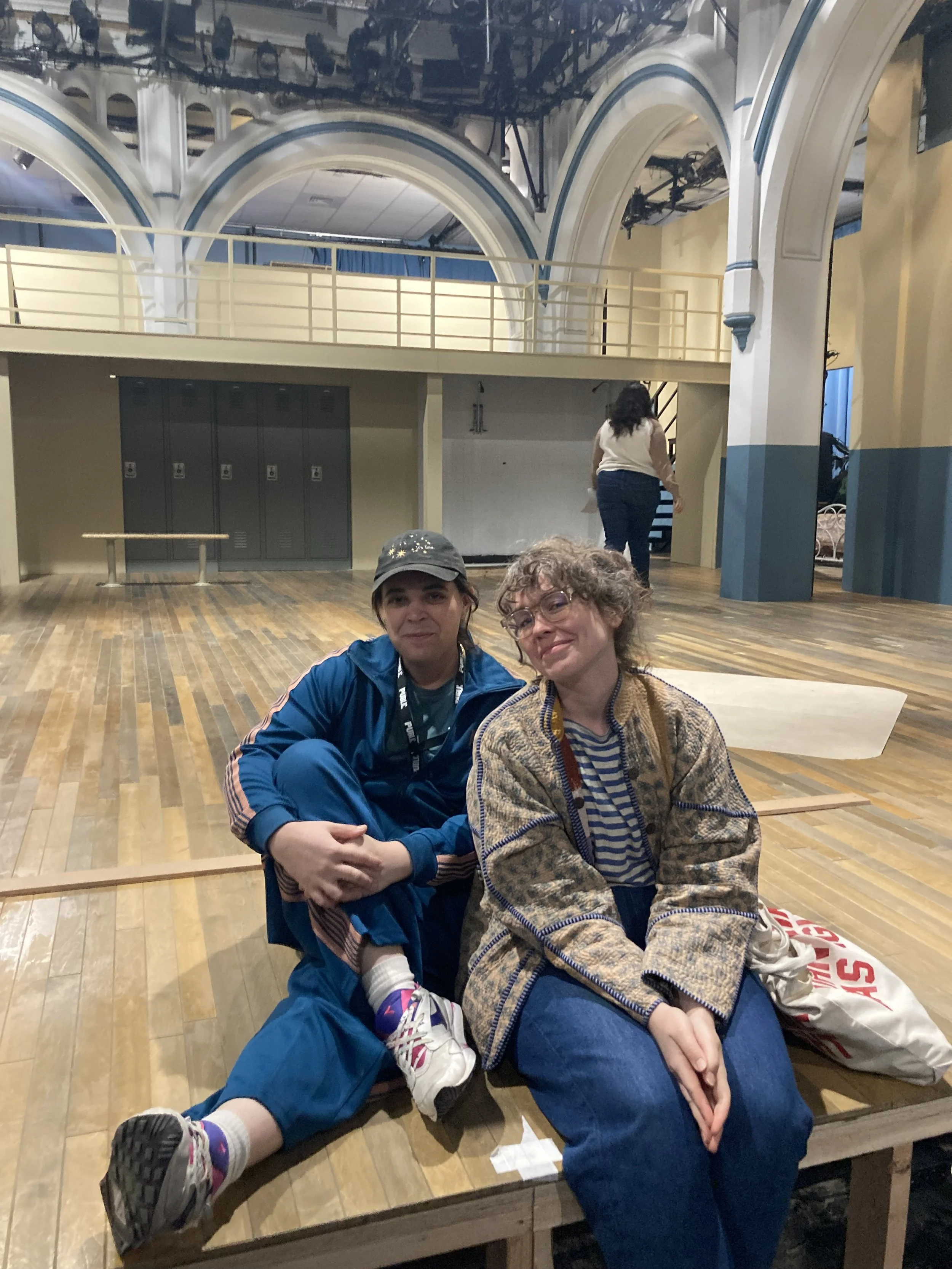
Else Went and Sarah Lunnie during tech rehearsal for Initiative at the Public Theater in 2025.
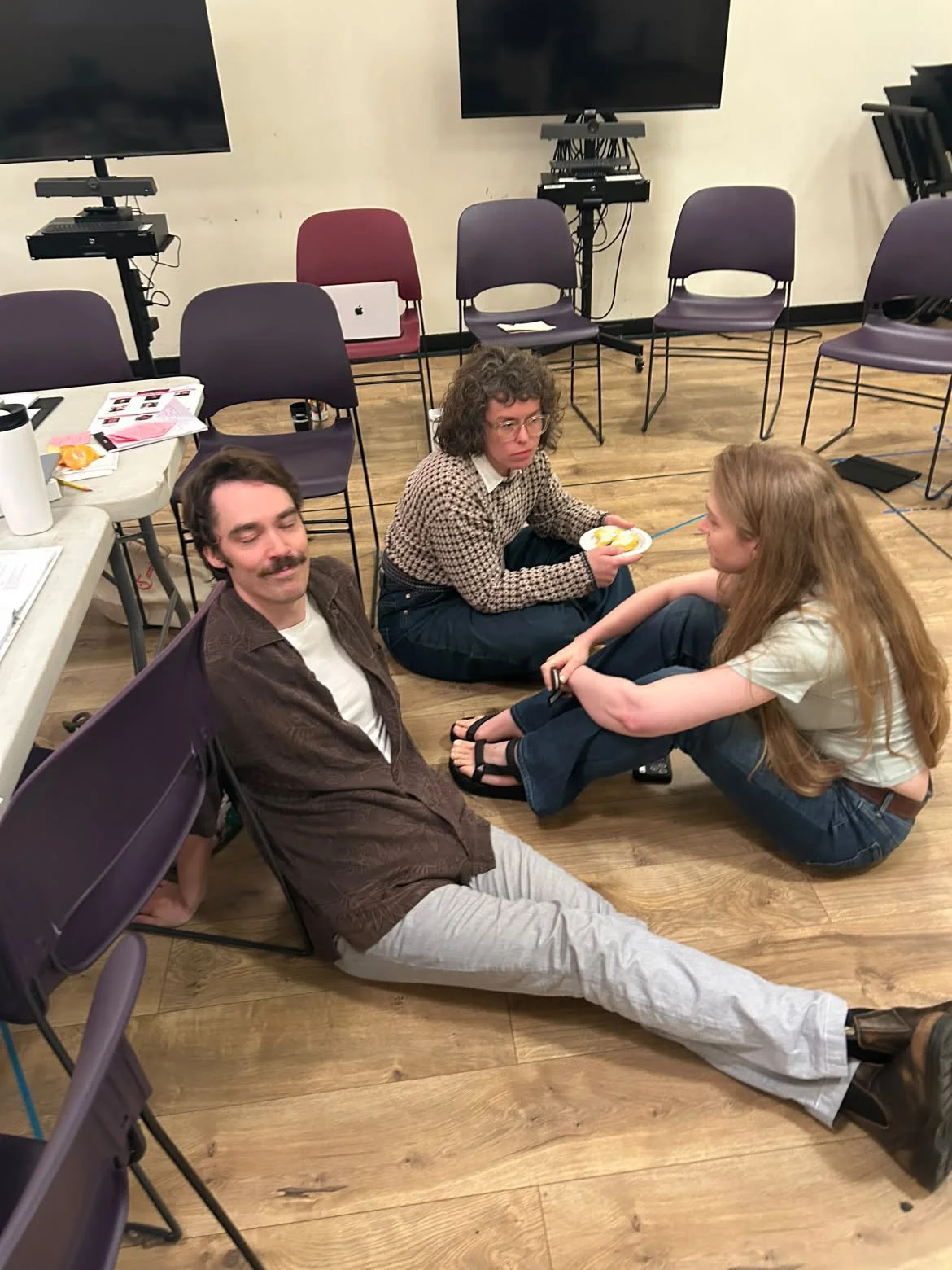
Zachary Desmond, Sarah Lunnie, and Olivia Rose Barresi in rehearsal for Degenerates at Playwrights Horizons. Photos: Emma Rosa Went.
“I feel like I had always been craving dramaturgical feedback at a molecular level of specificity, and I had never received it. Sarah is exceptional at identifying what the artists are trying to do.”
—Else Went, playwright, Degenerates
Are there practical skills or techniques that help you pay attention in a room?
Put your phone away, which sometimes now, as a parent, I can’t do. The management of your attention when it has to be split—I think everybody is contending with it, not only the dramaturg, you know? I appreciate being in rooms where there is a culture of holding everyone accountable to being present, and it’s harder to do the work joyfully when there’s a diffusion of attention. All of the infrastructure of modern life is designed for you to not do it, and you just have to put your phone down and try.
“It’s amazing to me that she can have such conviction in what she’s saying and also bring no ego to what she’s doing. She really wants to serve the play, and the amazing thing that she does is open up space for us to all have a better understanding of what the play is doing.”
—Eliya Smith
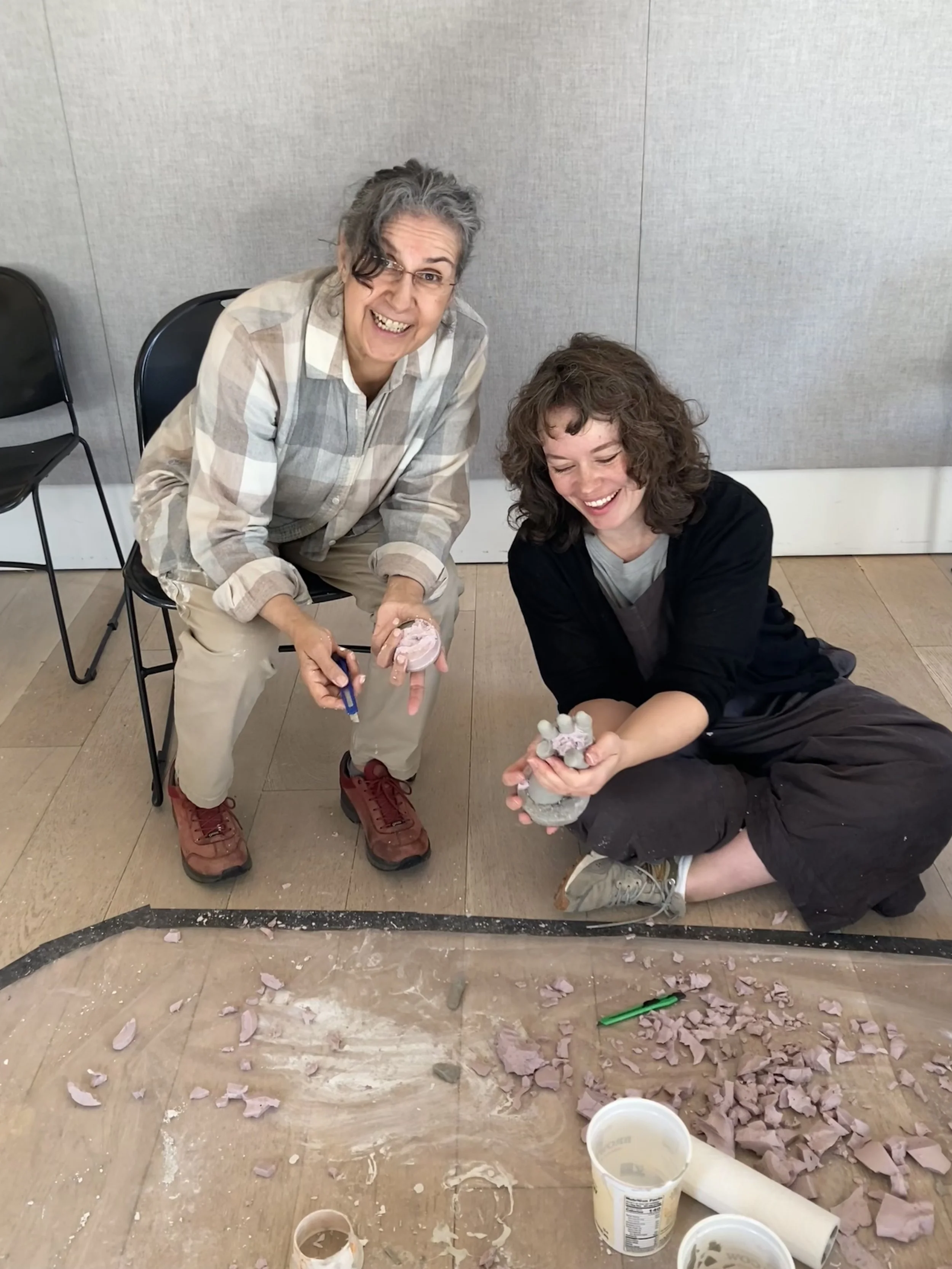
Socorro Santiago and Sarah Lunnie at the Mercury Store in 2024 working on Lyndsey Bourne's play The Second Body. Photo: Lyndsey Bourne.
Has the space afforded to you in the room as a dramaturg changed over the years? Does that space to pay attention feel rarer now?
There’s never enough time when you’re making a play. On the one hand, I would wish that the resources were there, which are primarily financial, for rehearsal periods to be longer, to have previews, and then more spacious rehearsal. The scarcity of time is really a scarcity of money. That’s what it is, and I would wish more time for everyone. And yet, on the other hand, there is something about the crisis of “it has to happen now” that mobilizes everyone and makes something happen improbably, despite all the forces working against it. I don’t think it would be accurate to assume that more time and money would de facto make better work.
Because a lot of my work is being present and watching and organizing my own thoughts, there’s a lot that I can do that’s very productive that’s just between my ears. But none of it matters if I can’t sit down and converse with the artist, and that can’t really happen on a break in 10 minutes. And so you kind of have to plan and build it into the schedule. You just have to know what you need and then not wait for it to happen magically. You have to create the conditions for the exchange to happen.
“She’s extraordinary in terms of structure, in terms of character. She has great instincts, and she’s just a genuinely good, wonderful, soulful person. Those things go hand-in-hand. Her intellect is enormous, but also her heart is huge.”
—Ryan J. Haddad
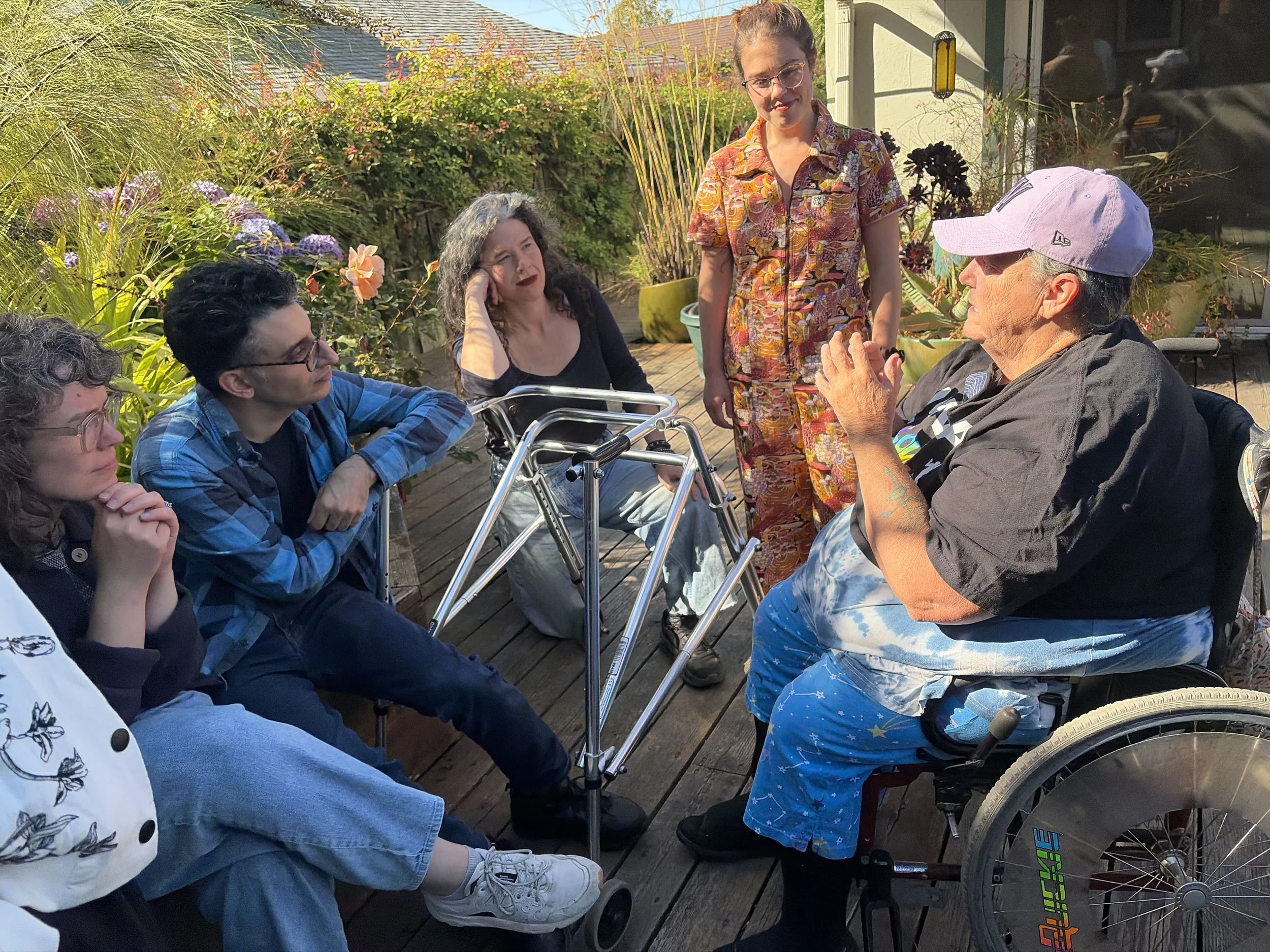
Sarah Lunnie, Ryan J. Haddad, Abigail Bengson, Alison Kopit, and Corbett O'Toole at The Ground Floor at Berkeley Rep in summer 2026, where they were working on a musical adaptation of the documentary Crip Camp. Photo: Sam Gold.
When you’re reading a script, are you conscious of what you’re looking for? Are there decision trees you go down as you try to identify what the play is attempting to do?
I don’t come in with an agenda, and I don’t come in with expectations, and I’m not trying to impose a prefab structure onto a thing. Whether I’m reading something on the page or watching something on its feet, at the beginning I’m just an audience to the thing.
The most useful question with which to meet a play is, “What happens in this play?” I mean something deeper than just “what are the series of incidents?” What I mean is: What changes? Where are the sites of radical transformation? You could make something where the whole point is that nothing changes, and Beckett did that. But even then, the hope that something will change and the thwarting of that is its own kind of threshold. What I am trying to attune to is where the thresholds of major transformation are. That’s the first thing that I want to speak with an artist about.
“It’s hard to find someone who cares as enormously and intensely about the story you’re telling as you do. But then you get to production, and 50 people have to make the thing, and you’ve gotta have those core individuals who know what the intention is and what the heart of the thing is that everyone has a part in making.”
—Ryan J. Haddad
Your own path as a dramaturg has taken you through several American theater nonprofit institutions that have either greatly reduced staff or outright ceased to exist. Has the path for dramaturgs changed?
I don’t know if there was ever a path. My teachers were my peers, and the useful experiences were those moments of going into a room and saying, “I don't know what to do.” Lila [Neugebauer] was making her own work at night. They submitted to this festival at the Brick in Brooklyn as though there were excerpts from a [larger] thing, and they got in. But there was no [larger] thing. They weren’t excerpts. [Laughs] Lila told me, “We’re all gonna get in a room together, and we’re gonna make a play.” And I told Lila, “I am not the right person to do this because I have not made devised work, and I don't know how.” And Lila gave me a very big gift when she said to me, “It does not matter. Come to work, and we're going to do it.”
It all comes back to: what is actually happening in front of you, and can you be present enough to see what's actually happening? And Lila taught me that. There is a trap in worrying that there’s a path and that you’re not on it, because if you’re worried that there’s a path and you're not on it, that is probably taking you out of the present tense and noticing the opportunities in front of you that are interesting to you.
“As a freelancer, she has the power to choose what she wants to say yes to. So it’s incredibly meaningful for me that we were one of the yeses.”
—Ryan J. Haddad
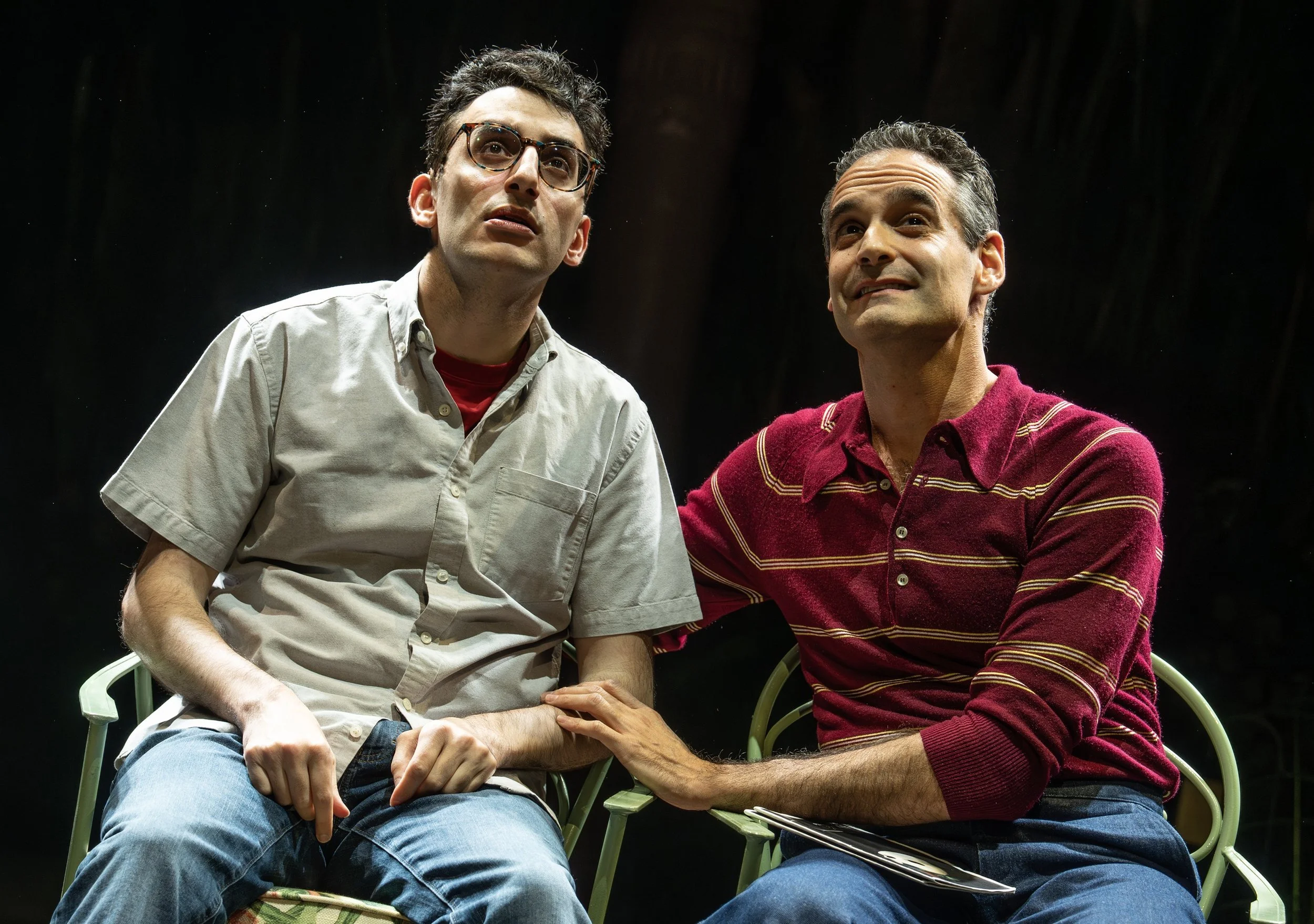
Ryan J. Haddad and Jonathan Raviv in Good Time Charlie directed by Danny Sharron at the Public Theater. Photo: Joan Marcus.
So many collaborations with writers start with a first encounter with their work. If I read you a list of names, can you say in three words what first struck you about their work?
I’ll try. [Laughs]
Lucas Hnath.
Strange, mythic, funny.
Heidi Schreck.
Numinous, weird, kind.
David Adjmi.
Batshit, unhinged, true.
Ryan J. Haddad.
Playful, irrepressible, “onto you,” if that's a word. [Laughs]
Else Went.
Elegant, panoramic, loving.
Eliya Smith.
Insouciant, canny, misdirection.
Misha Chowdhury.
Humane, sensual, fractal.
The Bengsons.
Raucous, joyful, embodied.
“I remember sort of falling in love with her, like, ‘Oh, this is probably the smartest person I’ve ever been in a conversation with.’ Sarah is one of my most important resident audience members, the audience that I am interested in checking in with the work at each of its base camps before we go up a level.”
—Emma Rosa Went
A director looks back at a production, a playwright looks back at a script. For something as mercurial as dramaturgy, when you look at yourself, your work, the collaborations, what do you see? Are there patterns or structures that emerge in your own life?
I’ve been doing it for 20 years, and the through line through those collaborations … I don’t know that I know. I’m attracted to work with a strong formal identity. Artists who are interested in the opportunity of the container of the theater and have a perspective not only about something that they want to say or open up a mystery about, but also how they want to use the container of the theater and the crisis of the encounter with the audience to activate that. I’m interested in work that contradicts itself, and what I mean by that is that I like work that is sad and funny, smart and dumb at the same time. It just feels true to me, everything and its opposite. I’m into all of that.