

Pete Simpson Is Everyone Everywhere All at Once
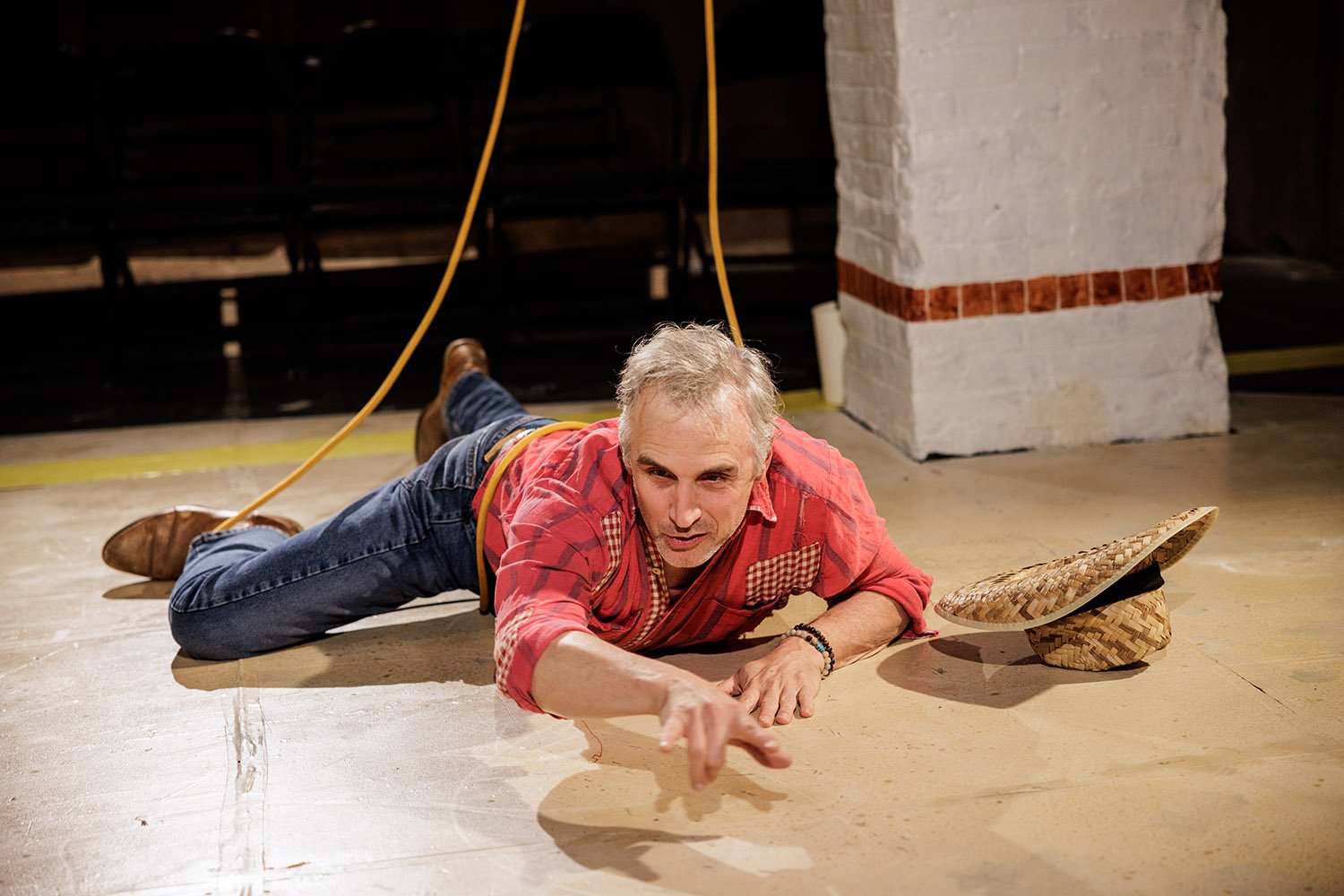
Pete Simpson played two roles in Amanda Horowitz’s Bad Stars at Collapsable Hole in spring 2025. Photo: Maria Baranova.
Pete Simpson is wondering: Can we say his 2025 was a year of rebirth, but also just more of the same? Because somehow, it was both.
A rebirth, yes, because Simpson finally ended his time at the Blue Man Group, the day job where he’d performed continuously since 1996 (sometimes part time, sometimes full time), as the show’s 34-year New York run came to a close in February.
But also, more of the same, because Simpson never let that Blue Man gig stop him from taking on wild experimental projects whenever he could. Though now he’s able to pack in a few more.
“I end up saying, ‘Yes’ to a lot,” laughed the versatile Simpson, a fixture of New York’s downtown scene for the past three decades. “To my great detriment, sometimes.”
This year alone, Simpson was an FBI agent for a return engagement of Tina Satter’s Is This a Room, in Australia; one half of an elderly Polish couple, among many roles, in the Goat Exchange’s Deadclass, Ohio; a mild-mannered history buff in Daniel Holzman’s Berlindia!; and an acting instructor at a retirement community in Peggy Stafford’s Everything Is Here. Perhaps I won’t strain too hard to explain his role in Amanda Horowitz’s Bad Stars, where Simpson played a mother and father — Macrame Mama and Papa Pasta — in the same body.
Now, Simpson is prepping back-to-back shows at Exponential, the Brooklyn-based festival of experimental performance running throughout January. Simpson will first appear in Nurit Chinn’s Godbird, running at the Brick from January 21 to 25, and then in Horowitz’s Fashion, staged at Life World from January 29 to February 2.
Simpson received an Obie Award for Sustained Excellence of Performance in 2017. His long career has been characterized by an unflagging commitment to the avant-garde — multiple shows with the Wooster Group, Young Jean Lee, Elevator Repair Service, and New York City Players pepper an eclectic resume of boundary-pushing work.
“He can be terrifying, hilarious, hyper-naturalistic, and very strange on stage,” said Chinn, also a co-director at Exponential. “Anything. He is just electric.”
JOEY SIMS: When I observe that you’ve had quite a run this past year, specifically around Off-Off Broadway and experimental work, does that resonate? Or do you think, “I’m just doing the same stuff I’ve always been doing.”
PETE SIMPSON: There’s truth in both. I have the good fortune of so many artists, both established and up-and-coming, asking me to do things. And if it passes that magical first read, and all those wonderful chemical things happen when you meet the person, I end up saying “Yes” to a lot. To my great detriment, sometimes. In fact, when Blue Man Group closed, which is still a pain in my heart — wonderful run, no regrets, but I do miss that outlet — one thing that my body was accustomed to was: “Next, next, next! Where we going?”
Blue Man Group ended its New York run last February, so for the first time since joining their ranks in 1996, you weren’t working around that commitment in 2025. In all those years, you were always doing Blue Man either full time or part time, is that right?
Blue Man Group were, to their great dismay at times, my de facto patron. They were smiling upon it, but it also created tension. Like, how many holiday weeks can I compromise and still be on their payroll? For every wonderful thing they approved, I’ve got a parallel universe out there of the “Nos.” But yes — they were the secret to survival.
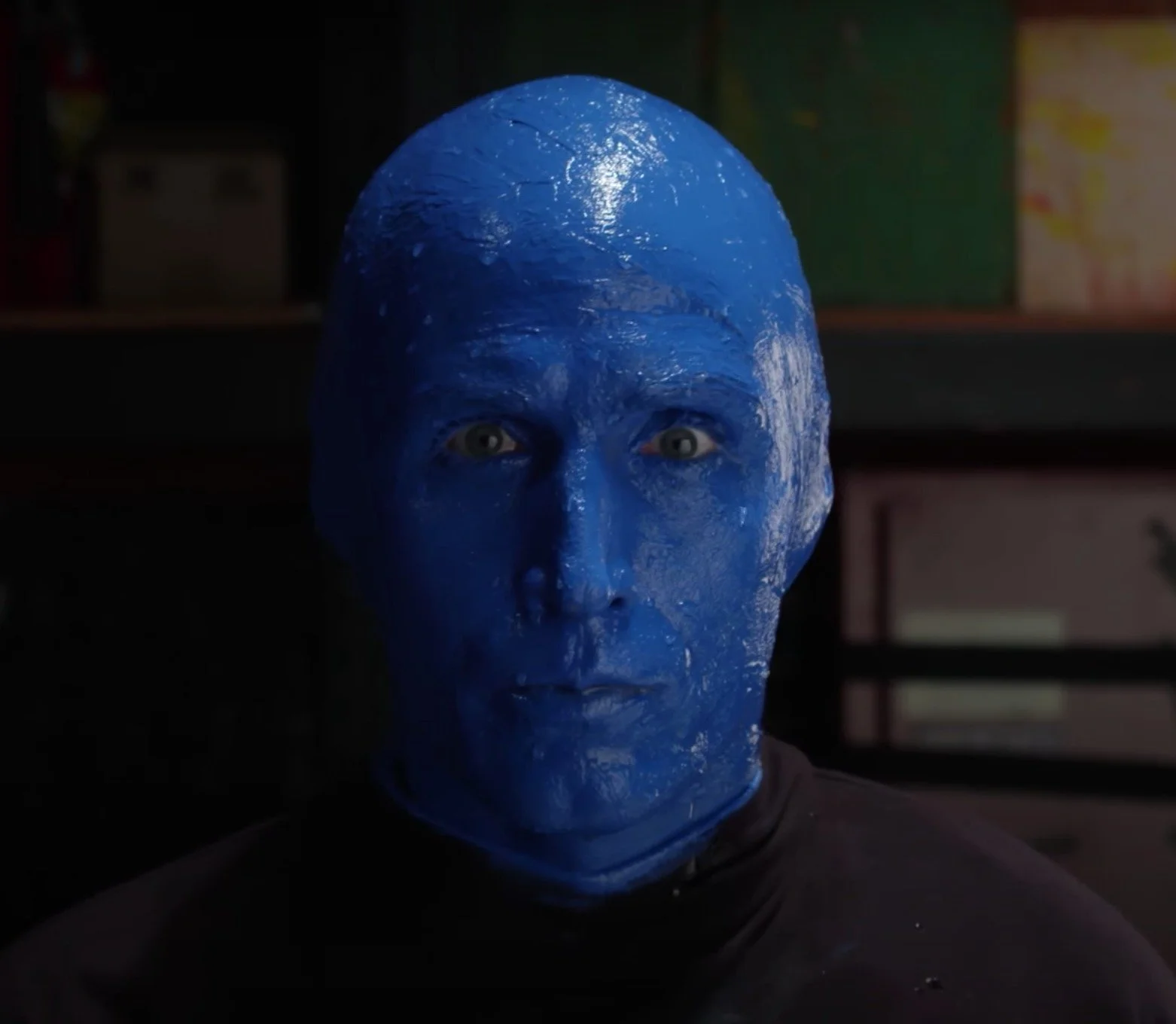
For 29 years, Pete Simpson performed in Blue Man Group, including in their music video for the show’s original song “Snorkelbone” (pictured here).
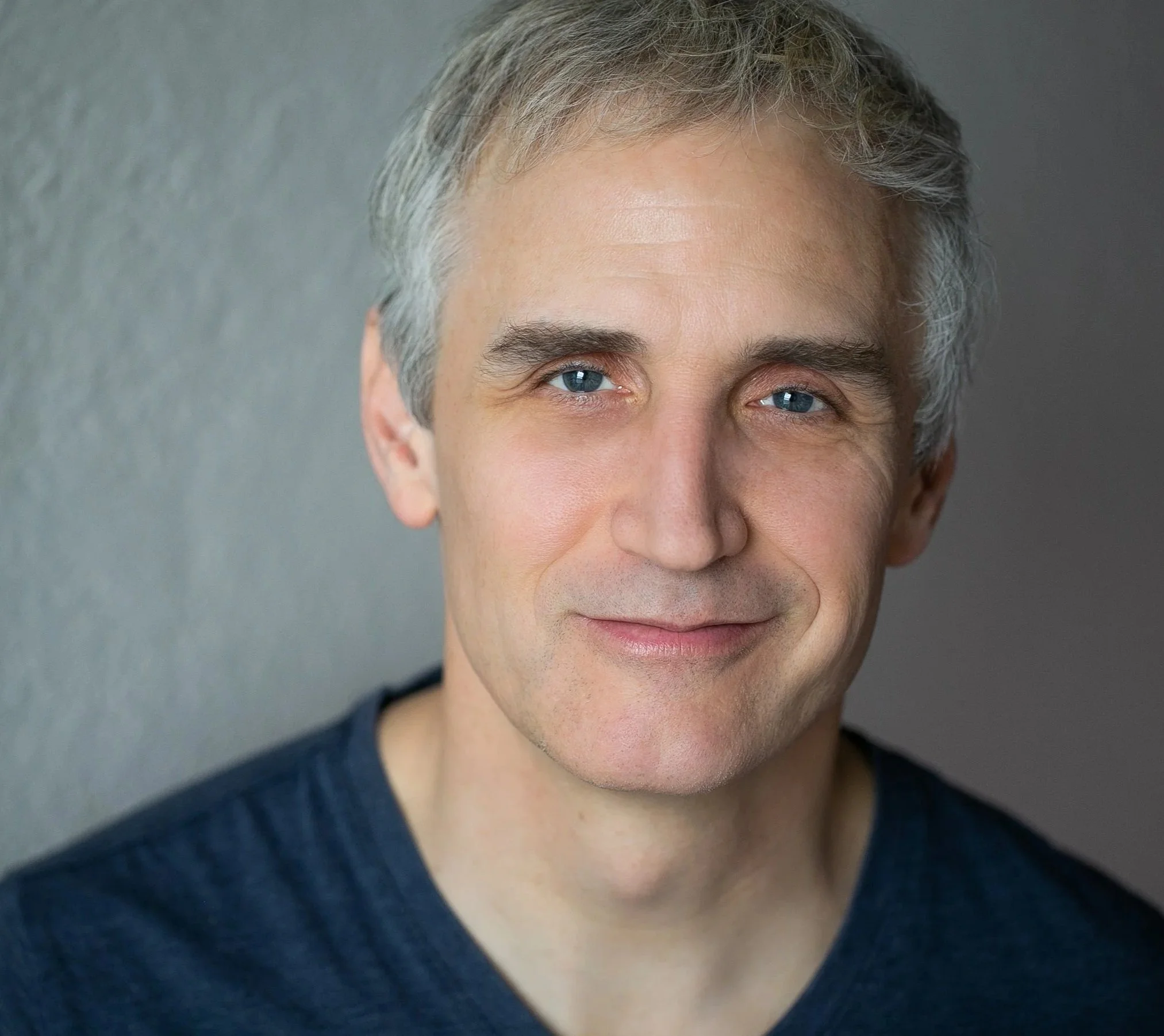
Pete, no longer blue. Photo: Matthew Stocke.
And so you built around that Blue Man schedule, fitting in as many passion projects as you could?
I remember one day when I knew I was in trouble. I had a 1 p.m. matinee of Christina Masciotti’s Bingo at PS 122; then a 4 p.m. Blue Man; then a frightfully close 7 p.m. of Richard Maxwell’s Drummer Wanted, again at PS 122; and finally a gig with my cabaret band The Petersons at West Bank Cafe at 10 p.m. The days were like this a lot.
Now, it’s sort of like a rebirth. I’m doing what I should have been doing right out of grad school — get some support jobs, and try to find gigs. That’s what I am now doing in my 50s, with kids.
Going back a bit — had you always thought of yourself as a physical performer, even from an early age?
Yeah, guilty as charged. On my first day of movement class at grad school [at the now-defunct National Theatre Conservatory], we’d be running around creating all these protoplasmic shapes and whatever, and then: “Freeze!” And my “Freeze!” was this [mimes writhing motions with fingers, hands and neck]. It became a running joke, the teacher was like, “Freeze! And … Simpson Freeze!”
Where does that hyperactivity come from, that preternatural ability to express so much through your body?
For me, that probably came from being the youngest in a very dynamic family. My older siblings were these demigods who had arrived fully charismatic, and I had no right to say anything to them, so I’d just listen and live in my body. Every once in a while I’d get kinetically involved. The family would be riffing on some dinner conversation and I’d suddenly throw something out. “Is this what you guys are saying?” And I’d physicalize some person or aspect of the story they were discussing. The family would be like: “Oh, look, Pete is talking.” So I guess I was always info-gathering, containing — maybe repressing? — and expressing with my body.
Your mother had gone to New York to pursue acting, I believe.
She was on a track here in New York and living at the Rehearsal Club on 53rd Street, a boarding house of aspiring actresses. That was where Carol Burnett lived when she was being discovered. Mom went back to Wyoming for Christmas, and my dad fell for her at some country-club party. She jumped up on a table and did a menagerie of impersonations of barnyard animals. My dad was like [pointing], “That! Her!” So he went out to New York to court her, aggressively. They did a whole 13-day courtship, a proposal in Penn Station, then off we go. My dad Green Acre-d her, as they say, out of the city.
Then your parents co-founded Spontaneous Theater Productions in Jackson, Wyoming, and your siblings performed in shows there.
They started that company nearly 70 years ago, and it’s still going! My dad’s 95, mom is 86. They did a lot of productions with family, but I didn’t want to be a part of it. The first time I said yes, we were doing The Fantasticks. You know there’s that silent, mimed character of The Wall? The family had already filled up all the parts, so they said: “Pete, why don’t you be Wall #2?” They split the mime character between my sister and I — she was Wall #1. We were both physical performers, even at the age of 11.
Did more family roles follow after Wall #2? Or were you still resistant?
I played hard to get. It was super tentative and tenuous, this whole theater relationship thing, even as I was surrounded by it. I was planning to be a journalism major when I entered college. Even in grad school, I still fantasized about selling my Honda Civic and going backpacking in Ireland.
When did that resistance finally fall away?
A powerful moment was getting into that grad school. Didn’t expect that. Eight students chosen out of 400 auditioning, it was a major deal. Getting that call, I remember putting the phone down and doing this kind of scary, celebratory Spartan cry. I was like, what was that? I guess I am excited about this?
Another powerful moment was when I got the call about the Obie Award. I was on the street in New York, and I grabbed a garbage can and shook it, like, “Yeeaah!!” So there’s that guy again who, with all his denialism, felt a validation of: “This is what I should be doing.”
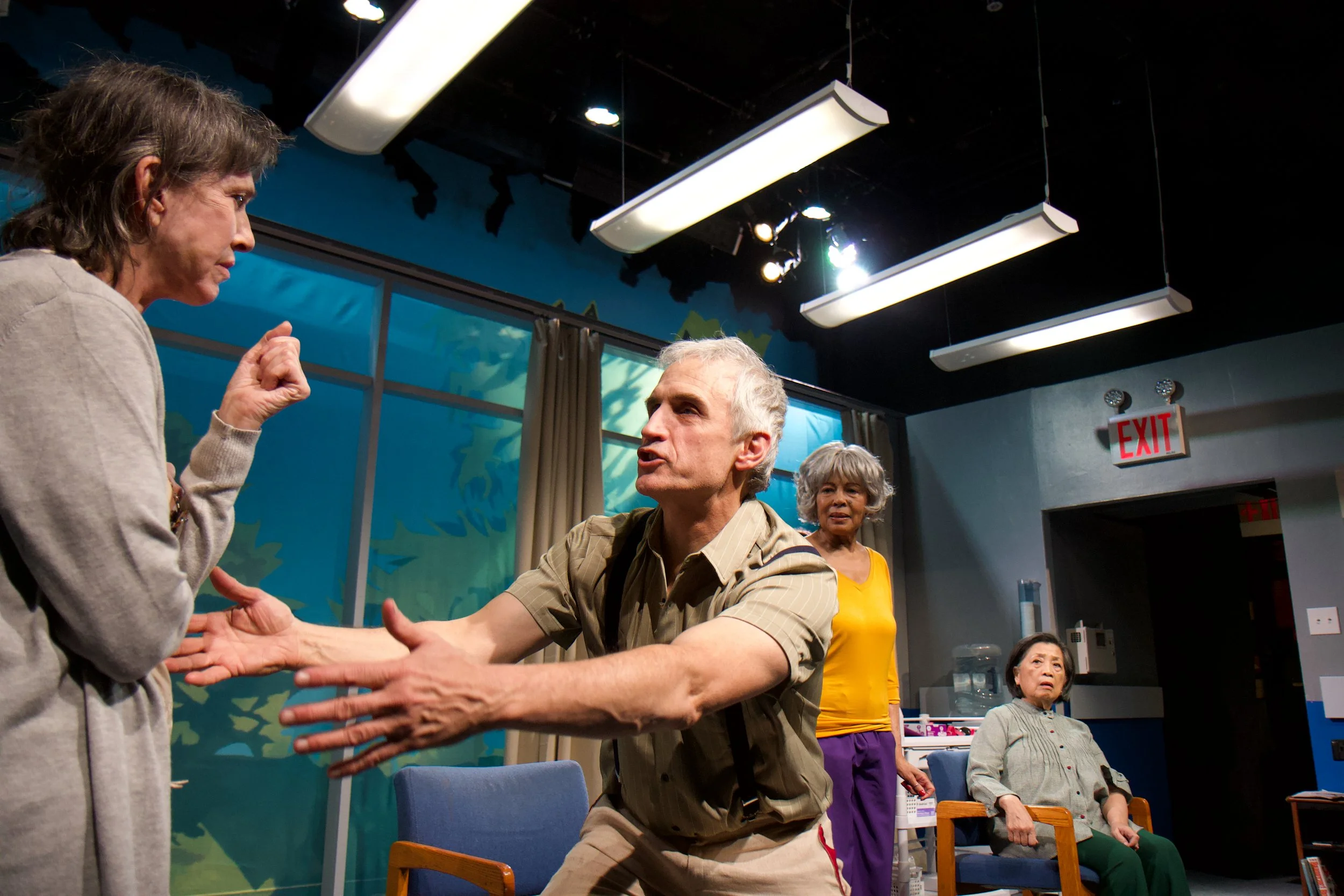
Jan Leslie Harding, Pete Simpson, Petronia Paley, and Mia Katigbak in Peggy Stafford’s Everything Is Here, directed by Meghan Finn. Photo: Mari Eimas-Dietrich.
However you might have viewed yourself over the years, it’s clear from that Obie win, and from the high regard in which you’re held within the experimental community, that you’re seen as this reliable and dedicated presence by a broad range of your peers.
Because I was always doing Blue Man alongside New York City Players, or Wooster Group, that made me the guy who could step out of one company, then right into the next. That said, when I’m in a project, it is full loyalty. It is throwing myself right into the wall, over the cliff, to get to the truth of whatever this room, this artist, this show is trying to get to.
Amanda Horowitz’s Bad Stars, this manic riff on True West, which I saw you in at Collapsable Hole last year, was such a wonderful example of that. You played both of the siblings’ parents, Macrame Mama and Papa Pasta. Especially as Papa Pasta, this wild drunk, you were just hurtling yourself across the stage and in and out of that bathtub.
I had this Australia-sized bruise from leaping in and out of that metal tub, my God. But yeah, that’s the thrill! We are alive at this one precious time, and you have to know what it is to throw yourself fully into something. And Amanda is so quietly, almost unconsciously enabling of like, “Yeah, why not?” Not sweating credibility or sweating certain rigors, but just a wide open channel.
You and Amanda are collaborating again on Fashion, a pair of plays debuting at Life World as part of the Exponential Festival. Is that one equally physical?
Fashion is less aggressive than Bad Stars. I mean, that was True West we were handling. It’s this meditative land of strange that she’s starting to marshall into the universe. It’s a pretty musing play. So it’s a different gear. I’m appreciating it. And so is my body. Don’t have to throw myself around quite as much.
And before that, you’re appearing in another show at Exponential, Nurit Chinn’s new play Godbird at the Brick. In that one you play The Birdman, described as “part-narrator, part-bird, part-excavator of consciousness.”
Oh, Nurit’s writing is just wonderful. This Godbird, this bird man, there’s an omniscience to him. He is stewarding but also pushing back against this budding relationship between two people who meet randomly in a park. First he is a presence commenting on the energies they are both privately holding, and then he becomes their memories. One moment I’m this lower-class British guy, the next I’m a concerned mother, then I’m this hot woman doing sweat yoga, then a homeless dude in the park … it invites all those protean things that I love.
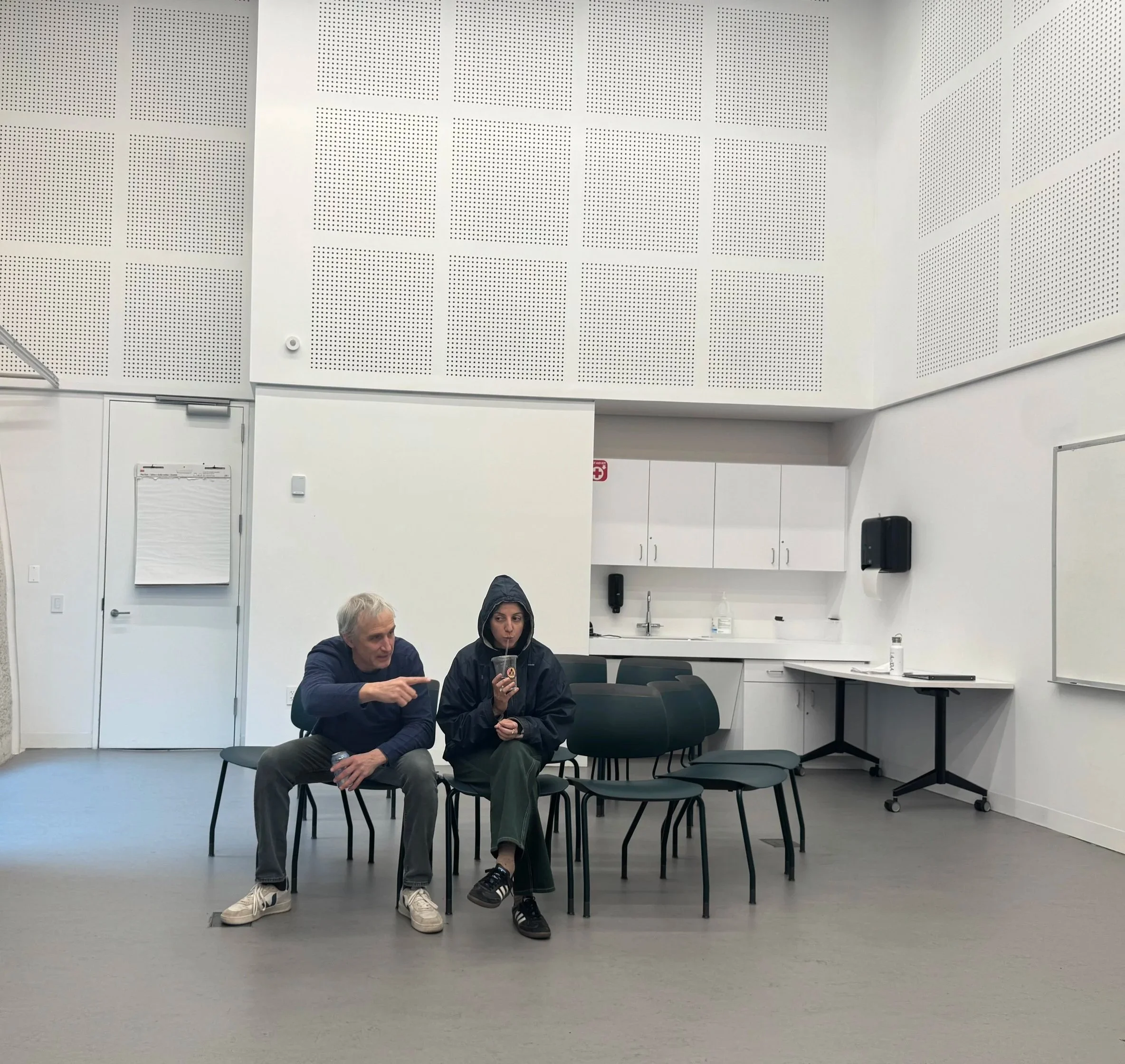
Pete Simpson and Layla Khoshnoudi in rehearsal for Godbird, directed by Kedian Keohan, at the Exponential Festival. Photo courtesy Nurit Chinn.
How does one get to be a reliable hand for so many strange and wonderful assignments? What’s the secret to being Pete Simpson?
I think I’m good at resetting myself to full-on tabula rasa. With these up-and-coming playwrights and directors, they are on this cutting-edge level of their own sense of vision and aesthetic. In real time, in the room, they’re trying to figure out what they stand for artistically. So I can’t come into the room living in a place of wanting to defend or promote my own code of performance, or any of that stuff. If I plan to learn from it, I’m gonna have to be an empty page, and start all over. And I think I’ve become really good at that.
Making your own stuff is so hard. And I know what it’s like, as you’re making stuff, to have great people helping you. So why not be a great helper?
This interview has been edited and condensed.