

The Theatrical Audacity of Anne Gridley
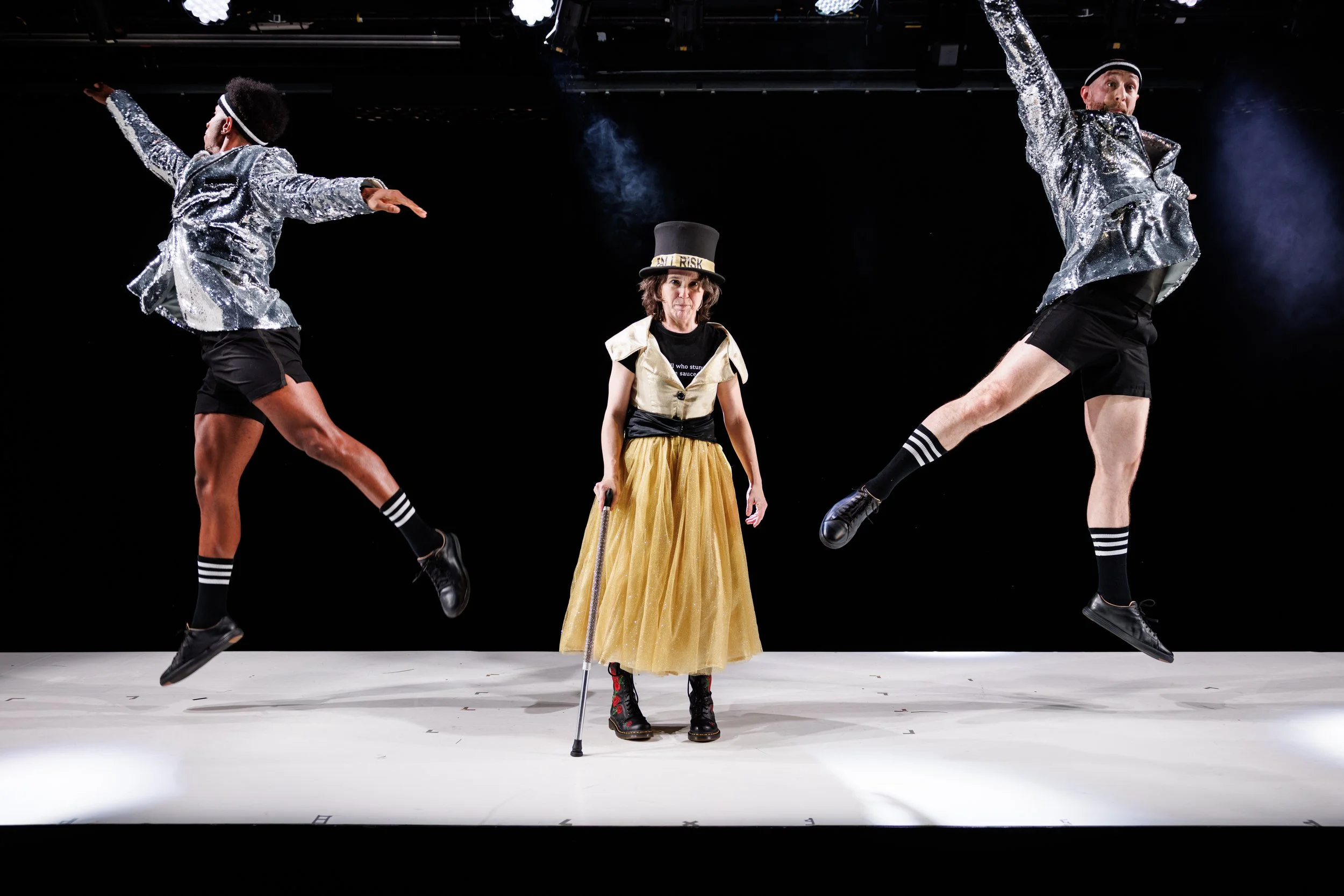
Anne Gridley, with Keith Johnson and Alex Gibson, in her autobiographical, not-quite solo show Watch Me Walk, produced by Soho Rep. Photo: Maria Baranova.
A petite woman climbs an eight-foot construction ladder while singing about ableism and her own self-loathing. Her gold tulle dress and matching top hat sparkle. Two strapping men, dressed as tennis pros, spin the ladder from below. How did she get up there?
The climber is Anne Gridley and this is Watch Me Walk, Gridley’s one-woman(ish) show about her experience having hereditary spastic paraplegia (HSP). HSP is a progressive genetic disorder caused by degeneration of the nerves in the spinal cord and, in Gridley’s case, results in weakness of the legs and difficulty walking. Both Gridley’s mother and grandmother had HSP, and sixteen years ago, at the age of 29, Gridley learned that she had inherited the disorder. Directed by Eric Ting, Watch Me Walk is a Soho Rep production that can be seen at Playwrights Horizons until February 8, as part of the Under the Radar Festival.
“Some people were reluctant to let me use the ladder, but then I just promised that I wouldn’t sue them,” says Gridley. “The question that has always been a part of this process is, ‘How can Anne Gridley have all the freedom she ever wanted on stage?’ I wanna climb that damn ladder. How can we make that happen?”
Gridley is fierce and gritty. She owns that much of her acting style is inspired by Gloria Swanson in Sunset Boulevard. In Watch Me Walk the similarities are evident: she contorts her face into angles so sharp as to seem geometrical, and vibrates her voice melodramatically. Small yet somehow towering, she presides over her stage and commands attention as totally as any film star bathed in spotlights.
Watch Me Walk is Gridley’s debut as a solo playwright, and it’s hard to imagine that someone so fearless found the prospect of creating this play “terrifying and overwhelming.”
Having only ever worked in an ensemble before — Gridley is a founding member of Nature Theater of Oklahoma — she was skittish about writing on her own. She struggled with writer’s block and kept getting stuck. “It was like, ‘Oh, this is getting really personal’ and ‘I want to avoid feeling sad about that.’ So I just wouldn't write,” she explains.
Director Eric Ting saw the earliest version of Watch Me Walk in October 2023, at CUNY’s Prelude Festival. It was only thirty minutes long and didn’t feature any original text from Gridley. Instead, the script consisted of the “juiciest” doctor’s notes from her medical chart, medical jargon, findings from neurologists’ reports, and the definition of an upper motor neuron rattled-off by a neuroscientist in “ninety seconds or less.” Gridley calls this approach “clinical distance.”
After Soho Rep commissioned a full-length play from Gridley, Ting collaborated closely with her over the development of the script, urging her to open up more about her personal experiences with HSP and its connection to her family.
In one section of the play, Gridley traces the origin of HSP in her gene pool, clicking through a slideshow of her family members, many of whom, including her parents, are now deceased. In classic unsentimental fashion, this segment is called “Whose Fault Is It Anyway?” and is accompanied by cheesy game-show music. A devotee of Samuel Beckett (she wrote her undergraduate thesis on his short prose), Gridley reminds me: “Nothing is funnier than unhappiness.”
When Gridley had difficulty picking photos for the slideshow, she went to Ting. “He started looking through the photos and said, ‘This reminds me of picking out photos for my mother’s memorial,’ and I was like, Oh, that’s exactly it,” Gridley recalls. “We’re both orphans, so we have that understanding of grief.”
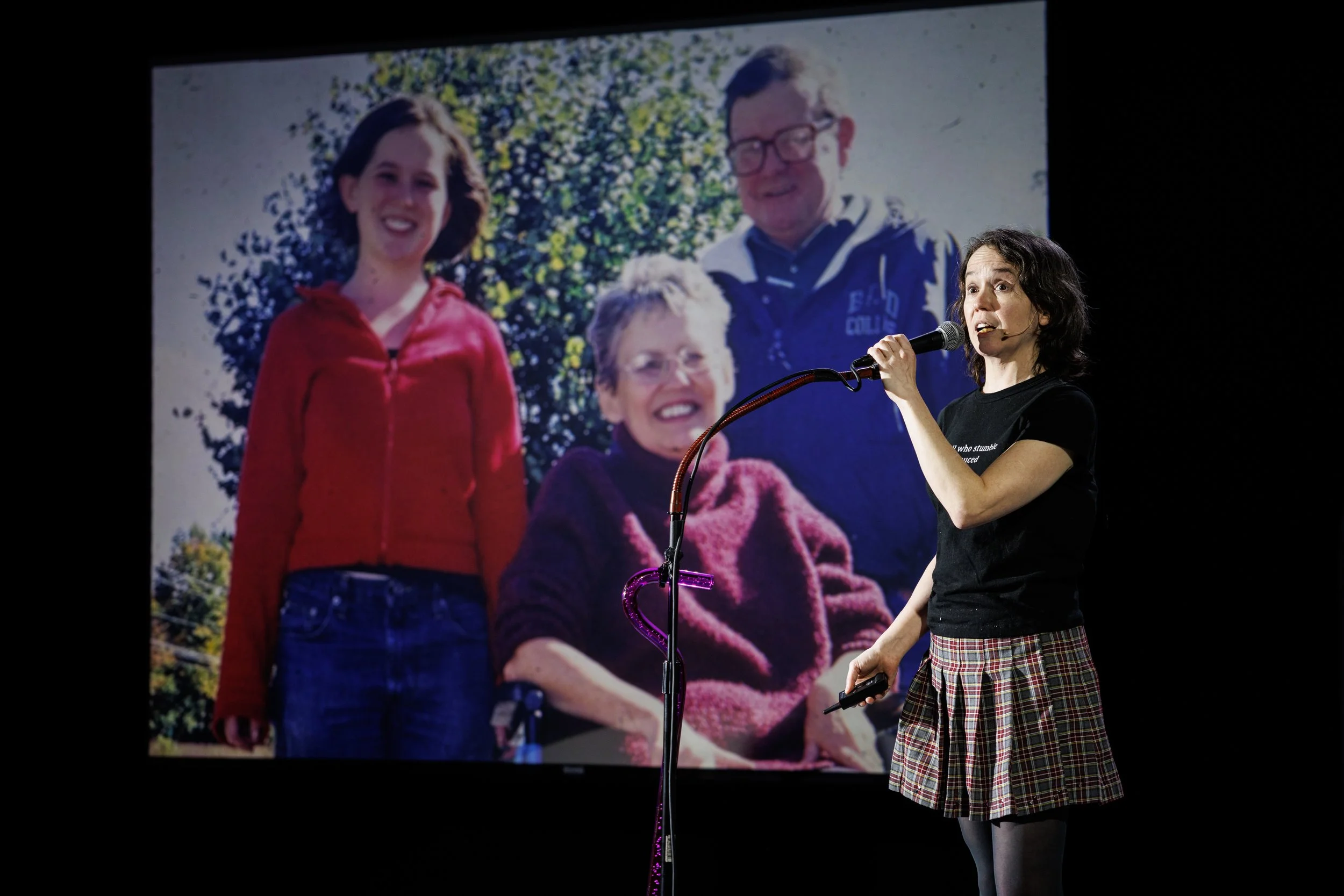
Gridley dives into her family history with the genetic disorder hereditary spastic paraplegia. Photo: Maria Baranova.
Gradually, Gridley shed the layers of clinical distance, bringing more of her own story into the script. She also insisted upon including elements of what she calls, fondly, “Dumb Theater Magic.”
It may seem incongruous that in a play about disability, trauma, death, and the fucked-up American healthcare system there is a stage direction which reads: “SPECTACLE SPECTACLE SPECTACLE! CONFETTI CANNONS! WIND! FOG + HAZE! STROBES! GOBOS!!!!”
But for Gridley, this is what makes theater so special. “Film and TV have their own kind of magic, but there’s something really exciting to me when all of these humans are sitting in a room together, and a confetti cannon goes off,” she says.
Watch Me Walk contains such musical numbers as “I’m Just an Orphan with an Orphan Disease,” in which Gridley dons a red dress and curly wig and sings about her mother wishing she had never been born, while two tennis pro “Adonises” leap about the stage in sequined jackets and tight, white shorts. There’s razzle-dazzle and choreography — Gridley learns cane-twirling from one of the Adonises, in a routine reminiscent of Shirley Temple and Bill “Bojangles” Robinson in The Little Colonel.
In the showstopping number, “I’m the Biggest Ablest of Them All,” Gridley gleefully shakes her top hat from her precarious perch, taunting the audience, “And now I’m on a ladder, and it’s making you nervous, and yes that is the point!”
Her control over the audience is thorough: Watch Me Walk is itself a command, and we obey. Watch Gridley walk back and forth, back and forth across a runway (its narrowness and white sterility suggestive of a doctor’s office), the only noise the sound of her feet hitting the floor. Listen to an eight-minute-long recorded telephone conversation while sitting in total darkness. Join a blind sing-along and realize, too late, that what you are singing is “hahaha” in response to brutal facts from the history of disability.
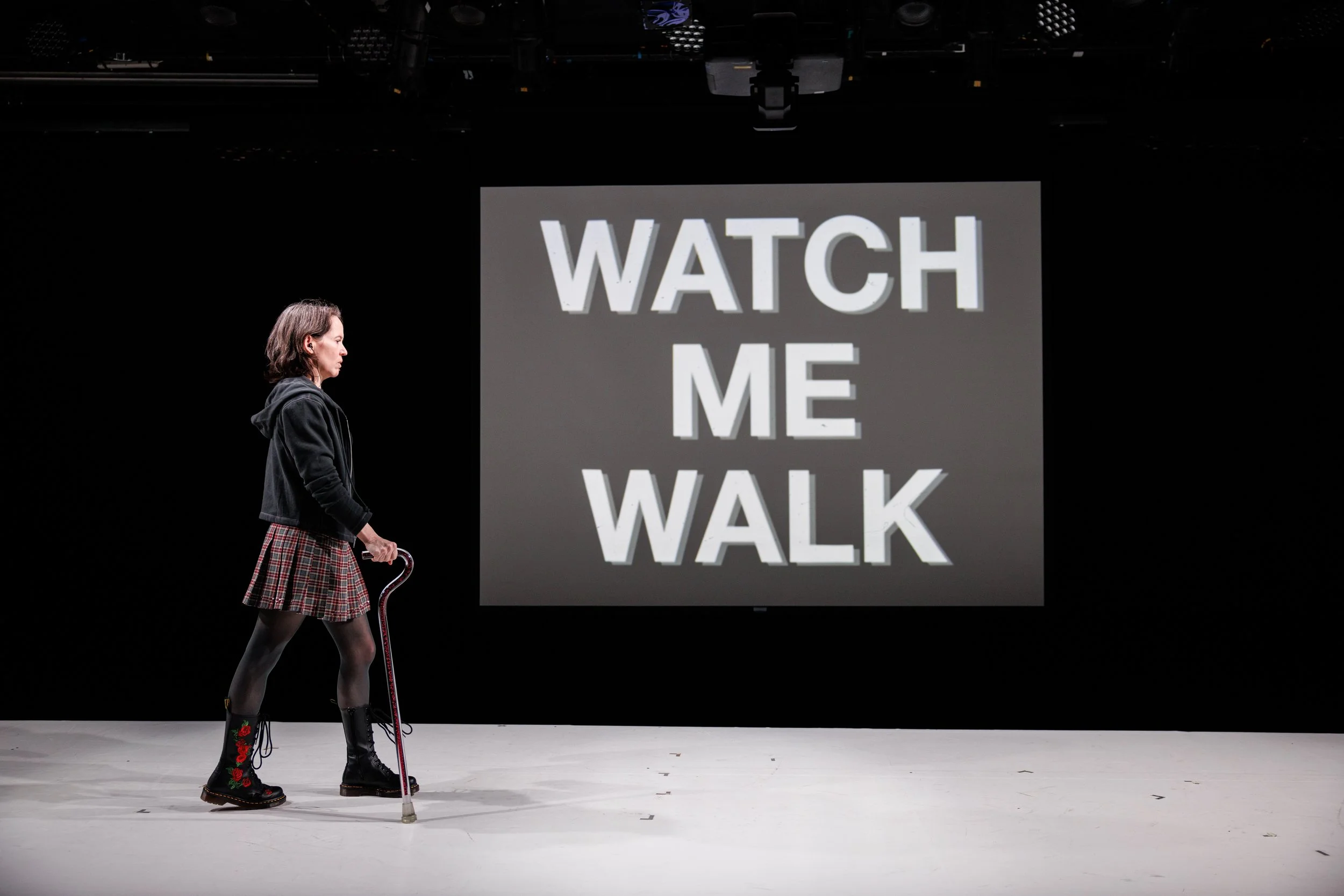
While singing, dancing, climbing a ladder, and walking, Gridley commands the stage in Watch Me Walk. Photo: Maria Baranova.
We are held completely in her world. And then she lets go.
The final scene of the play is absent of spectacle or theatrical magic. Wearing a plain tank top, Gridley engages in a wild, raw “rain dance,” defying the edge of the eighteen-inch platform on which she moves.
“I wanted to create unity,” Gridley explains. “Before, the audience had that distance. They are watching me. But then it changes.” A sign flashes behind her: “DANCE WITH ME.” It’s an invitation, not a command. “Instead of something happening at me, it is happening with me,” she says. And then Gridley moves with all of the freedom that she ever wanted.