

On Creative Resilience and the Post-Show Blues
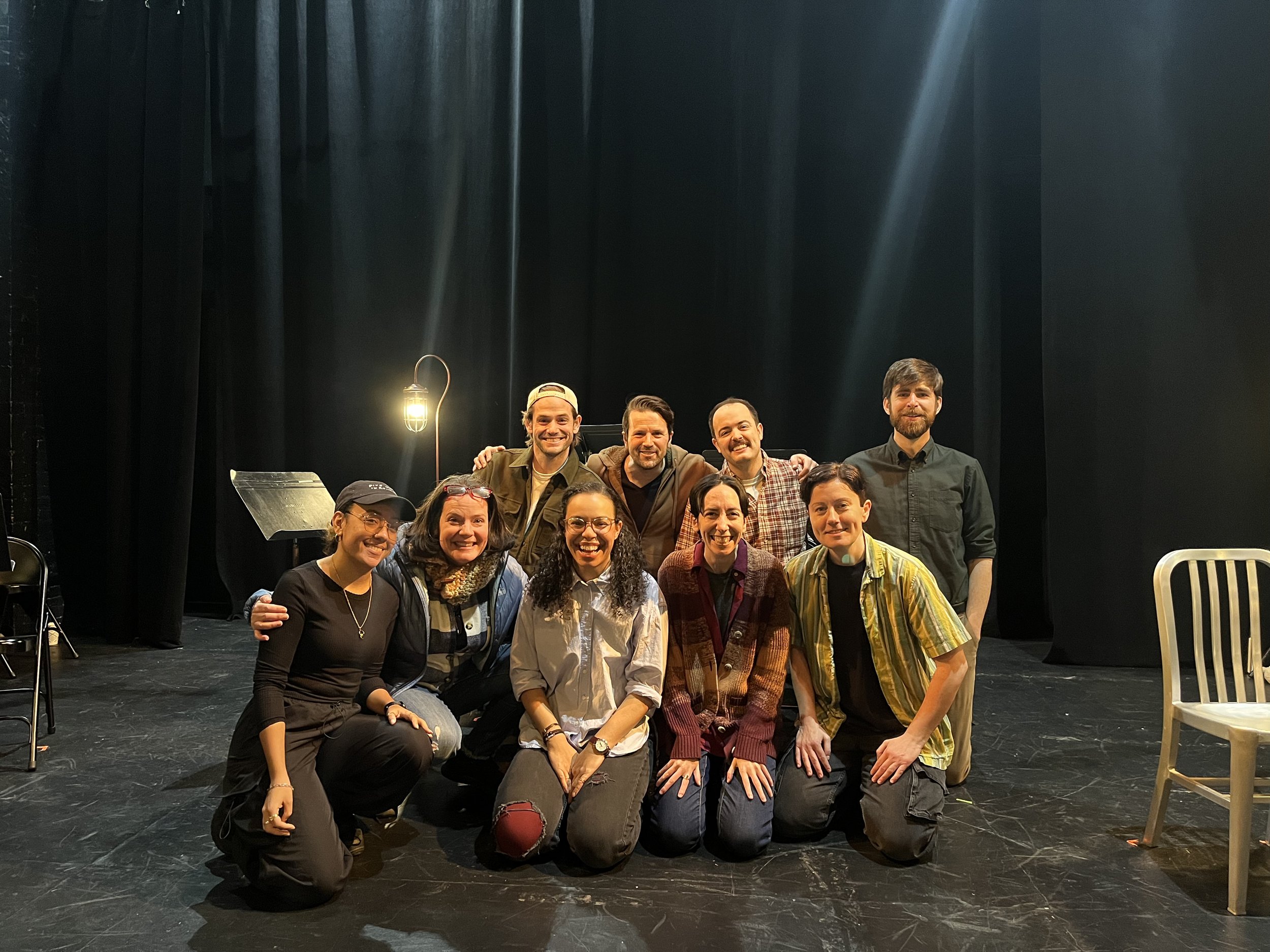
The cast and creative team from Gina Femia’s new play lisa; a fantasia. Back row, left to right: Doug Harris, John J. Concado, Matt DaSilva, Sam Heldt. Front row, left to right: Alyssa Rios, Danielle Skraastad, Taylor Reynolds, Gina Femia, and Stacey Raymond.
Last night I was running around on a stage, performing in a play that I also wrote.
Today I am sitting on my couch, staring at my television as it auto-plays episode after episode of Superstore. I’ve lost track of the number of episodes it’s played.
On Instagram, I’m smiling. And why wouldn’t I be? It was so thrilling, so fulfilling to embody my play, to hear an audience’s response from center stage rather than from the back of the theater. To do that somewhat taboo thing and cast myself in my own play. To be in community with six other actors, my director Taylor Reynolds (who is also my best friend), and the crew and design team who held the piece so thoughtfully. The play, lisa; a fantasia is autobiographical and metatheatrical. It’s as much of a critique of theater as it is a love letter. It scares me to share it and all I want to do is share it. It was thrilling to stand in artistic purpose so boldly.
Yet 12 hours later, my face can’t seem to make the shape of a smile. My body feels heavy, like a wet sponge, damp with the usual postshow blues of a project being over, and somehow buzzing with anxiety, wondering what might happen next. Maybe something. Probably nothing, at least for a little while.
I want to stay on this couch forever. I do not want to think. I cannot stop thinking. Every minute of the last week is still inside me, but I can already see them splintering into a fractured kaleidoscope of moments rather than full memories. I’m trying not to forget them, even as I forget them. I’m trying to predict the future. I’m trying to exist inside a past that’s already gone.
Questions run through my mind, like leaves in a wind storm. Will I ever have that chance to share this piece again? Will I ever be able to perform again? What’s next?
This is the push and pull of being an artist. Our lives are like riding the crest of a wave, up, up, up to the top before the inevitable coming down. Sometimes in the same day, the same breath. It’s tricky to navigate, especially because we’re never supposed to talk about the rough parts of being alive, even though those are the parts we should share the most. Who can I tell “Hey, I’m frozen today?” without being told, in a well-meaning way, to practice gratitude or to focus on the good or to find the next horizon. It’s another taboo act, to admit when we’re feeling anything other than happy. We’re not supposed to be low, especially when we were just so high.
Except that’s not how being a creative person works.

The cast of Theater of NOTE's production of Gina Femia’s For The Love Of (or, the roller derby play), including Tania Verafield, Jenny Soo, Alina Phelan, Crystal Diaz, Yolanda Snowball, Faith Imafidon, Lynn Odell, Briana Price, Liesel Hanson, and Faith Imafidon at Center Theatre Group’s Kirk Douglas Theatre in Los Angeles. Photo: Craig Schwartz.
We’re often told that in order to survive being a professional creative we need to have a thick skin. But how does one go about thickening their skin? Do we turn it into ice? Iron? Tin? It’s a phrase that is often repeated but means nothing — something to say when an artist is feeling their big feelings from a rejection or a bad note. And while I understand the sentiment behind it — the one that says we shouldn’t allow these common, bitter stings to hurt us so badly that it keeps us from accessing our creative joy — I’m not a fan of the phrase.
Don’t get me wrong, I believe we need to navigate the everyday obstacles of being an artist, the mundane pinpricks of our daily lives: the rejection that pops up in our inbox right before we’re about to sit down to work on our novel; the casting announcement that stings right before our self-tape; the note that sends you into a tailspin as you wonder if your play is even worth figuring out how to rewrite.
The phrase “thick skin” implies a resistance to feeling. A numbing of the self. A hardening that allows the “bad” to bounce right off us.
But I’m not sure making our skin tougher is the answer. Especially when it’s an artist’s job to keep our hearts soft. So how do we build this creative resilience to keep ourselves going in the face of those painful, everyday hurts?
We need to feel the feelings rather than try to avoid them. I’ve always found it easier to move through uncomfortable moments by accepting them rather than denying them. Welcoming the sadness. Ushering in the uncertainty. Embracing the answerless questions. Not judging any of the feelings that bubble up as good or bad. Giving myself permission to sit on the couch without guilt, or turning these feelings into words that only I will see.
It’s a rebellious act, to allow the big, uncomfortable feelings to move through us. Our lives will be full of the uncomfortable — there’s no way to run from it. We’ll set huge goals, and as we stretch our hearts to try to reach them, our hearts will break. It’s inevitable. Ignoring our big feelings can cause us to become bitter, and can curdle our spirits like spoiled milk.
That happened to me when I was first starting out as a playwright. I would send out plays and receive rejections, and instead of viewing them with a balanced eye, I viewed them with resentment. I’d look at the playwrights whose plays were accepted into the same programs I had applied to and would list reasons why I felt like I should have received the opportunity over them. Playwrights became my competition, competing in a game that they hadn’t signed up for. It made me resentful, shattered my community, and made my art muddied and soulless. It took me years to realize that trying to thicken my skin just hardened my heart. Instead of feeling the big, uncomfortable feelings of sadness, disappointment, anxiety, I turned it outward, as far away from myself as possible. I was left numb and bitter, without even realizing I was numb and bitter.
If we don’t allow ourselves the space to feel the big feelings, how can we be artists? So much of the role of a theater artist is to see the world with empathy, to center humanity. Whether we are writing stories that explore the mess of being human, or we are inhabiting those humans, directing humans who are portraying humans, designing what the story looks like or keeping all those humans on track during the course of a play process, theater is an artform of humanness. And one of the most beautiful things we can do is give ourselves permission to feel our big, messy, human feelings so we can continue to tell the stories that feed our hearts, and share them with the world.
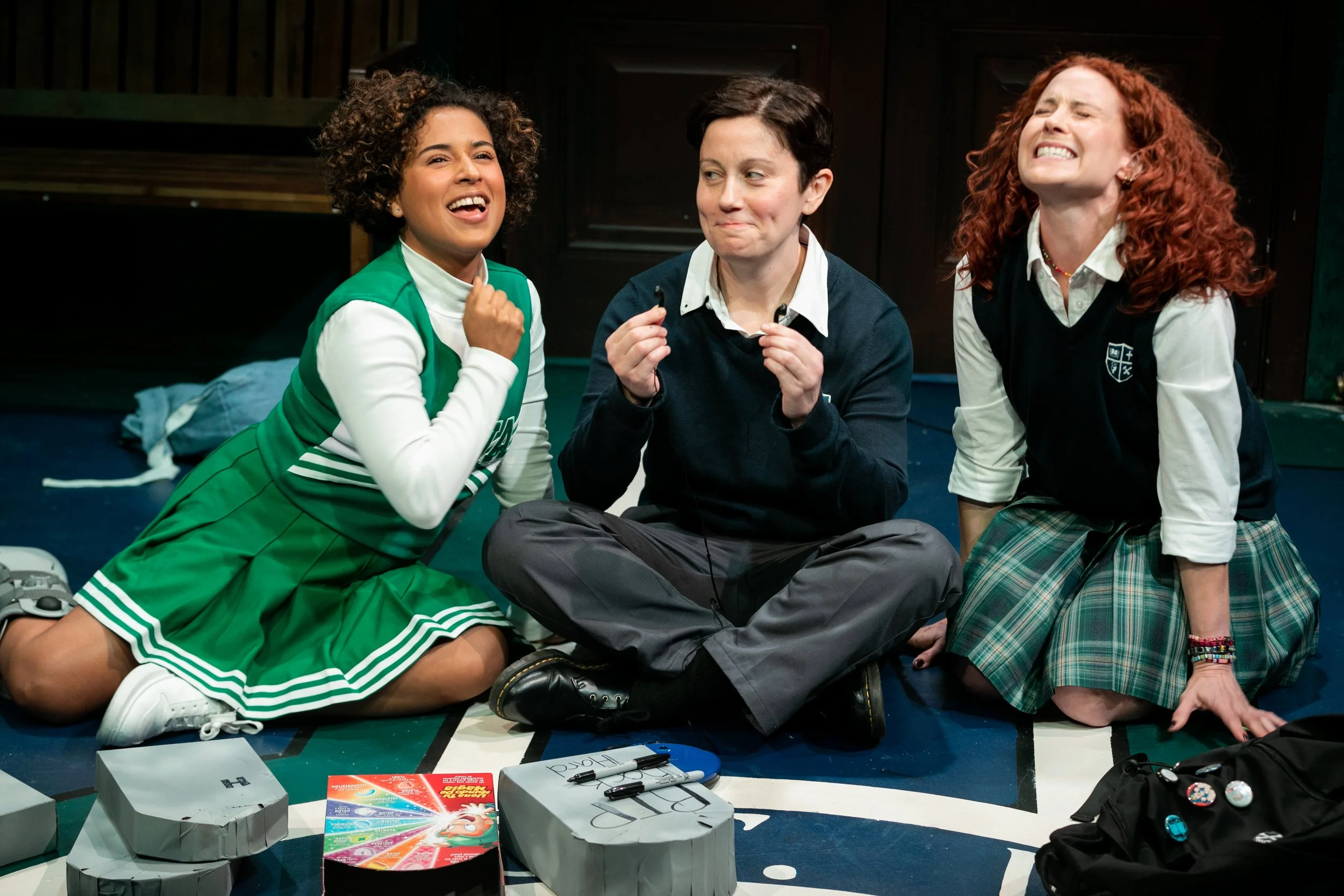
Boomerang Theater’s production of Gina Femia’s Mercutio Loves Romeo Loves Juliet Loves was performed at ART/NY in November 2024. From left to right: Rocky Vega, Stacey Raymond, and Leah Nicole Raymond. Photo: Isaiah Tanenbaum.
I am not going to stay on this couch forever. In a few hours, I will silence my television. I will stand up and stretch my neck and walk around my small living room. I’ll shuffle into the kitchen and do the dishes and make my way to the bedroom to put away the laundry and a moment from my play will cross my mind and the corner of my mouth will twitch into a smile. My mind will float away from this past project and open itself to something new, and I will slowly and assuredly begin again.