

At Rise: Bubba Weiler and Jack Serio, Before First Rehearsal
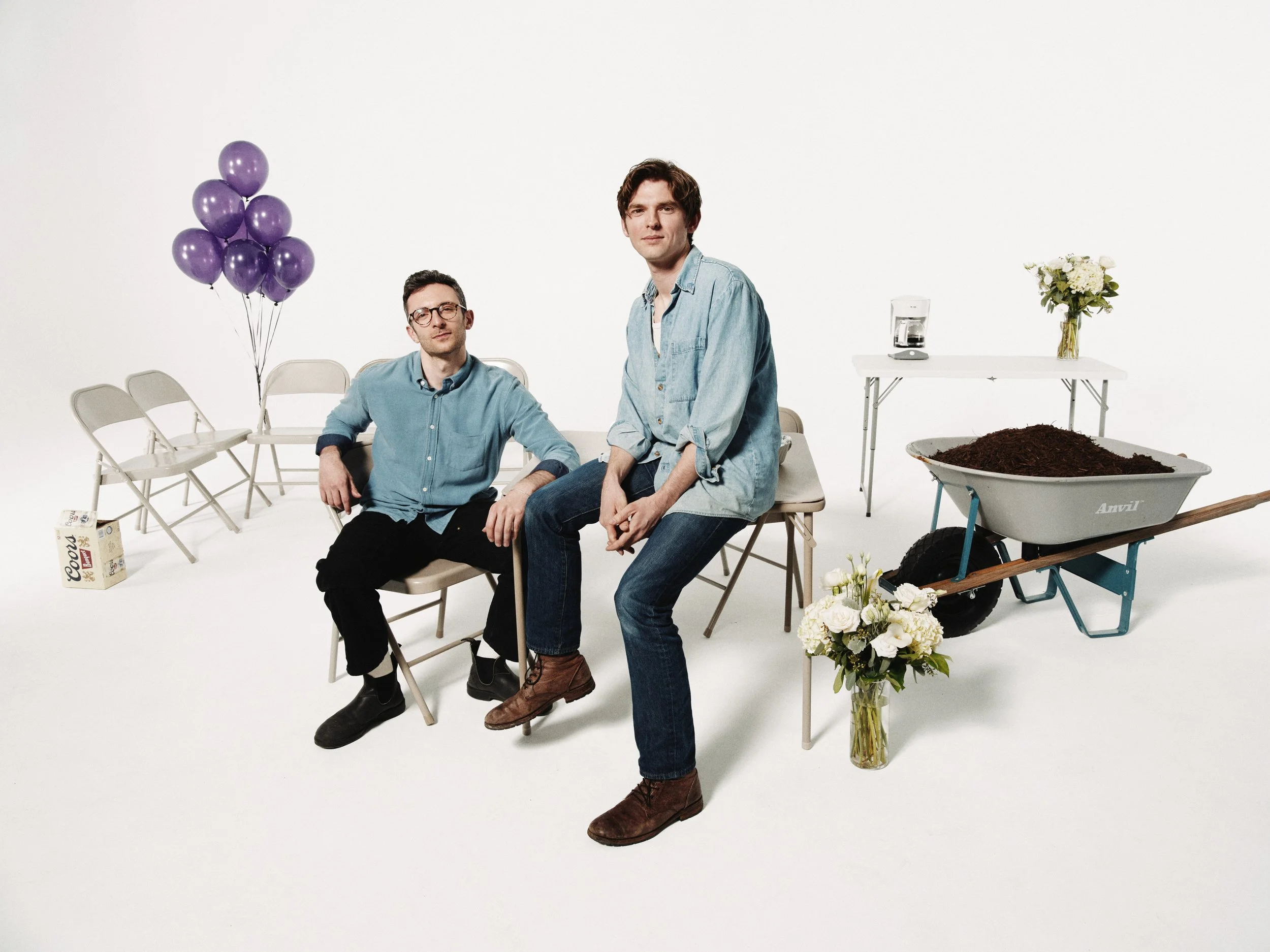
After a successful run at the Irondale in Brooklyn last summer, Well, I’ll Let You Go director Jack Serio and playwright Bubba Weiler are readying for the play’s return engagement at Studio Seaview. Photo: Emilio Madrid.
On a blustery (but promising) spring morning a couple of weeks ago Jack and I grabbed breakfast at the Westway Diner, an old-school greasy spoon (laudatory) on 43rd and Ninth. We were celebrating — sort of — or at least taking a moment to gather our thoughts on a day we’d very much been looking forward to: the first rehearsal of our play, Well, I’ll Let You Go, at Studio Seaview.
I thought it might be a good time to interview Jack; to sort of grab a snapshot of him as he prepares for what is — for both of us — an incredibly exciting opportunity to bring our work to a bigger stage, literally and figuratively.
What followed was a giddy and kinda nervous (at one point Jack spilt an entire glass of water) little chat over a Greek omelet (mine) and corned beef hash (Jack’s). We talked about our dreams and anxieties for the transfer of this production, what we yearn for in a night of theater, the landmark productions that inspire us, the exact right amount of politics we like in our plays, and the emergence of a legitimate commercial Off-Broadway landscape in New York theater.
The thing is, I did forget to hit record for like the first half hour of our breakfast (I told you I was nervous!) — so we’re dropping you in in the middle.
I had just asked Jack a question about what attracts him to the plays he decides to work on, when I realize my mistake and finally begin recording. Unfortunately for Jack, I catch him mid-answer, and so our interview begins.
JACK SERIO: I don’t like reading plays. Therefore, when I am voracious in reading a play, when I can’t put a play down, when I start seeing stage pictures in my mind — I know I’m interested because that happens so infrequently. It’s a good litmus test for myself, it teaches me when I’m really excited about something.
And the first play we started working on [together] was The Saviors. And my recollection of that was that you and I had decided we were going to make The Saviors in a real church. No one wanted to do it. I assumed because we were insistent that two children be in it, and no one knew you as a playwright then. You were basically an actor who wrote a play that we were insisting real children be in and carry the whole show. And I think everyone was like, “We’re good, thank you.” And so I said, “Well, we’ll do it ourselves and we’ll put it on in a real church.”
And you, Frank Oliva, and I spent a day together. Election day, wasn’t it?
BUBBA WEILER: It was the day after, the day that Trump had won.
SERIO: Yeah. We were all a little…
WEILER: We thought about canceling, but then we were like, we need to do something and be together.
SERIO: It’d be nice to be together. And we went around New York City, went to a bunch of churches and tried to find one we thought might work for the play. And my recollection is we then went back to the design studio I share with Frank [Oliva] and Stacey Derosier. And on your way out you were like, “By the way, I’m also working on another play, maybe I’ll send it to you.” And that was Well, I’ll Let You Go, which you sent me. I had a bunch of plays that I procrastinated reading and I thought, I’m going to go and sit in the park by my house and chip through them all. And yours was the first I read and I read it quickly in one sitting and was immediately obsessed with it. Which rarely happens.
WEILER: So I remember I had like very sheepishly brought the play up and then sent it to you. I’d been working on it for like four years. I literally hadn’t shown it to anybody. It felt to me like I would send this to you and then we would develop it for a long time, and there would be a lot of writing still to happen — which there was, but you kind of just did a big shortcut on the process.
And so, anyway, I sent it to you and then I remember an agonizing week where I didn’t hear from you. And in my head you had read it and had hated it so much that you also didn’t want to do The Saviors anymore.
SERIO: Hang on, I’m looking: You sent me an email with the play attached that says, “okay, here’s this! Probably a bit of a mess for now but with your help I think it could maybe really be something.”
WEILER: Okay. And you responded to the email?
SERIO: I texted you nine days later and I said, “Bubba, I love it. I think it’s really exciting and it consistently upended my expectations. I was very moved by the end of it. I think there’s so much there. You have a singular voice and it’s all the things I get excited by in a play. It’s beautifully observed, has an original theatrical structure, and is scratching at and asking questions that are really big and important. We should work on it.”
WEILER: Oh, wow. I didn’t remember all that. That’s so nice.
SERIO: Interesting…
WEILER: Well, I remembered it was really nice!
SERIO: Nine days is pretty good turnaround time for me on a play.
WEILER: Nine days is pretty good. Nobody reads a play in nine days. I have plays that I am supposed to have read in my inbox from like a year ago.
What are all the things that get you excited about a play?
SERIO: That it feels singular. Playwrights who are interested in both form and content, and plays whose form is unique and specific to the content of the play that they are writing. You felt like you had original observations about the world and didn’t want to put those observations inside an inherited structure or a playwriting structure that felt familiar. You were like, “I’m going to craft a structure around this play that communicates the idea of the play as much as the dialogue does.”
And, I mean, I should say Our Town is my favorite play. And it was evident to me immediately that you were in conversation with that play, which felt like a big gamble too, because, you know, if it’s not good, it’s embarrassing.
WEILER: Totally, totally. Big fear of mine.
SERIO: Yeah. It felt so readable. I felt like the dialogue was how people actually speak. And the moment where I felt like we must do this, was when I thought I was ahead of the play. I thought, “Oh, well, you know, I’m a smart enough guy. I went to theater school. I see where he’s going with this.” And what I came to learn was that I was entirely wrong and that I had followed a trail of breadcrumbs that you were leaving for me. I had fallen right into your trap of the play and made all the assumptions that I was supposed to make, and I was wrong.
And I was wrong in a way that excited me because you were actually exploring something less sensational than I thought you were, and more quotidian and simple and beautiful. And I was thrilled that actually the interests of the play were smaller and more universal than the kind of red herrings that I followed. I was like, “Of course I’m wrong, of course this is how the play ends.”
WEILER: So Our Town is also my favorite play. Do you remember your first encounter with it?
SERIO: I don’t. When I was picking a senior thesis at Playwrights Horizons Theater School, where we both went, I was between three plays that, when I think about this now, I think I barely knew those plays. I probably had read those plays once. I was not chapter and verse on those plays, but it was Macbeth, Uncle Vanya, and Our Town, and I was maybe the most familiar with Macbeth, to be honest.
WEILER: Those are pretty good plays.
SERIO: Yeah. I think I was too intimidated by the language in Macbeth. And for Uncle Vanya, I thought: everything I’m interested in by this play is about age. And I don’t want to do a production where everyone is the same age, where everyone is in college. And so I said, okay, let’s do Our Town. And I really wasn’t that familiar with it, but I was excited by how big it was and the challenge of it.
And I also had an inkling that there was maybe an interesting idea about everyone being the same age, because that play, like yours, is so interested in time. One of the first things Emily says when she goes back and sees her mom is, oh my God, I never remembered mama was that young.
And the Stage Manager asks us in the second act, before we see the soda-shop scene, to pause for a moment and remember what it was like to have been very young and when we were in love and we were like a person sleepwalking through the world. There’s all this stuff about age in the play. And actually, how when you’re young, you don’t feel time moving as fast as you do when you’re older.
WEILER: There’s a youth-is-wasted-on-the-young kind of thing.
SERIO: Yeah. And then we could adopt basically Emily’s perspective on the show. And what did it mean for everyone in the play to basically be her age? And then go back in time and feel like time was moving so fast.
But it was really the process of working on it that I became just quite certain that it was the greatest American play. And I got to work on it again recently in LA on a reading. And every time I come back to it, I find something new. And this time was really an admiration of the structure of it. There’s actually nothing like it. The play starts, there’s a guy talking to you directly, and then in the middle of the first act, we kind of stop the play. We take questions from the audience. That’s wild. A professor comes out and gives geological facts about the town. In the second act of the play, we go backwards in time. Characters speak to the audience that you didn’t know could speak to the audience. It just keeps breaking its own rules in a way that I’ve not experienced in any other play.
WEILER: The narrator enters the play and speaks to the characters as a character. I think it’s done so much and we all grow up with it that we forget how fucking weird it is. How actually experimental and revolutionary it is.
SERIO: And rooted way more in a tradition of European and Russian drama, and Italian drama and Pirandello, than anything Americans were doing. Our Town premiered in the middle of the Depression when Broadway was like the Ziegfeld Follies. You would go to the theater to be distracted from how awful your life was. And so when you’re used to spectacle, to walk into an empty Broadway theater where you were seeing the back wall of the auditorium and some ladders and a guy smoking a pipe leaning against the proscenium was radical.
WEILER: It also does this really sneaky thing where you think you’re watching something simple and sweet and moving, and you care about everyone and you’re following this love story — and then it just fucking gut punches you out of nowhere.
And that’s one of the things that I love about it so much: it is a play that whenever I see it I am totally bowled over by it and like immediately want to call my mother.
SERIO: Yes.
WEILER: When theater makes me want to call my parents, that’s what I want to see. That’s what I’m always aiming for.
SERIO: I would say my love of theater — and it’s a deep love — is built on a foundation of disappointment in most of it, because I know how powerful it can be. And if I’m lucky, once or twice a year, I will have that kind of religious experience in theater that reminds me why we do this. And so often I feel like I am sleepwalking through going to the theater, that it’s not reaching me in the way that I know the form can.
And the first real experience of that for me was seeing Scenes from a Marriage at New York Theatre Workshop that Ivo [van Hove] directed. I feel like I am always chasing the feeling I had after seeing that production. And another hugely instrumental piece for me was 600 Highwaymen’s The Fever. With both of those shows I can draw a straight line to their influences over Well, I’ll Let You Go. I refuse to let the theater be anything.... What do I want to say? I feel protective of it. I so badly want it to be as good as it can be and to wake people up, and for people to really feel something at the end of it. I really value catharsis, and I don’t always succeed at that. But that’s the goal.
I don’t think that people go to the theater because it’s important or it’s good for them to see it. I think they go because they believe that it can change them and move them. And so I feel like that’s always the goal I’m reaching towards, even when I fail at it.
WEILER: So it has to be about us.
SERIO: Theater that acknowledges the presence of an audience. That we are integral to the thing happening. Because otherwise make a movie or write a book.
WEILER: I think one of the things that spooks me out about doing this transfer actually, is that theater is sort of meant to go away. And it can feel, when you’re doing a remount, that you are bringing something back from the dead. And so I do think that there has to be a really good reason why a second version of a thing should exist.
SERIO: I agree.
WEILER: What is your sense of that for our play?
SERIO: One answer is that not enough people got to see it. The work is good enough. You know what I mean? That people should see these performances. People should hear your play.
But I think more importantly, I’m no less hungry for community now than I was in the summer, in fact I feel even more hungry. I feel even more isolated from my fellow man. There’s a reason we come back to Our Town again and again. There’s a reason we come back to Chekhov again and again. Because they are scratching at ideas that reach across centuries. And your play is particularly interested in a kind of dissolution of the American Dream, it’s foregrounding everyday people in the wake of a broken American experiment. These people are living in the shadow of harmful policy and harmful politics and looking at the effects of that policy in a kind of interpersonal way. I always say the play is lowercase p political, because there is a politic to it, but the politics are kind of the wallpaper, they’re in the background.
WEILER: I always like to say that the space that the play should occupy is the exact centimeter that the political touches the personal.
SERIO: Yeah, that’s right.
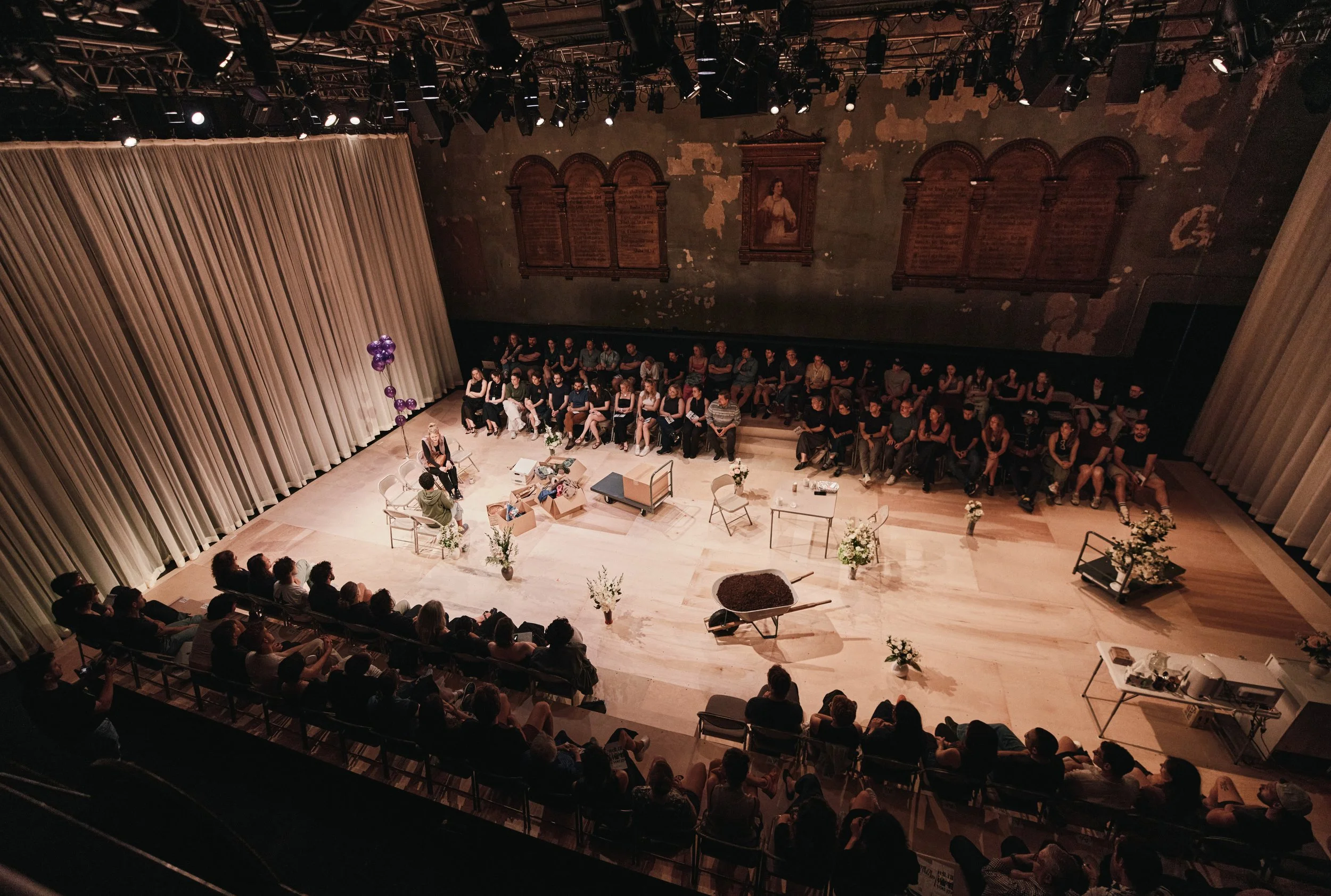
The original production of Well, I’ll Let You Go at the Space at Irondale in summer 2025. Photo: Emilio Madrid.
WEILER: I went home to the Midwest a couple of weeks ago. And you can just feel the way that all of these — and maybe this is so obvious — but the ways that all of these headlines are touching my family members and neighbors in the Midwest in this really visceral way. For instance, my parents’ house is suddenly surrounded by data centers. And so everyone was talking about that, and how high gas prices are, and ICE presence, and it’s just such a good reminder that these political conversations that we’re having are actually always about people’s lives.
SERIO: I think there’s something beautiful about the kind of celebration of the place you’re from, but also the part of you that wants to bring those people into New York City and show them to us.
WEILER: Yeah. And then they all came to see it too, which was so moving.
SERIO: What happened with you? Let’s back up. I feel like what we should say is that you reached out to me after seeing a couple of my plays. We’d gone to school together, we were friendly, but we weren’t tight.
WEILER: I loved [your production of] Uncle Vanya so much that I was like, I just want to talk about that. And then at the end of like a two-hour hang, I was like, by the way, I wrote a play.
SERIO: Right.
WEILER: I was kind of being sneaky.
SERIO: So you graduated college in 2015 and have had a successful acting career, meaningfully so. You were on Broadway for a year. You’ve been in Netflix shows. But my first interaction with you was in a freshman playwriting class that you were the TA for. But do you feel like something happened in those 10 years? Why now did you start sharing these plays with the world? You’ve been working on The Saviors since college. You’ve been working on Well, I’ll Let You Go since 2020. Why is New York City only now getting to know you as a playwright?
WEILER: Well, the truth is I have always been a playwright. I’ve always wanted to be a playwright. I would stay up late in high school after getting my homework done — I grew up in a big, noisy family and I would wait until everybody went to bed so I had some quiet, and I would sit up and I would write plays, from the time I was like 14. And I was a child actor in Chicago and had this incredible opportunity to be part of all those developments of new plays at Victory Gardens and Steppenwolf and Red Orchid.
SERIO: Working with our friend David Cromer on Picnic.
WEILER: That’s right. William Inge’s Picnic in 2008. And so it’s always been a dream of mine to have a day like today, where we’re about to have a first rehearsal in this big, amazing Off-Broadway venue where so many directors and playwrights that I admire have had their work presented.
And I think the truth of “why now” is it’s really hard to get anybody to pay attention to you as a writer until you are at least 30 years old. I actually think that’s true.
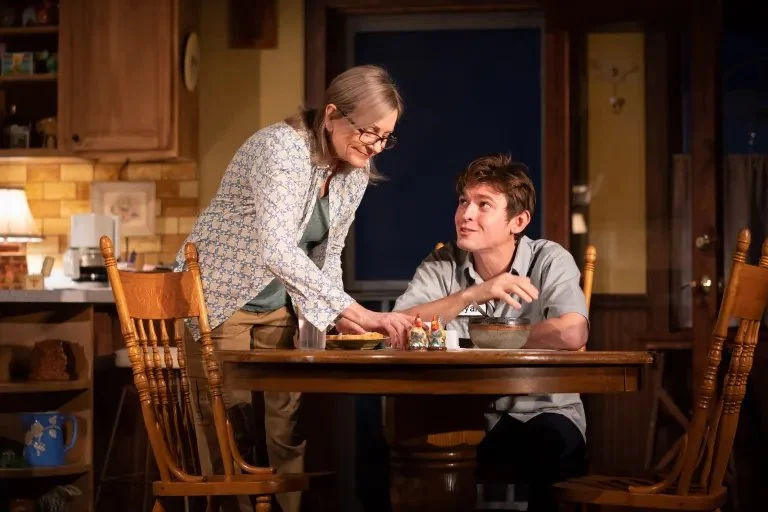
Mary Beth Fisher and Bubba Weiler in Swing State. Photo: Liz Lauren.
SERIO: But were you applying for writing groups and fellowships?
WEILER: No.
SERIO: You weren’t trying and failing. You were kind of protecting the things you wrote.
WEILER: That’s true. But that has a lot to do with the acting career that I was also pursuing.
The sort of “right way” that you’re supposed to become a playwright in New York is doing the residencies and doing the writers groups. And there’s this slow introduction to the world that you’re meant to do.
SERIO: You’re supposed to put in your time. Or everyone’s supposed to know you and you’re not supposed to be produced for a while until someone finally kind of anoints your writing as good.
WEILER: Yeah. And you’re supposed to maybe go to grad school. And I was doing this acting thing and there was never an opportunity where I knew that I could be in one place in a writer’s group or in a residency every Tuesday and Thursday because how I made my money and paid my rent was acting.
And then the pandemic happened and I had all this time where I couldn’t act. I was upstate with my now husband. And we didn’t have any phone service or Wi-Fi and we were just reading a lot of books and taking a lot of hikes and writing a lot. I hadn’t written a play in a long time, but I tapped back into that feeling, and I started writing about my life back home and all the people that I missed. I think what I was responding to is that there were all these people at home who I loved so much and I didn’t have access to and who I knew were hurting.
People in my community were dying and there was this huge change happening. And not that this play is in any way about the pandemic, but it was a way for me to be surrounded by them. And to try to tap into some sort of empathetic experience about what they were going through and are going through.
But I feel like I could turn this question around on you, which is that to the naked eye, it could feel like you sort of came out of nowhere in this big way. But I think for many artists there’s this big iceberg, a submerged iceberg of work and we only ever see the top of it.
SERIO: Yeah.
WEILER: One thing that I’m curious about, is all the work that went into your career before This Beautiful Future. And one thing that I think is really awesome about theater direction, and I think this is true for theater design too, is that there is a real atmosphere of apprenticeship.
SERIO: I’ve just spilled a cup of water.
WEILER: Jack does not want to talk about this.
Okay. But there is this old-fashiony apprentice thing that happens where you come up under somebody and you learn on the job. These great directors do this both because they genuinely need the help. And because somebody did it for them and they’re wanting to give back. So I guess I wanted to hear about your associate days, who you worked for, who you learned from, what were the big lessons you learned in that time?
SERIO: I graduated from college in 2018. I worked for Austin Pendleton twice, both during college. I did A Taste of Honey [by Shelagh Delaney] at the Pearl Theater with Austin. And then Austin and I did The Traveling Lady, an Inge play, at Cherry Lane. And I assisted Jason Eagan and a couple of people before the pandemic. But I always found it very hard to get a footing. I would apply for fellowships and not get them.
I did the Lincoln Center Directors Lab, which was an incredible three weeks of meeting other theater directors from around the world, some of whom I’m still friends with today. But none of that led to work.
I was frustrated before the pandemic. I was like, I don’t know how to do this. I can’t seem to get on a path towards making work. Between 2018 and 2020, I was working in general management at Playwrights Horizons. I was working as a personal assistant to Aasif Mandvi. I was doing small readings of plays when I could, and the only thing that was public is I had a one-night show at Ars Nova, a piece that Misha Brooks wrote and performed in called Happy and Grateful.
And then the pandemic happened and I felt really allergic to the influx of Zoom work that was happening. It really didn’t speak to me. And it wasn’t about the thing I was most excited about in theater, which was the gathering, which was people getting together and being with each other. And it felt like the pandemic, amongst many things, was an attack on that. We weren’t able to be together.
And so I thought, well, we just have to wait this out. And I read books and watched all of The Sopranos for the first time.
WEILER: So did I!
SERIO: I put that up there with Our Town for my top five favorite pieces of art in any medium.
WEILER: And so much about the American experience.
SERIO: Absolutely.
The work right after COVID, it felt like all of a sudden artists were making work about good people and bad people. And work that felt almost politically didactic — that we had just all collectively experienced this trauma and now this play or this piece of art was going to solve something for us. It was going to tell me how I should be or how the world should be. And that had not been the work historically that had moved me, that had kind of reached my soul.
I’d never anticipated self-producing again. I had run this company when I was a teenager and I had self-produced all these plays. And I was so frustrated and disappointed with everything that was going on and I said, “Boy, I want to do a play.” And I had read this play, This Beautiful Future, that I had really loved and I thought was a morally really hard and complicated play. A play that really kind of refused to tell you how to think.
WEILER: Yeah. Sort of the opposite of the things that you were talking about.
SERIO: We were asked to kind of empathize with someone who had done something horrific.
We put that play on at Theaterlab. I went to Orietta Crispino, who runs Theaterlab, and I had worked there as assistant for Rory McGregor on two shows. Orietta and I are both Italian, and so we got along when I was working there as an assistant, and I think I emailed her and I said, “There’s this play I really want to do. Could I do it at Theaterlab?”
And she said “yes.” And I put together a cast and we did it for $12,000 on an Equity showcase contract. And $5,000 was from a grant that I had won that I had said was for a different project, but then secretly used for This Beautiful Future. And then went out and tried to raise some money and whatever else I couldn’t raise I put on a credit card that I knew I could pay back with the box-office sales before I had to pay interest.
WEILER: Wow.
SERIO: And the flats from that show were borrowed from Theater for a New City. The microphones were borrowed from Ars Nova. Everything was begged, borrowed, and stolen, and we did the show and it was in the middle of Omicron when things were shutting down again. Under the Radar was canceled, Prototype was canceled, Broadway shows were going dark again. And so there wasn’t a lot going on in January of 2022 and miraculously the New York Times reviewed the show and people came, and I don’t know that we would’ve gotten that attention for that small show if it weren’t for the moment.
WEILER: What made you feel that you were ready? I feel like so many people wait and wait and wait until somebody ordains them ready.
SERIO: I still don’t feel like I’m ready. But I think I felt like I wanted to add something to the conversation and I was at least as good as the worst artist I saw working.
WEILER: Yeah, seeing bad theater can be very inspirational.
That brings us to this exciting moment in New York theater, which is this rise of commercial, independent Off-Broadway theater that exists outside of the nonprofits, where we’re used to going to see great theater. The commercial sector always existed, but is changing.
SERIO: When I moved to New York in 2014, commercial Off-Broadway theater was basically only The Gazillion Bubble Show.
WEILER: Exactly.
SERIO: You know what I mean?
WEILER: It was Fuerza Bruta.
SERIO: Yeah, it was not taken seriously by the rest of the culture. And it was for tourists. If you wanted to go see real theater Off-Broadway, you were at the not-for-profits.
WEILER: And what changed, do you think?
SERIO: I think the not-for-profits were hit hard during COVID. And you’ve seen a huge contraction in how much work they’re able to produce post COVID, and you’ve seen many of those not-for-profit institutions meet a moment of financial scarcity with safety in programming choices.
And I think what happened was there were so few opportunities now, theaters that used to produce eight shows a season that are doing three — I said, “Well, I’m not going to wait around for them to hire me. We’re going to put on shows ourselves.” And you’ve seen this abundance of people in our generation putting on shows in whatever spaces they can get a hold of, usually nontheatrical. And that work has been exciting because I think it’s been a pure expression of what those artists are interested in. We’re able to work quickly. I had the idea to do Uncle Vanya in April and we were in rehearsals by June. And it was open in July.
WEILER: Same with this. We had a reading of this in November [2024].
SERIO: We had a reading in November and then we kind of sat around on it. I pitched it to Jacob in April [2025] after Danger & Opportunity one night. We were touring theaters in May, and it was open later that summer. And that’s a speed that bigger institutions can’t work at.
WEILER: I also think that doing a play outside of the nonprofits just naturally attracts a different audience because it’s not subscriber based.
SERIO: It’s a young audience. It’s an audience that’s on social media. It’s an audience that we need to build and cultivate if we want this thing we’re doing to go on for generations. The subscriber audience is gonna be dead. We have to be thinking about exciting our own generation about going to the theater.
And I think you’re seeing a resurgence in interest in being together. It’s why the Catholic Church is blowing up at the moment. I’ve been researching this a lot for The Saviors, but there’s swarms of young people in their twenties and thirties that are turning to the Catholic Church in a way that is confounding Church leaders. And so many of them seem to think that has to do with the longing for community. And that is, I think, what will protect us from the advent of technology.
WEILER: And it goes back to what we were talking about earlier: you’re talking about Our Town during the Depression and how the impulse was to make people forget about their lives, entertain, be flashy, be fun. And then we did this play last summer. And I think we found that, yes, people came because they want a live experience. They want to be in community. But also I think what we were maybe surprised by is that people seemed really hungry to feel something, to really have an emotional experience. In a way that I find, at least personally for me, I experience that most profoundly in the theater.
SERIO: Me too. When theater is good it is singular in how it can affect me. The theater has been able to affect me so profoundly in a few instances that I’ve dedicated my life to making it, and to hoping that I can replicate a thing that happened to me a handful of times for other people.
WEILER: What are those plays?
SERIO: Ivo van Hove’s Scenes From a Marriage. 600 Highwaymen’s The Fever. Daniel Fish’s Oklahoma!. A production of Midsummer Night’s Dream that toured from the Bristol Old Vic that they did with Handspring Puppet Company that I saw in Boston. Rob Icke’s Hamlet with Andrew Scott. Simon Stone’s Yerma. Those are the big ones. Recently Kramer/Fauci.
WEILER: Ugh, I missed it. Devastated that I missed it. Hope it comes back. So the flip side of all these amazing reasons why commercial Off-Broadway is so great is that you have to sell the tickets because nobody is subscribed to see it.
SERIO: It’s a business venture.
WEILER: How do you do it?
SERIO: I don’t know. I mean, this will be the biggest show I’ve had in New York. Capacity-wise, this will be the most seats I’ve had to fill.
WEILER: More than Grangeville [at Signature Theatre Company]?
SERIO: Yeah. 199 over there. If we were doing this in a 50-seat theater, I would have no doubt that we would be able to sell out the show because there’s enough people. I don’t know. I think this is a gamble. The reason this was a gamble over the summer remains a gamble now.
WEILER: Which is kind of fun.
SERIO: I don’t know if anyone’s going to come or if this is successful and I am grateful that enough producers have believed in this to do it again.
WEILER: What I will say is, regardless of how it goes, I stand firm on the things that we are betting on. And I’m proud to bet on them. Which is that we have the best actors in New York, all in the same place.
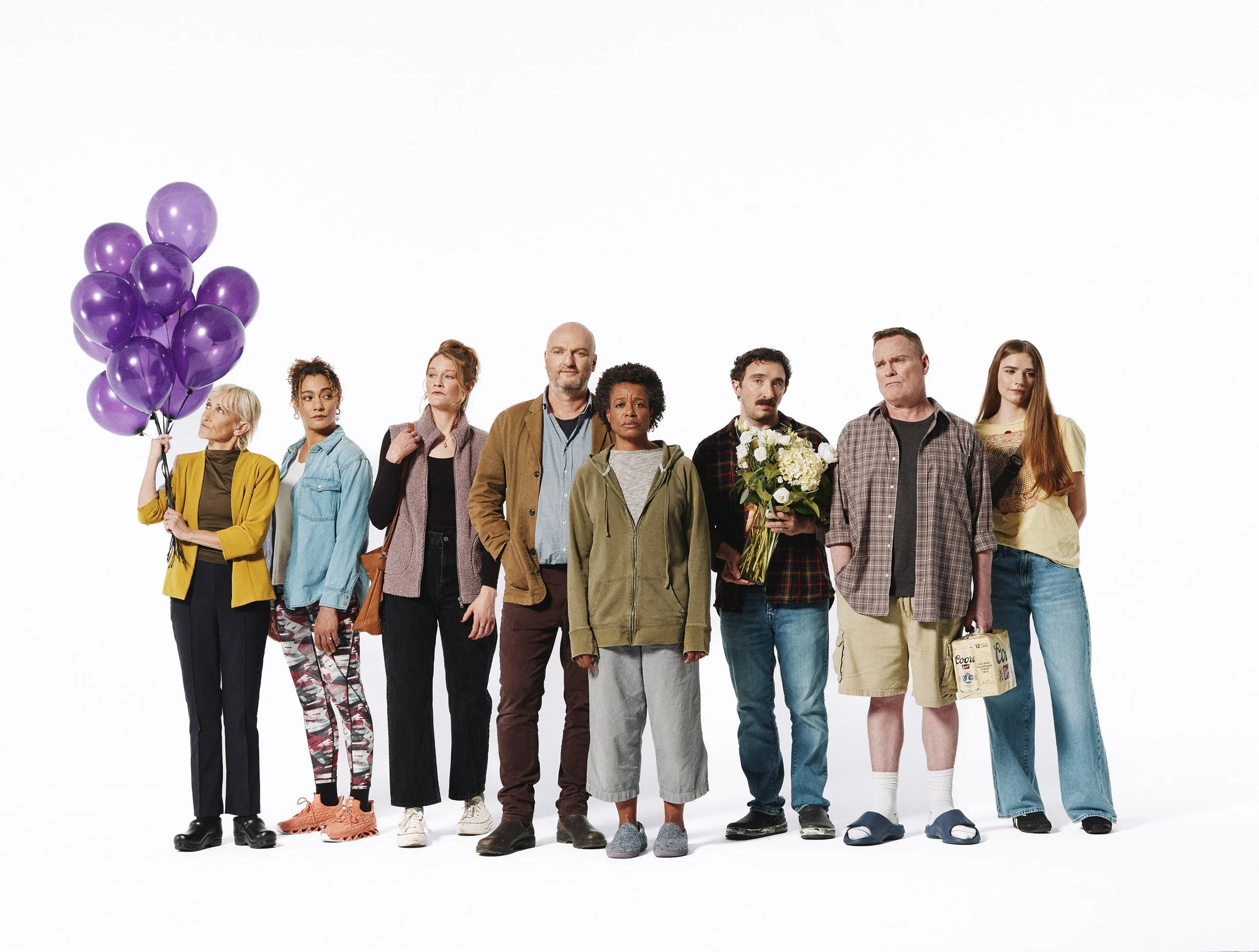
The cast of Well, I’ll Let You Go: Constance Shulman, Amelia Workman, Emily Davis, Matthew Maher, Quincy Tyler Bernstine, Will Dagger, Danny McCarthy, and Cricket Brown. Photo: Emilio Madrid.
SERIO: An original new play by a first-time playwright.
WEILER: We are sort of committing to the idea that if you build something of quality that something will happen. That people will come see it. And hopefully be moved by it and tell other people.
SERIO: Yeah. We’re trying to make the ecosystem we want to be in, which is that in commercial Off-Broadway, you can do a new American play with great New York theater actors. None of them have to be a celebrity. And that is a worthwhile financial venture.
WEILER: Yes.
SERIO: Not every show needs to be a revival of a title you’re familiar with, with an actor you know.
WEILER: It’s interesting because in some ways, I feel like so many plays are produced in this reverse engineered way, where they’re thinking about who’s going to come before they build the thing.
SERIO: Yeah. What do we think an audience would like?
WEILER: Yeah. And you’re building our play to be audience-centric, in a different way, in the experience, which is something you always do with your work. You’re always very concerned with the entirety of an experience an audience will have, and you’re obsessed with the way that an audience interacts with the play. So it’s not that you’re not thinking about the audience.
SERIO: Also, just to say that is a result of Ivo and 600 Highwaymen.
WEILER: In Scenes from a Marriage, you had to stand up and walk to a different room.
SERIO: And the whole set changed in the middle of it. It’s also the effect of someone like Jason Eagan, who ran Ars Nova, on my life. You know, Great Comet, Small Mouth Sounds, K-Pop: that room was turned over and over and over again to meet whatever the particulars of that play were. Same with New York Theatre Workshop: there were seasons where you were going from Othello to Red Speedo, to that Geoff Sobelle show, [The Object Lesson]. They were just upending what that room could be.
WEILER: That’s totally true. And something I really appreciate about your work is that you always tailor the experience to exactly that play. You’re not cramming a play into a space or putting your work on top of it. Really every play is like its own event. How would you describe the event that you have tailored for this play, both at Irondale and how will it change at Seaview?
SERIO: I think the event is a community gathering. It feels like, in the wake of a fictional tragedy inside your play and a real tragedy going on in America, we’re all going to get together and look at each other. We’re all going to get together and take on some hard truths.
If theater is a mirror to reflect ourselves back to us, I am most interested in looking at the parts of myself that I don’t look at usually, that I am afraid to look at, that scare me a little bit, as opposed to reflecting back the parts of myself that I want everyone to see.
So that feels a bit like what the event of this play is. I think the event of this play also for me is a celebration of eight extraordinary actors. Eight actors that I have spent all of my time in New York City going to see in multiple plays.
WEILER: And who I cannot believe that I get to work with. Just heroes of mine.
SERIO: And that to me feels like as much of an articulation of the power of theater as anything else that we’re working on. Watching actors be virtuosic gets me out of the house.
WEILER: Totally. That’s kind of how I think I pitched this whole endeavor to you: that the structure of the play is an opportunity to have this dugout of New York’s best theater actors who all get like one big swing at a scene.
SERIO: It’s a testament to you that all these people are doing this play. Many for one scene.
WEILER: Yeah. No, that’s absolutely crazy. I mean, I think every time we had an offer accepted, we were like, oh my God, that person’s going to do one scene in our play in Irondale?
SERIO: Crazy. In Brooklyn, in the middle of the summer.
WEILER: We’re so lucky. Okay, I want to talk for a second about what we’re doing next: we are about to do a play that I wrote when I was 19 years old called The Saviors. That is about a 13 year old and a 14 year old who are best friends and we have committed to casting a real 13 year old and 14 year old.
SERIO: And have.
WEILER: And have, and they’re so good. I can’t wait for everyone to see them at The Atlantic. Can you give me a little snapshot, just for fun, of Jack Serio at 13 years old.
SERIO: Jack Serio at 13 years old was a professional magician.
WEILER: Amazing. Professional.
SERIO: Yeah, I had business cards.
WEILER: You had an LLC.
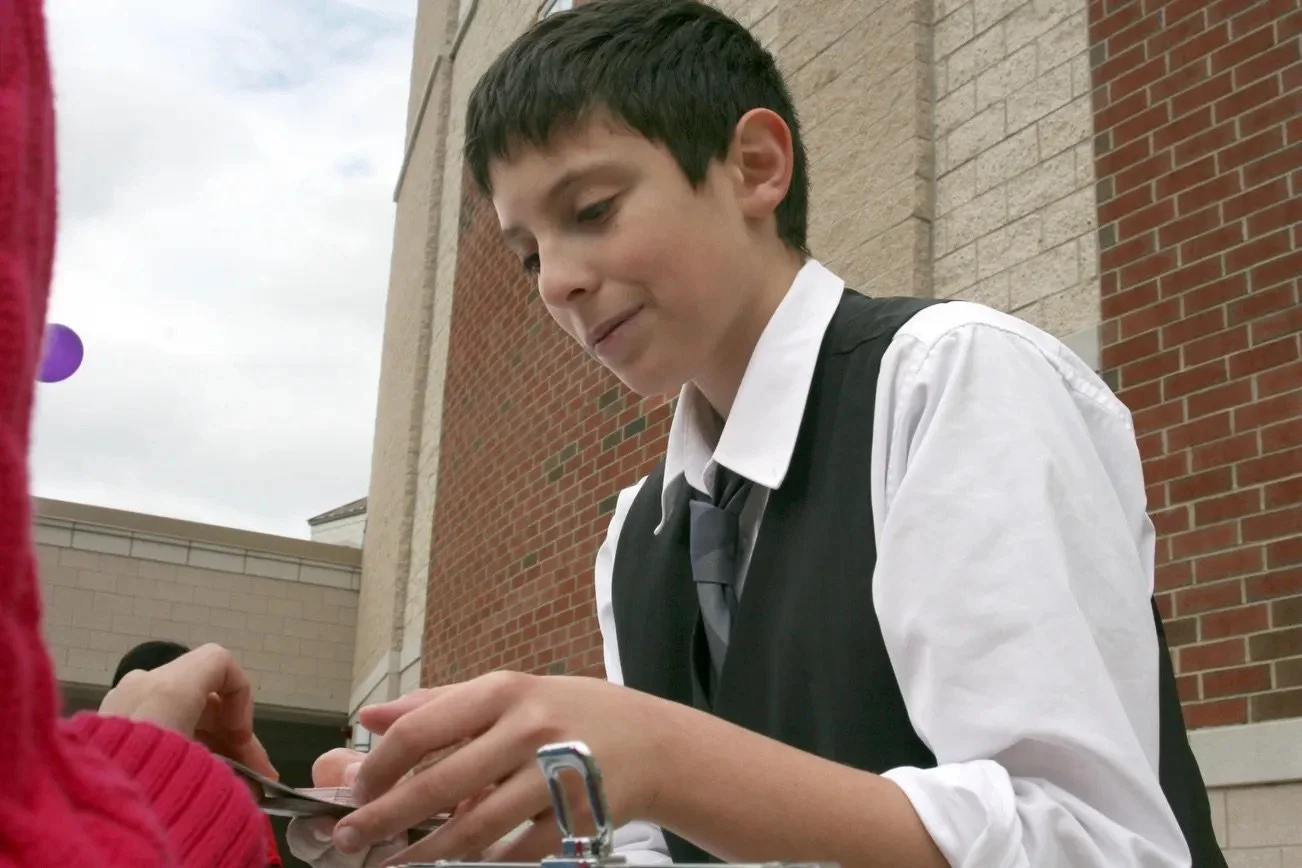
A young Jack Serio hard at work as a professional magician.
SERIO: I was working in a magic shop. I was performing at birthday parties, Bar Mitzvahs, and weddings. I was an actor who wasn’t particularly good, but was loud, which was sometimes half the battle in community theater. An anecdote my friends remind me of, which is pretty insane, was that I was given the keys to my community theater when I was around 13, and my parents would drop me off. I would let myself in and I would build the sets for the shows. I was using power tools, alone, unsupervised, in a community theater.
And then, shortly thereafter, started my own theater company in a vacant storefront in Hyde Park, Massachusetts.
WEILER: What was it called?
SERIO: The Boston Teen Acting Troupe.
WEILER: Amazing. What was your first production?
SERIO: The 39 Steps.
WEILER: Is that public domain?
SERIO: No, no. We got the rights. And we started the rehearsal process not knowing if we could get the rights. And I remember being so afraid that we would get shut down if we didn’t get the rights or that I would be arrested.
WEILER: Like they were going to give a cease and desist to a 13 year old.
SERIO: But I couldn’t be more excited about The Saviors. It feels like such a challenge, and one I’m so excited about, because if we can pull it off, I think it’ll be kind of extraordinary.
WEILER: I think so too. Okay, last thing. There’s a lot of hemming and hawing about all the challenges of making theater in America right now. I’m just wondering what gives you hope about the American theater?
SERIO: I think it gives me hope that there is a generation of young people taking theater producing into their own hands. That you see a generation of people imagining other ways that we could make theater in this environment, in this economy. In the same way that there was the regional theater movement and the Off-Broadway movement, and the way that we had to imagine things after the New Deal.
And most of us aren’t making very much money doing it, and yet we’re all still doing it, and that means we’re doing it because we’re passionate about it. And an ecosystem of theater making that’s built on passion is encouraging to me.
I just went to see Ivanov, by the New American Ensemble. Them, the success of Job, the success of the Good Apples Collective. Our friend Francesca Carpanini and Katie Birenboim self-producing Nina at Theaterlab. Adult Film. There are a countless number of people and organizations that are just making their own work on their own terms. And also people are going to it and loving it. Their work is being seen and celebrated. So that gives me hope.
WEILER: Yeah, me too. Let’s go to our first rehearsal.
SERIO: Let’s go.
WEILER: You ready?
SERIO: Yeah.
WEILER: Okay.
This interview has been edited and condensed.