

BAM and the National Theatre Are Betting on Each Other — and on “Hamlet”
A new partnership links Brooklyn and London, as both institutions look to stabilize, find new audiences, and expand the transatlantic pipeline.

Hiran Abeysekera stars as Hamlet in the National Theatre production currently running at BAM. Photo: Julieta Cervantes.
What happens when two theater powerhouses across the Atlantic join forces? Call it Bamlet.
As the National Theatre in London was announcing its first season under its new artistic director, Indhu Rubasingham, the Brooklyn Academy of Music, commonly known as BAM, was establishing a new president in Tamara McCaw after several years of rapid turnover. And as these two storied institutions experienced simultaneous leadership shifts, their teams looked at each other, shook hands, and decided to step into their new chapters in partnership.
“It just seemed absolutely the right thing to do to align institutions that are like-minded, share values, share enthusiasms, and are committed to great theater,” said BAM’s artistic director, Amy Cassello. The aim for both is stability, but also, more importantly, providing great art to its loyal audiences — and growing new ones. They announced a muti-year partnership that began this April with the transfer of the National Theatre’s production of Hamlet starring Hiran Abeysekera (Life of Pi) and directed by deputy artistic director Robert Hastie (Operation Mincemeat).
The relationship didn’t come about out of the blue: in 2023, Rubasingham directed the Zadie Smith adaptation The Wife of Willesden at BAM, and “we all hit it off,” said Cassello. Going back further, the National Theatre’s robust NT Live program — film screenings of the National Theatre’s live productions — once had a presence in BAM’s movie theaters, something they hope to revive with this partnership, said Elizabeth Moreau, BAM’s producer and chief programming operations officer.
Those were one-offs, whereas the new partnership is meant to provide years-long predictability for both institutions. In recent years, BAM’s financial struggles have led to layoffs, a decreased operating budget, and a lighter slate of productions, while the National Theatre operated at a £1.6 million deficit last season and saw a 6 percent drop in attendance. Broad community-building could be a lifeline. “When we announced the first year of programming by Indhu, our key strategic goal was to bring the National Theatre to the world and the world to the National Theatre,” said Kate Varah, National Theatre’s co-chief executive and executive director.
For BAM, it provides reliable, high-quality theatrical programming. “The National is a producing theater, and we’re primarily a presenting theater,” said Moreau. “A partnership that allows them to produce shows that we can present in Brooklyn made a lot of sense, and I know the National is also really interested in making their presence in New York and in the US more predictable.” Alongside the BAM partnership, the National Theatre is also transferring its production of Inter Alia to Broadway next season, as well as pursuing a “creative exchange with the Shed,” said Varah.
All of this speaks to the robust London to New York theater pipeline that has recently borne fruit on Broadway, with shows such as Operation Mincemeat, Giant, and Two Strangers (Carry a Cake Across New York), and Off-Broadway, including the acclaimed Andrew Scott one-man Vanya and, currently, the Olivier-winning Kenrex. This is not to mention the dozens of Off-Broadway presentations over the years, including frequent Donmar Warehouse shows at St. Ann’s Warehouse and the annual Brits Off Broadway season at 59E59 Theaters. Producing in London, by the way, costs significantly less, is heavily subsidized by the British government, and, in no small part, is a great way to generate word-of-mouth and audience enthusiasm before a show hops the pond.
Kicking off the exchange with Hamlet was a no-brainer for both institutions. BAM’s presence in Brooklyn dates back to 1861, and it presented Hamlet that year as one of its earliest theatrical endeavors. Though the National Theatre got its start a century later in 1963, its first production was Hamlet, too, directed by Laurence Olivier.
“What feels so notable about [Hastie’s] production is how contemporary and clear it feels. The company as a whole connects with communities and across generations.”
“It’s deeply fitting to bring Hamlet [to BAM] as our first production, a play with such profound and lasting legacy, especially here at the National Theatre,” said Varah. “Hamlet is so rooted in being part of the beginning of things [for both organizations],” said Moreau. But both teams were also quick to clarify that this isn’t “Laurence Olivier’s Hamlet,” as Cassello put it. “What feels so notable about [Hastie’s] production is how contemporary and clear it feels,” said Varah. “The company as a whole connects with communities and across generations.”
And the production indeed drew younger crowds. Varah shared that 23 percent of Hamlet’s audience in London was under 35, well above the national average. Moreau’s interpretation of why people showed up was a little more vibes-based: “There’s a kind of fresh irreverence to the whole production. I think you can do a very stodgy Hamlet easily, but this is a young people’s Hamlet.” Contemporary costuming and an emphasis on the dark humor within the text make it more accessible.
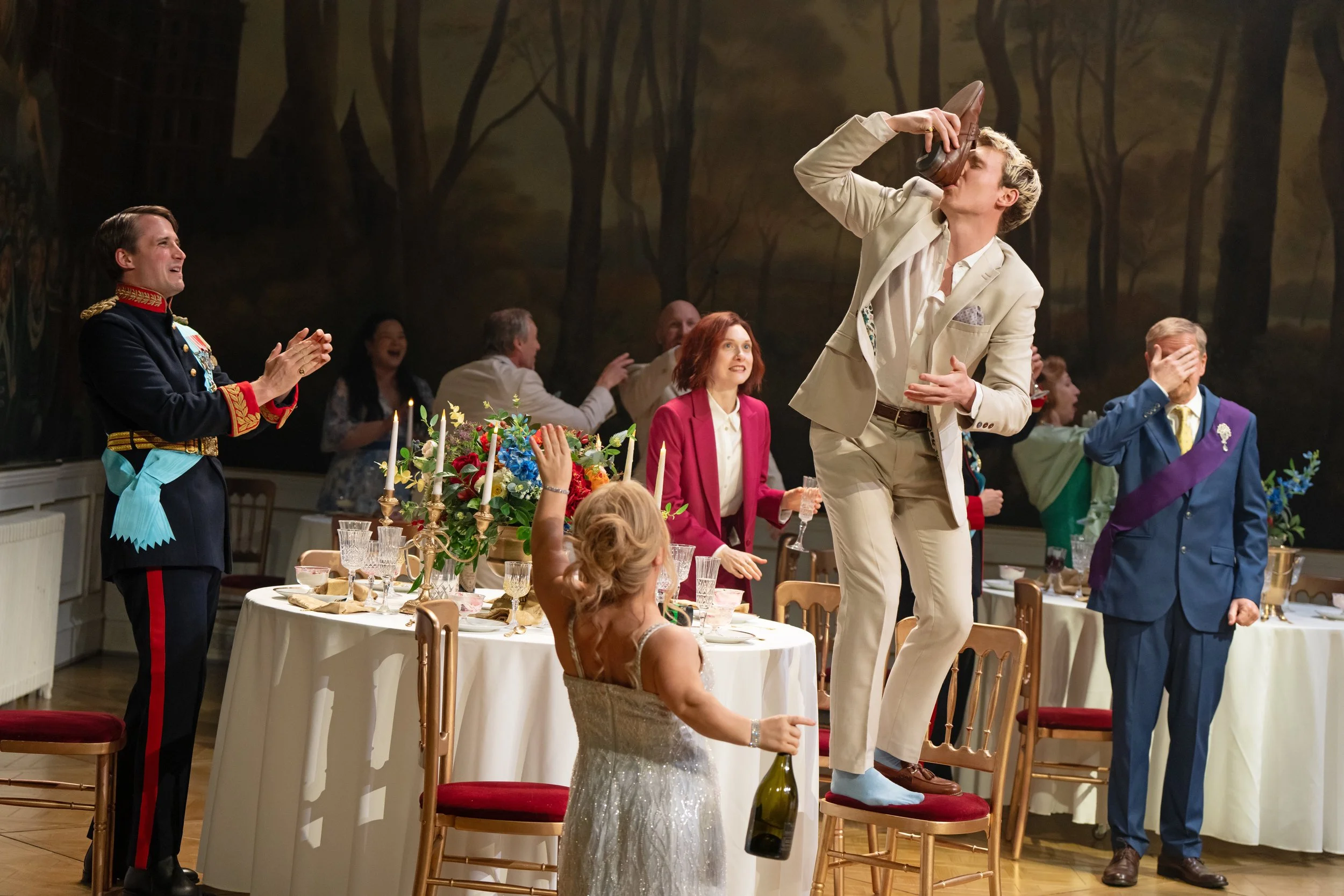
There’s a “fresh irreverence” to this production of Hamlet, says Kate Varah, National Theatre’s co-chief executive and executive director. Photo: Julieta Cervantes.
The emphasis on youth dovetails with the partnership’s commitment to education. Both institutions operate robust education programs in New York City public schools. The National Theatre provides subsidized tickets to its programming as well as free access to its National Theatre Collection, allowing schools to stream the theater’s productions in classrooms. BAM sends teaching artists into schools to teach about the shows they’re producing, then invites those students to a matinee performance of the show. “The School-Time matinee is one of those moments that always feels like a pinnacle of success,” said Moreau. “This is a group of people who many amongst them have never seen Hamlet before. Hopefully, some of those young people go on to become lifelong theater fans.”
Beyond the production itself and the education initiatives, the institutions’ archivists are engaging with the vast collection of materials maintained by the National and BAM. “We have this amazing BAM Hamm archive and the Levy digital archive, and the National also has a huge robust archive program,” said Moreau. “And so our archivists getting to work with other archivists is delightful.”
They’ve produced a timeline of Hamlet through the ages, which will be on display in the lobby of the Harvey Theater. “It’ll stay up long past Hamlet, just as a reminder that these things don’t just appear,” said Cassello. “You don’t want to always be looking back, but if you’re not grounded in what happened in the past, you make very bad choices about the future.”
And while the full size and scope of the BAM–National Theatre partnership is still emerging, Hamlet is only the beginning. Audiences can expect more productions, education initiatives, archival experiences, and NT Live screenings. Beyond that, Cassello said, “Part of the partnership is an openness to what will come.”