

What Theater Can Learn from Game Design
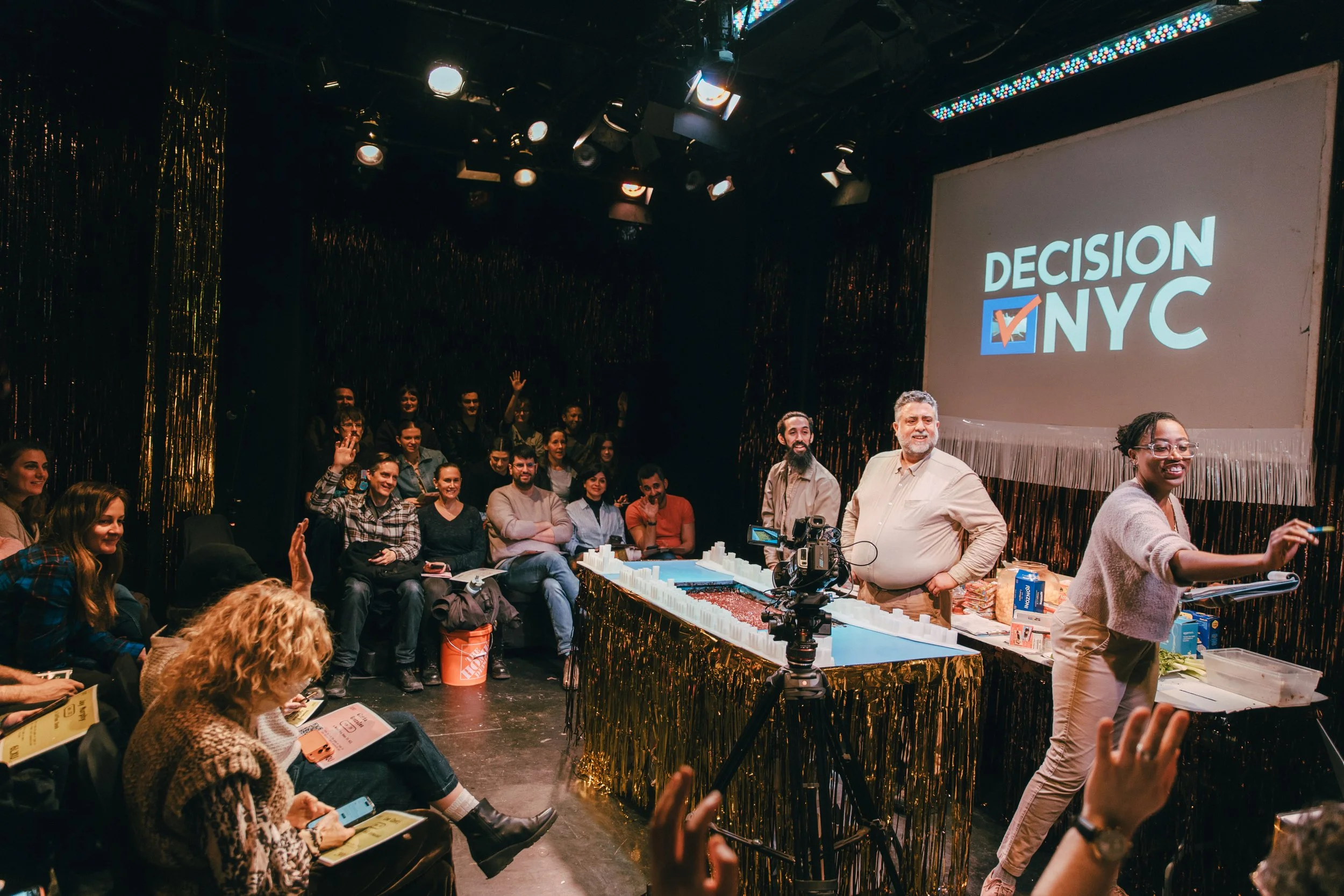
Sour Milk’s production of DIRT, which ran at the Tank in winter 2025, is an example of game theater, in which a city is constructed in a pool of chocolate pudding, with the audience members playing citizens who vote on what gets constructed. Photo: Myrah Sarwar.
Former theater kids are everywhere — but they might have an especially strong, if unexpected, presence in the world of game development. As someone who straddles the two industries, I am shocked how often I find myself milling about a conference full of technically minded game developers until I suddenly hit it off with someone, only to discover that they, too, have a life in theater.
This shouldn’t really be surprising: the video game industry has been the dominant entertainment market for decades, overtaking Hollywood by the mid-1990s and surpassing movies and music combined in the 2010s. Storytellers flock where stories are made (and funded). The skill sets demanded by game development and theater-making are interchangeable — each requires an ability for intense interdisciplinary collaboration, as well as scrappiness and resourcefulness.
But in those moments when I encounter someone else in my slice of this Venn diagram, I sense something beyond statistical likelihood or resume overlaps: we have been pulled toward extraordinarily powerful fictions. Makers of theater or games are driven by the desire to engage in a strongly embodied story, whether the embodiment takes place on stage by performers or by the game players themselves. By studying how game designers conceptualize player immersion and agency, theater-makers, especially those who strive to propagate political change through their work, can forge new relationships with their audience.
For instance, take what is arguably the most influential concept in game design: the magic circle. Coined by Johan Huizinga in his landmark book Homo Ludens and expanded upon by Katie Salen and Eric Zimmerman, the magic circle is the boundary between the gaming world and the surrounding “real” world. When the player steps over this boundary by beginning a game, they understand that the rules, norms, and behavior of the real world do not apply anymore. For example, on the dodgeball court, you are allowed to pelt other humans with balls; in a game of League of Legends, a question mark emote implies a dunk on a poor play; in a college dorm’s game of two truths and one lie, it is suddenly easier to reveal relatively intimate details about yourself. By altering what is acceptable, the magic circle alters your behavior.
As a game- and theater-maker, I understand the magic circle as an extension of a much older idea: the fourth wall. If the fourth wall is an epistemological border, one that allows the audience to believe in a different reality than their own, the magic circle draws a border of knowledge and behavior: not only can an audience member suspend disbelief about the fictionality of a world, but they can also participate in that world, equipped with a different kind of agency. The stage curtain or starting screen is a permission slip to discard what you understand to be true, and what you understand to be the limit of your agency.
A framework I have borrowed from the world of game design, which has been deeply impactful for my artmaking, is that deep playfulness and deep seriousness are not opposites, but are very closely related. This attitude was developed by Joost Vervoort, scholar of games, imagined futures, and politics.
It is common for people to think of works of theater as existing along a linear continuum: the slapstick comedy to the hefty drama, with a lump called dramedy in between. But Vervoort writes that the attitude of thinking about people or works of art on a linear spectrum from serious to playful is unhelpful: “this denies the richness that can be found when playfulness and seriousness are both understood to be ways into the depths of life, as represented by the bottom half of the circle in the image — and that on top of the circle, the middle point between the two is a sleepwalking zombie existence that is not much of anything at all.”
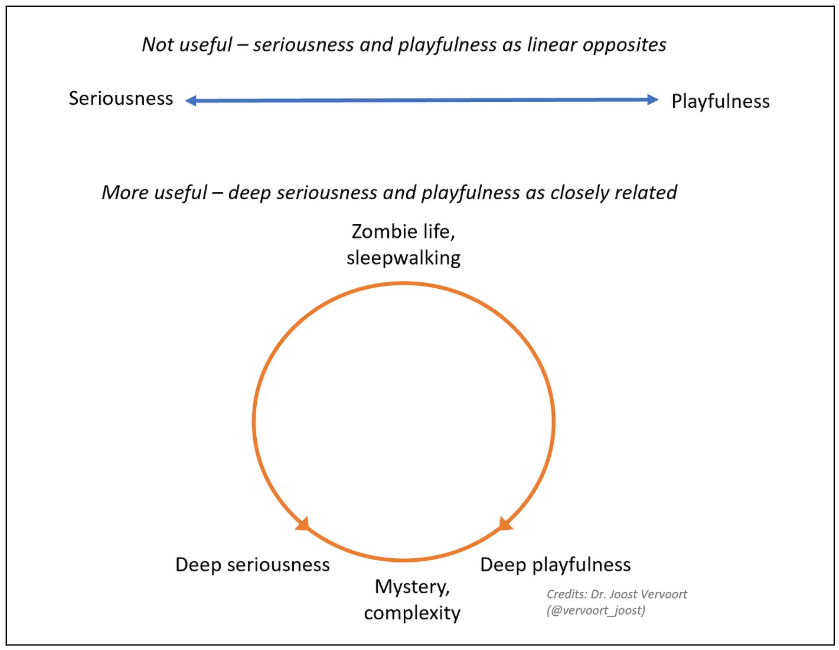
I find this diagram to be a paradigm shift when considering political theater. It insists that the playfulness or arresting entertainment provided by video games can be harnessed toward helping people access that place of “deep complexity.” This speaks to both the tone of playfulness — irreverence, joy, childlike wonder — and the mode of playfulness, which is a state of being in which you feel called to participate, to discover with others.
Political theater always involves an image of the world as is. Some of these works also evoke the world as it should be, and draw a meaningful relationship between these worlds. Perhaps playful political theater can help us reach further: it can allow audiences to practice imagining their own worlds as they should be, exercising agency beyond witnessing them. Political theater is at its most powerful when it unsettles perspectives. Games, by their interactive nature, are shaped to destabilize and mobilize, and game design can therefore serve as a useful tool for achieving this end.
What does theater look like when one can see and do it? One easy answer is audience participation, a technique going back to the origins of theater as ritualistic community engagement. A good contemporary example is Every Brilliant Thing, the Broadway play featuring Daniel Radcliffe, which recruits audience members to “perform” lines throughout the show. But while this is a highly engaging utilization of participation, it doesn’t allow audience members to meaningfully shape the direction of the work itself.
Game theater, which has been gaining more of a spotlight in recent years, distinguishes itself from traditional audience participation by using interactive elements as a genuine exercise of agency rather than purely toward experiential ends.
CirqueSaw, a production company exploring the intersection of art and technology, presented their browser-based remote performance Lab Rats at this year’s Game Developer’s Conference to a rapt audience, explaining their goal of engaging audience members in a completely immersive live experience in which they play as lab rats who escape a facility.
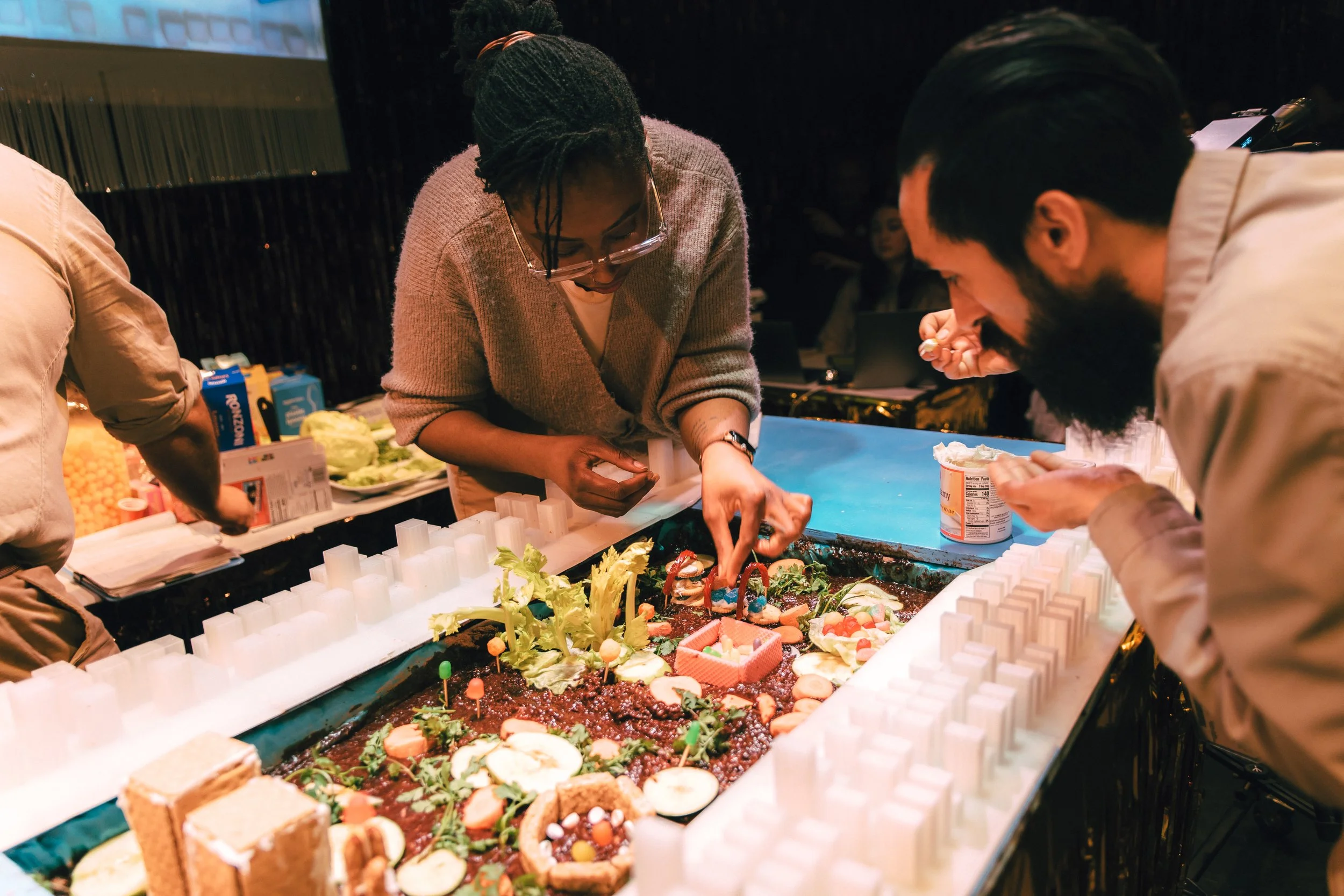
In DIRT, “biscuit apartments and marshmallow castles rise from the pudding in front of our very eyes.” Photo: Myrah Sarwar.
In Sour Milk’s production of DIRT at the Tank, a giant pool of chocolate pudding takes center stage, simulating a plot of land left behind after the mysterious vanishing of the East River. Audience members play as citizens with varying interests, voting for mayors and discussing real estate development. It is unmistakably a work of theater: the performers fluidly switch between humorous characters to facilitate the city’s development and the audience’s progression through the narrative.
But its identity as a game is equally clear: participants vote for what gets built, and the thing gets built — biscuit apartments and marshmallow castles rising from the pudding in front of our very eyes. In this sense, DIRT is a perfect embodiment of playfulness in both tone and mode, an experience that uses the magic circle to provoke audience members into fictional political participation. As I wrestled with a split-second decision between voting for building a clock tower, which my section of the audience had formed a voting bloc around, and a park, which seemed like a more sensible choice for my character’s backstory, I found myself in a place of mystery and complexity indeed.
Game design and theater-making already share an underdiscussed but robust vocabulary, as well as a yearning for transcendent, transformative experiences. Sour Milk’s performance poster credits the game designer right below the writer and director, and this seems natural, even obvious to me: that people interested in the question of world-building and imaginative futures should join hands.