


Claudia Logan, Breezy Leigh, and Nedra Snipes — and the pole — in Nia Akilah Robinson’s Push Party, directed by Chesray Dolpha. Photo: Travis Emery Hackett.
It’s a sightline issue for audiences, a staging dilemma for directors, and an iconic architectural feature: the infamous Theaterlab pole.
Smack-dab in the middle of the Midtown theater’s upstairs venue, the cylindrical white pole is unmissable. Obstacle or opportunity? Whatever it is, Theaterlab Artistic Director Orietta Crispino has one bit of advice for theater artists using the space: “The more you avoid it, the more you see it.”
Many directors have heeded this advice in recent productions. For Liba Vaynberg’s The Matriarchs, which traces decades of female friendship, Dina Vovsi staged the play in the round, with actors dashing around the pole. In Nia Akilah Robinson’s Push Party, which follows a baby shower, Chesray Dolpha had an actor twerk against the pole; and in Philip Ridley’s examination of tragedy, Tender Napalm, Rory McGregor staged a performer swinging around it during fantastical sequences.
Plenty of fun followed plenty of deliberating, as these directors and others shared in interviews with The Hat.
THE HAT: Describe the Theaterlab pole in five words or less.
Dina Vovsi (director of The Matriarchs): A sneaky pillar of opportunity.
Rory McGregor (director of Conway and Tender Napalm): A provocation.
Jack Serio (director of This Beautiful Future): Undeniable.
What did you know of the pole ahead of your production?
Katie Birenboim (director of Nina and The Lucky Ones): I had seen Jack Serio’s amazing production of This Beautiful Future [in 2022], so it was somewhere in the back of my brain.
Chesray Dolpha (director of Push Party): We did a walk-through of the space and that was when I met Champagne Pole-eesha. We were strangers at first, but my theater politics is about inclusion and equity. So I decided to make sure that our new friend, Champagne, felt included and at home with us, who were really in her space.
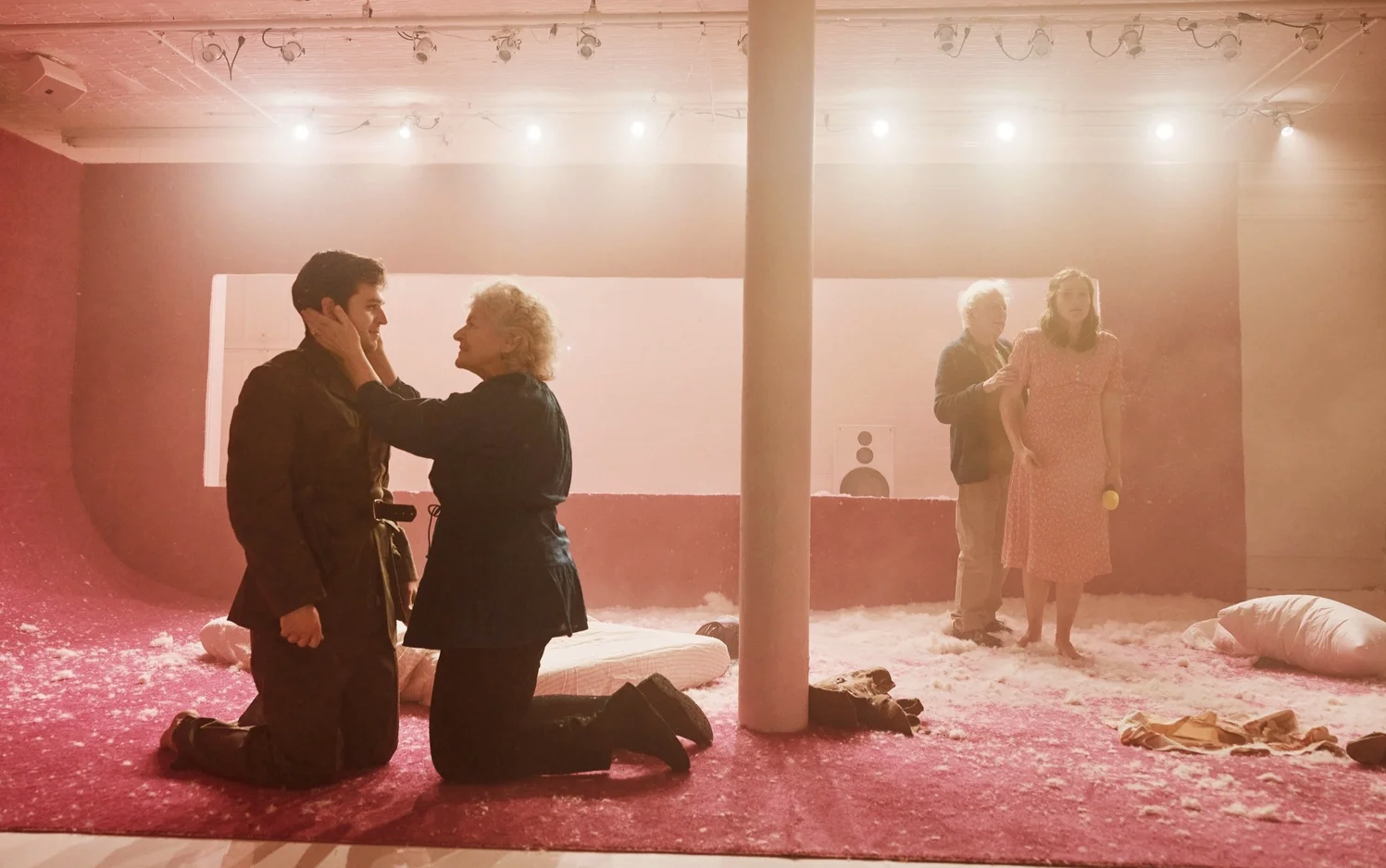
Justin Mark, Angelina Fiordellisi, Austin Pendleton, and Francesca Carpanini — and the pole — in Rita Kalnejais’s This Beautiful Future, directed by Jack Serio. Photo: Emilio Madrid.
What was your first thought about having to use the pole?
Serio: Orietta told me that it was productions that really embraced the pole that most succeeded. And she was absolutely right: those who try to hide it or arrange the room in such a way that ignores the pole really limit themselves.
Birenboim: With Nina, the positive is it took place in one room, in this dressing room, and dressing rooms are not always the most sensible spaces architecturally, so I was like, there would totally be a pole in the middle of a Juilliard dressing room.
Dolpha: It felt like the pole said to me, “I am here and I belong. What are you gonna do about that!?” To which my response was, “Thank you for being unapologetically yourself. I see you and I affirm you.”
Going into rehearsals, did you know how the pole would (or wouldn’t) be used?
Vovsi: We had done a staging workshop with the Hearth where I was able to explore the play in three different configurations and found it was so exciting for the audience to circle the actors as they circled this table. However, we didn’t know that Theaterlab was going to be our venue, so there was the question of whether that shape could still work in that space with the pole at center. From the workshop, I learned that the energy and motion of the play lent itself so beautifully to swirling around a central anchor, the way time moves in memory — it felt so dramaturgically connected.
McGregor: The sparseness of our design for Tender Napalm (two chairs, green carpet, LEDs) meant that The Pole was an integral part of my vision for the piece and was in my brain as soon as we picked the venue. I knew it needed intentional activation. [Actor Ben Ahlers] swung from it like the trunk of a tree, he climbed it to defeat a gargantuan sea serpent, he sank down on it as his partner threatened to castrate him. The Pole was a dreamscape, a pillar of possibility for play. And maybe also a nightmare. It’s also really quite wide.
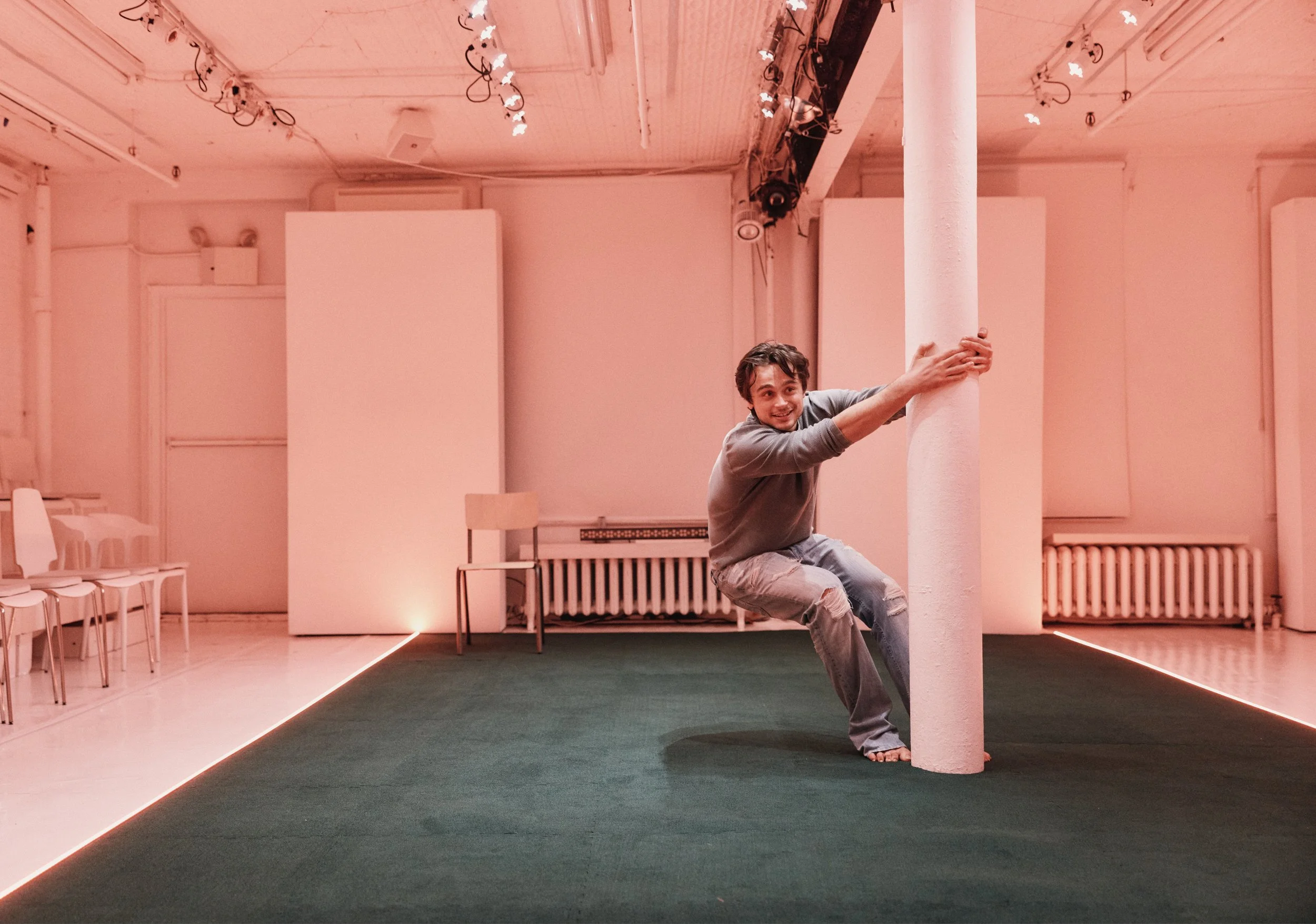
Ben Ahlers — and the pole — in Philip Ridley’s Tender Napalm, directed by Rory McGregor. Photo: Emilio Madrid.
What did the pole offer you as a director?
Dolpha: I ended up blocking moments around and with the pole. She brought us lots of joy and was truly an incredible ensemble member. Champagne reminded me about fluidity that is needed for theater to thrive.
Birenboim: One of the reasons I wanted to direct The Lucky Ones is because I had a lot of experience directing naturalistic plays [like Nina], and The Lucky Ones is a little more abstract, the world is changing and ever-shifting, and I wanted to stretch my muscles with that. That in some way makes the pole harder because it is easier, if you’re in one room, for the audience to accept there is a pole, and if you are changing locations and moving from a wine bar to a hospital, it’s a little harder to do. I think we created a design for a shifting, slightly more abstract world that still embraces the pole, but you also have to think about sightlines on a very practical level.
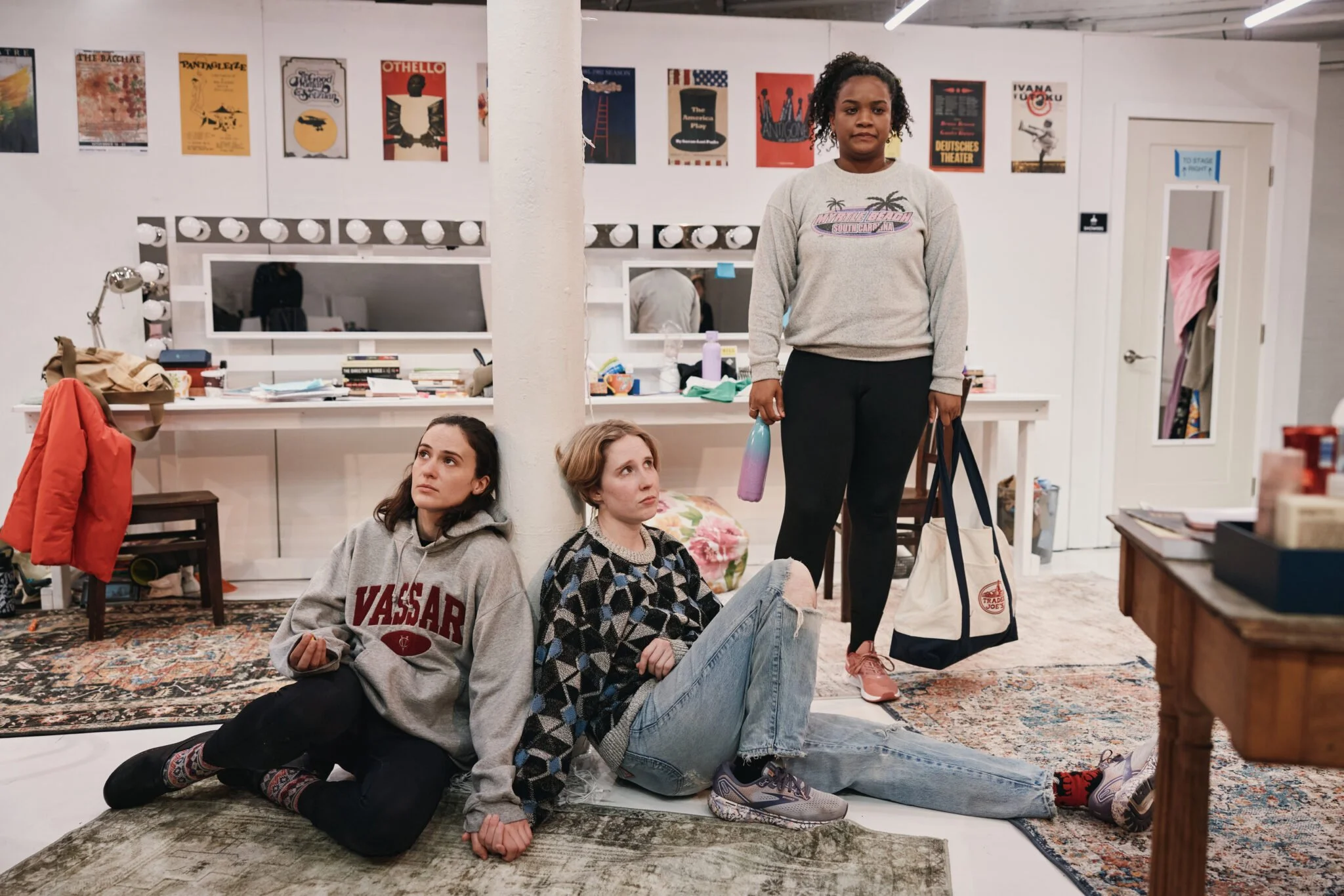
Francesca Carpanini, Nina Ross, and Jasminn Johnson — and the pole — in Forest Malloy’s Nina, directed by Katie Birenboim. Photo: Emilio Madrid.
Every venue has its metaphorical pole, some interesting design quirk. Is that an enjoyable part of problem solving?
Vovsi: I love constraints. I find them to be full of opportunities. Yes, it can be frustrating when you’re navigating them — lack of storage space, no crossover, limited entrances and exits — but more often than not, they challenge you to think creatively. Bring on the poles!
Serio: I’m most drawn to spaces that have unique or idiosyncratic architecture. The Theaterlab architecture became so integral to the design that when we transferred This Beautiful Future to Cherry Lane, we nearly replicated the pole. We decided against it, largely because sightlines at Cherry Lane work differently, but we ended up recreating Theaterlab’s iconic white brick and purchased replicas of their fluorescent lighting.
McGregor: Anne Bogart has this idea that I love called God’s Choreography, where she challenges directors to take 10 minutes out of their day once a week and imagine what’s unfolding in front of them has been directed by God. The slowness of the autumnal leaves dropping to the ground, the framing of two families in the background chatting with strollers, the light gust of wind and sounds of sirens, children whizzing by. None of these are mistakes, imagine that they were put there with purpose. Just like the pole.