

On Hiring: One Broadway Director’s View Beyond the Audition Room
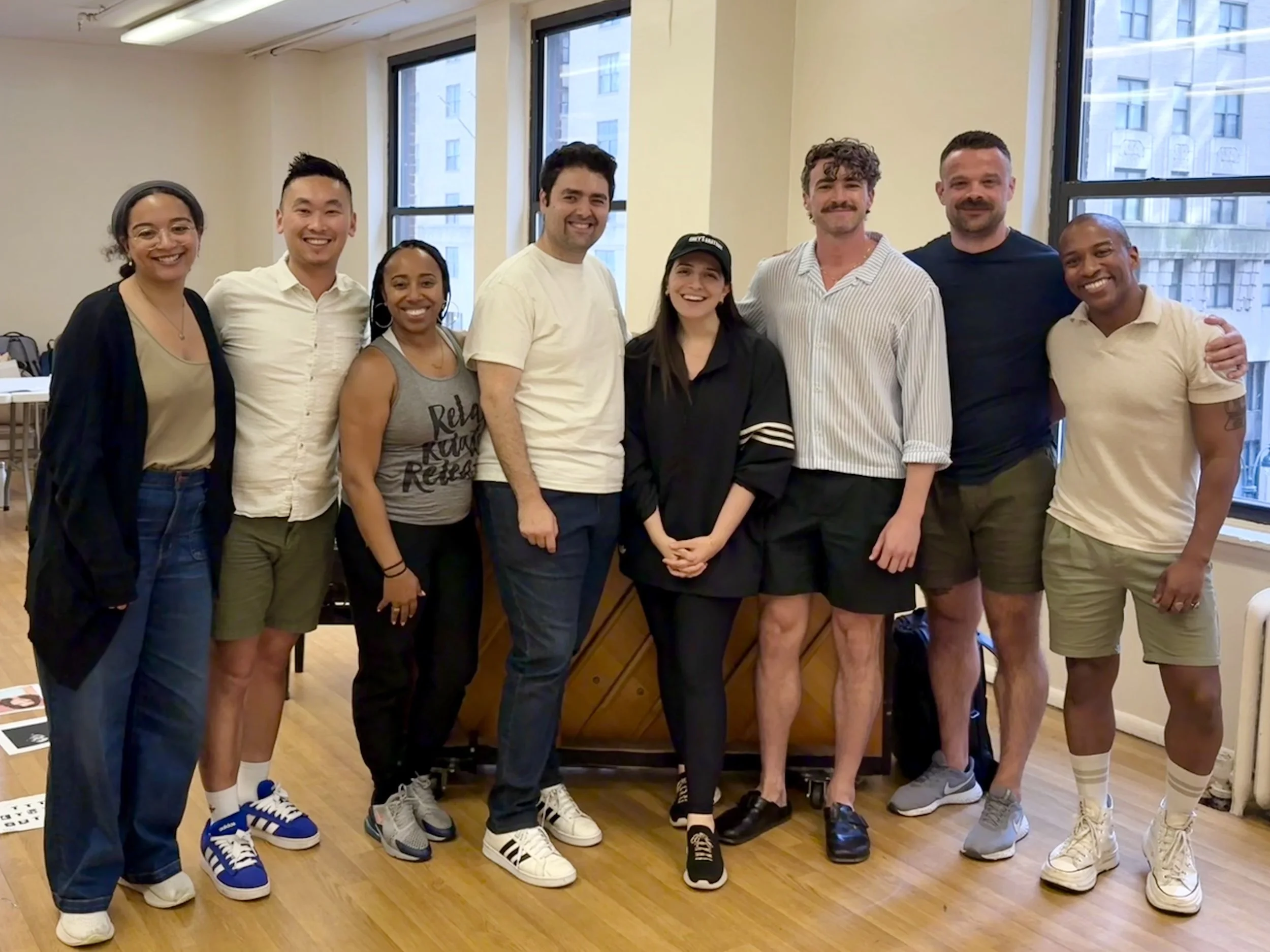
Sammi Cannold (center) and the creative and casting team of Zack Zadek’s new musical The Turning, which held in-room auditions last July. Photo courtesy of author.
One of the great privileges of being a director is having hiring power. And after a decade of working as a director in the arts, I’ve come to understand how heavy that privilege really is.
When I was invited to write a piece for The Hat and asked which topic I was interested in shedding light on from a director’s perspective, I didn’t hesitate: hiring. That’s because, when I sat down and did the math, I realized that in 2025, I was a decision-maker in roughly 239 hiring decisions, 166 of them involving actors. Those numbers humbled me and made me reckon with what hiring power actually means: who gets access, whose careers move forward, and how those of us in the “hot seat” might be more transparent in the future.
While it’s impossible to address all of that in one essay, I want to begin with transparency and provide a window into a few of the hiring processes I was involved in this past year. My hope is that one director’s experiences might be helpful as a case study to artists on the other side of the table. And though the numbers I cite above span film, TV, ceremonies, and multiple kinds of theater, I’ll focus primarily on hiring actors in musical theater, as that’s what I feel most qualified to speak about for now.
So, what does transparency actually look like? Let’s start with something surprisingly concrete: numbers. For actors envisioning a life working in musical theater, I think there’s an assumption that most hiring happens in audition rooms. My numbers tell a more complicated story. In 2025, I hired 58 actors for jobs in musical theater (spanning readings, workshops, concerts, and productions) and here’s how each actor was cast:
Eighteen actors (31 percent) were hired based on their work in an audition room.
Eight actors (14 percent) were “offer only” — meaning they were stars of a certain caliber who didn’t audition — and therefore, they were “star cast,” based on my own and my collaborators’ familiarity with their work.
Seventeen actors (29 percent) were artists I had previously worked with, and so, with the green light of my collaborators, they received direct offers.
Fifteen actors (26 percent) were cast through self-tape submissions for projects that either didn’t have an in-person audition process or because the actor wasn’t able to travel to the audition.
I’d personally like to shift these numbers toward more in-person interactions, but in the continued spirit of transparency, I’m going to focus on breaking down each of those hiring paths: how actors entered each lane, what moved the needle, and what mattered more or less than one might think.
In-Room Auditions
How did actors enter the lane?
Through casting director appointment invitations. In theater in 2025, I worked almost entirely with the brilliant Benton Whitley and Peter Dunn, who are exceptional at identifying actors who might be right for a given role.
Through agent, manager, or independent submissions that result in casting director appointment invitations.
Through open calls advertised on actor breakdown services and, in some cases, on social media.
Through creative team requests. Relatedly, I think it’s important to highlight the role that actor outreach can have when it comes to those requests, because some actors may not know that this route could be at their disposal. While it can be hard to find certain contact information and not all creatives respond to cold outreach, many do. Those requests do not always result in an actor getting an appointment — I’ll be honest about whether or not I feel the actor reaching out is a fit for the role — but in my opinion, it’s worth the try, especially when it allows an actor to express genuine enthusiasm for a project.
What moved the needle?
All things being equal, I find an actor’s confidence and assuredness can sell an audition.
What mattered more than folks might think?
References — I didn’t hire a single actor last year without first asking a colleague or colleagues for a reference or references; directors, casting directors, music directors, producers, choreographers, etc. talk among ourselves extensively.
Star Casting
How did actors enter the lane?
Through casting director, creative team, and agent/manager suggestions.
What moved the needle?
Most of the time, because there was already interest on our end, it came down to the star’s schedule.
What mattered more than folks might think?
Sometimes decision-makers may disagree significantly on who the right star for a production could be. For example, a colleague of mine recently worked at an institution that asked specifically for a Tony winner to be cast in a certain role. The institution was not interested in hiring anyone who might be a star for other reasons, because they wanted to market the show as “featuring a Tony winner.” Sometimes, directors have the ability to affect this criteria and sometimes they don’t.
Repeat Collaborations
How did actors enter the lane?
They did amazing work and were great to have in the room on previous projects. I personally keep a spreadsheet of every actor I’ve ever worked with and try to repeat happy collaborations when the opportunity presents itself.
What moved the needle?
Actors having an online presence in some form — either via a website (which can be cost prohibitive, so free alternatives can work just as well), a YouTube channel, Instagram samples, etc. It’s not enough for me to love an actor and want to hire them again unilaterally. My collaborators, who may not know the actor I’m suggesting, also need to sign off. So, when auditions aren’t budgeted for or a hire needs to be made quickly, being able to share current samples of an actor’s work is essential.
What mattered more than folks might think?
Actors having detailed information accessible on their websites and/or resumes is critical. This past year, I found myself frequently seeking actors with specific traits or skills — such as being a native Mandarin speaker, having SAG membership, or being trained in gymnastics. These are things the casting team or I might not otherwise know about an actor, but when that information is clearly discoverable online, it can put the actor into consideration. I’m often asked why directors and casting directors don’t simply reach out and ask actors directly if they have certain skills, traits, or qualifications. Sometimes we do, but often we can’t, either for legal reasons, confidentiality around a project, a project’s lack of a casting director who can liaise directly with representatives, concerns about raising expectations when personal outreach from a director might be viewed as an offer, etc.
Self-Tape Submissions
Whether self-tapes are ultimately good or bad for our industry and its artists is a much-debated topic (and one I’ll enter into at another time), but for now I’ll focus on the performers cast through this process.
How did actors enter the lane?
The route to self-tape submissions is essentially the same as the route to in-room auditions: artists find themselves asked to self-tape through casting director invitations, successful submissions, and creative team requests.
What moved the needle?
Humanity: This is such an elusive (and probably unfair) thing to say, but when I can feel an actor’s humanity and generosity of spirit coming across the interwebs in a self-tape, it makes me want to work with them more. Many of us directors struggle with the nonhuman aspects of self-tapes, just as actors do, and I often find myself trying to figure out if the person in the video is someone I’ll enjoy working with. When I sense passion, authenticity, kindness, generosity, or warmth, it really helps.
What mattered more or less than folks might think?
More: I think actors may not realize how much factors beyond their control matter in hiring. For example, someone could be the world’s best ensemble member on stage, but if who they are (in terms of age, vocal type, demeanor, etc.) doesn’t match up with a principal track they could understudy, there will likely only be a very small handful of tracks they can claim.
Less: I realize this may be a personal preference, but for me, self-tape background doesn’t matter. As long as I can see and hear the actor, I don’t give anyone “bonus points” for having a professional blue backdrop or “dock any points” for anyone filming on the beach while on vacation — we’re all human here.
***
If there’s a single takeaway I hope artists carry with them from all of this, it’s that hiring rarely hinges on a single moment. It’s not just about an audition, a self-tape, or a lucky break — it’s an accumulation of encounters, impressions, relationships, creative approaches, and trust built over time, often in rooms that don’t look like “the room” we envision.
I imagine that that reality can feel discouraging, especially when so many factors can affect access to those rooms. But that’s why transparency is so important. The more clearly we can articulate how decisions are actually made, the less actors are left to fill in the gaps with guesswork — and the more we can try to make our systems the best they can be. To that end, I greatly look forward to continuing the conversation.