

“The Bad Daters” Searches for Connection at Paradise Factory
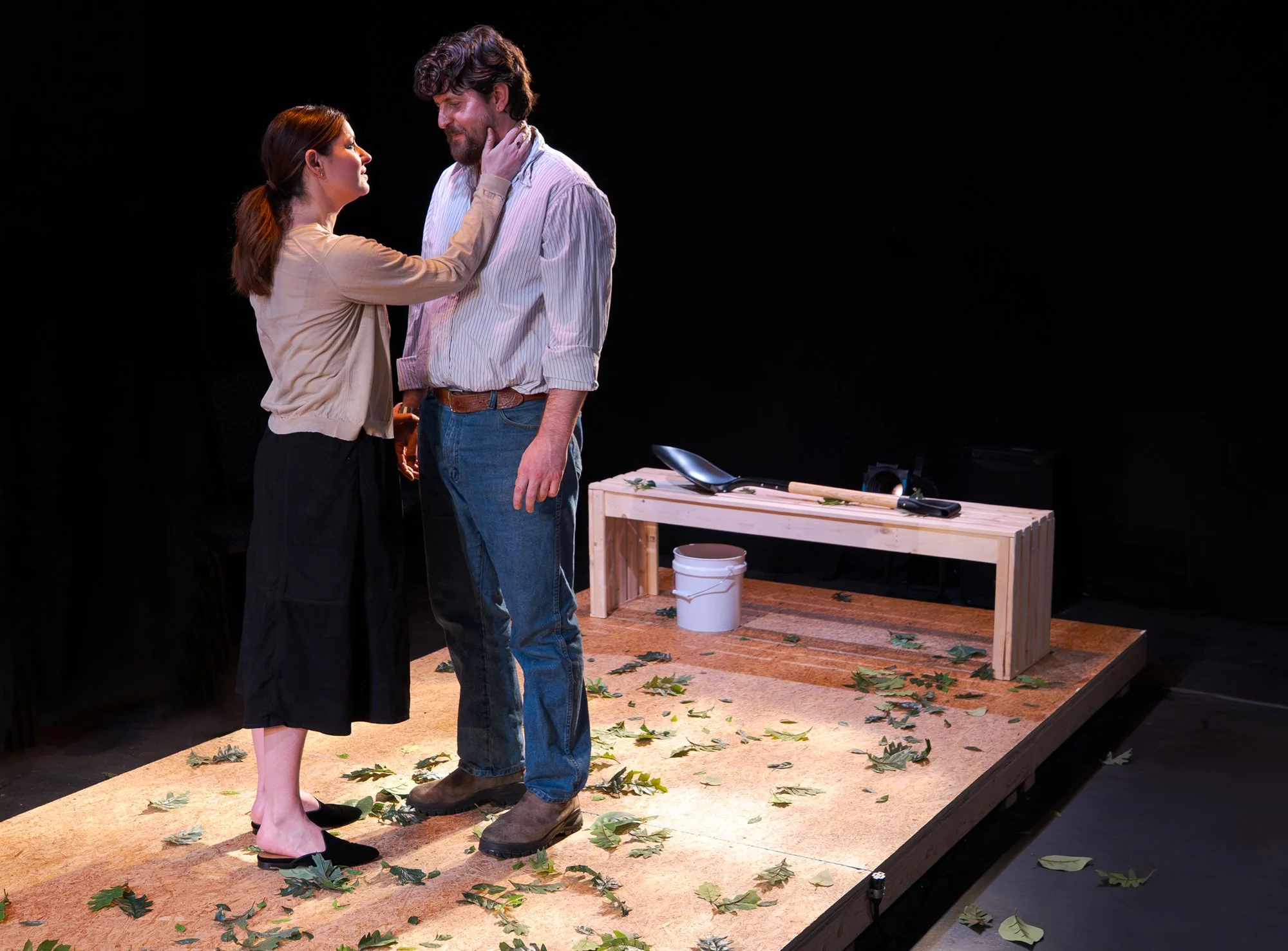
Kate Arrington and Shane McNaughton in the intimate two-hander The Bad Daters, written by Derek Murphy and directed by Colm Summers, at the Paradise Factory. Photo: Emma Kazaryan.
First dates rarely see us at our best. You’re torn between trying to make a good impression and sizing up your potential partner to see if they’re even worth that effort — all while keeping one hand on the pepper spray in your pocket.
Such is the case for Irish singles Wendy and Liam. When the two meet for their first date in the opening moments of The Bad Daters, they fumble through familiarly awkward exchanges, but it’s not long before things take a distinctly dark — and distinctly Irish — turn: When pressed for a fun fact about himself, Liam reveals that his wife killed herself. By the end of the scene, Wendy matches his confession, admitting that she feels responsible for the death of her mother.
Their origin story is far from a meet-cute, but it perfectly sets the tone for Derek Murphy’s dark comedy dressed as a rom-com. The play had previous runs in Edinburgh and Dublin, and now is making its US premiere at Paradise Factory, through May 17.
At the production’s helm is Colm Summers, a director with roots in both Ireland and America. The Bad Daters is set in Ireland, yes, but what makes the play quintessentially Irish is its blend of humor and tragedy.
Dark comedy, Summers says, is just as entwined with Ireland’s legacy as its postcolonial culture. The country’s take on the English language, Hiberno-English, is “kind of English backwards,” Summers reasons.
“In some ways that’s Irish people, too. Like, we’re people backwards,” he says. “We have a tendency to lead from humor where pain is just below the surface. And there’s an enormous tenacity in that, but there’s also enormous difficulty, because our very evasive talent for comedy also results in a difficulty of self-expression.”
Playwright Derek Murphy agrees that dark comedy is a signature export of his home country. “Guilt is probably one of our biggest industries in Ireland,” he says. “We’re born Catholic, we’re born into sin, we’re born as a result of sin. We grow up with this, and finally, if you’re smart enough, you cop on and you’re like, ‘That’s crazy,’ and you move on. But there’s a residue of it that is always with you, your entire life.”
“We have a tendency to lead from humor where pain is just below the surface.”
Murphy never set out to be a playwright. Rather, he fell into it “and never really got my balance back,” he jokes. The Bad Daters was born from a smaller plotline in a large-cast play of Murphy’s, where Liam and Wendy were just two of seven characters. Early audiences kept connecting with the duo’s story, so Murphy gave them the full-length treatment. He’s no stranger to awkward dates himself: He recalls one date ending in the emergency room and another culminating in a car chase.
But rather than adapting his misadventures into a run-of-the-mill rom-com, Murphy subverted the genre with a story about two people in mourning who also happen to be giving romance a chance.
“Any time I’m writing anything, I always start with tragedy and go out from there. It just makes it more real, and people are more inclined to connect with it,” he explains. Liam and Wendy “spend much of the play denying the fact that they’re grieving, and it’s through grief that they actually come to like each other, respect each other, and find the inner person in each other.”
The Bad Daters isn’t the only recent play to tackle themes of self-harm through the lens of humor, with the Daniel Radcliffe–led Every Brilliant Thing currently running on Broadway. Summers says that artists “have not always, I think, done well in terms of the dimensionality of characters who have an experience of suicide,” and he hopes the current theater landscape can change that.
“If I have a wish for audiences experiencing these two characters, it’s that folks who’ve maybe had resonant experiences are able to see a path to healing that isn’t peachy or blue-sky thinking,” Summer says, a path “that is as troubling and as difficult and tricky as the reality of that journey without sugarcoating it, but also in an accessible form, i.e. comedy.”
The Bad Daters features only two actors. In this production, that’s Irish actor Shane McNaughton as Liam and American actor Kate Arrington as Wendy. As the lone American in the rehearsal room, Arrington found herself surrounded by Irish culture on all sides.
Summers, Murphy, and McNaughton hail from different parts of Ireland and sport different dialects. With The Bad Daters set in Dublin, Arrington has had to master a Southern accent — no, not that kind of Southern accent, though Summers does mime playing a banjo in an early staging rehearsal when Arrington confuses the American South for the Irish South.
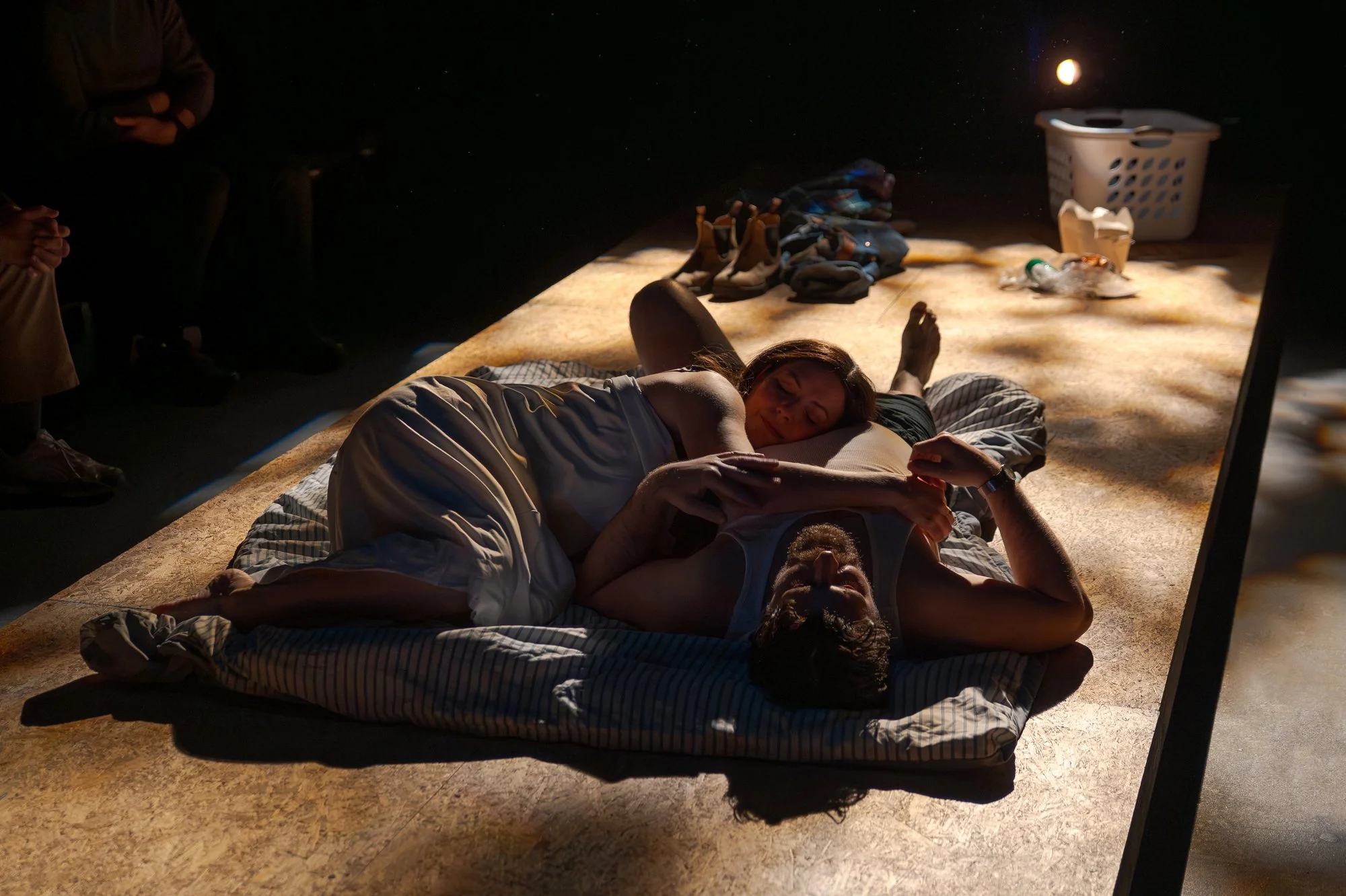
In The Bad Daters, Kate Arrington and Shane McNaughton portray Liam and Wendy, who “spend much of the play denying the fact that they’re grieving,” says playwright Derek Murphy. Photo: Emma Kazaryan.
“You’re getting more Irish by the minute,” Summers assures Arrington when she asks for clarification on her accent. “I’ll see you in your leprechaun hat next time.”
In February of this year, Paradise Factory’s founder Tom Noonan passed away, leaving a legacy as a playwright, director, actor, and all-around paragon of New York City’s downtown theater scene. Summers notes that Noonan’s most famous play, What Happened Was…, which was adapted into a 1994 film directed by and starring Noonan, is also about an unconventional first date. An Off-Broadway production of What Happened Was… is currently running at Audible’s Minetta Lane Theatre, starring Cecily Strong and Corey Stoll.
“It feels not accidental that on the occasion of his tragic passing, there are two plays honoring him, one of his own and one at the venue that he helped create,” Summers says, expressing gratitude at the chance to carry on the spirit of Noonan’s work in the theater he helped to build.
“I feel great about Paradise Factory. It’s a perfect setting for the play, and intimate in all the right ways, but also demanding of actors — and I love situations that demand everything of performers,” Summers adds.
Murphy hopes that for all The Bad Daters’ dark themes (and even darker humor), audiences are able to see some optimism sprinkled throughout its story.
“The grief doesn’t go away, the pain doesn’t go away, but there is hope there at the end of the play,” Murphy says. “You feel that you’ve gotten to know them and you want what’s best for them. So if an audience leaves feeling that, ‘Wow, I really hope they make it,’ the play’s job will be done.”