

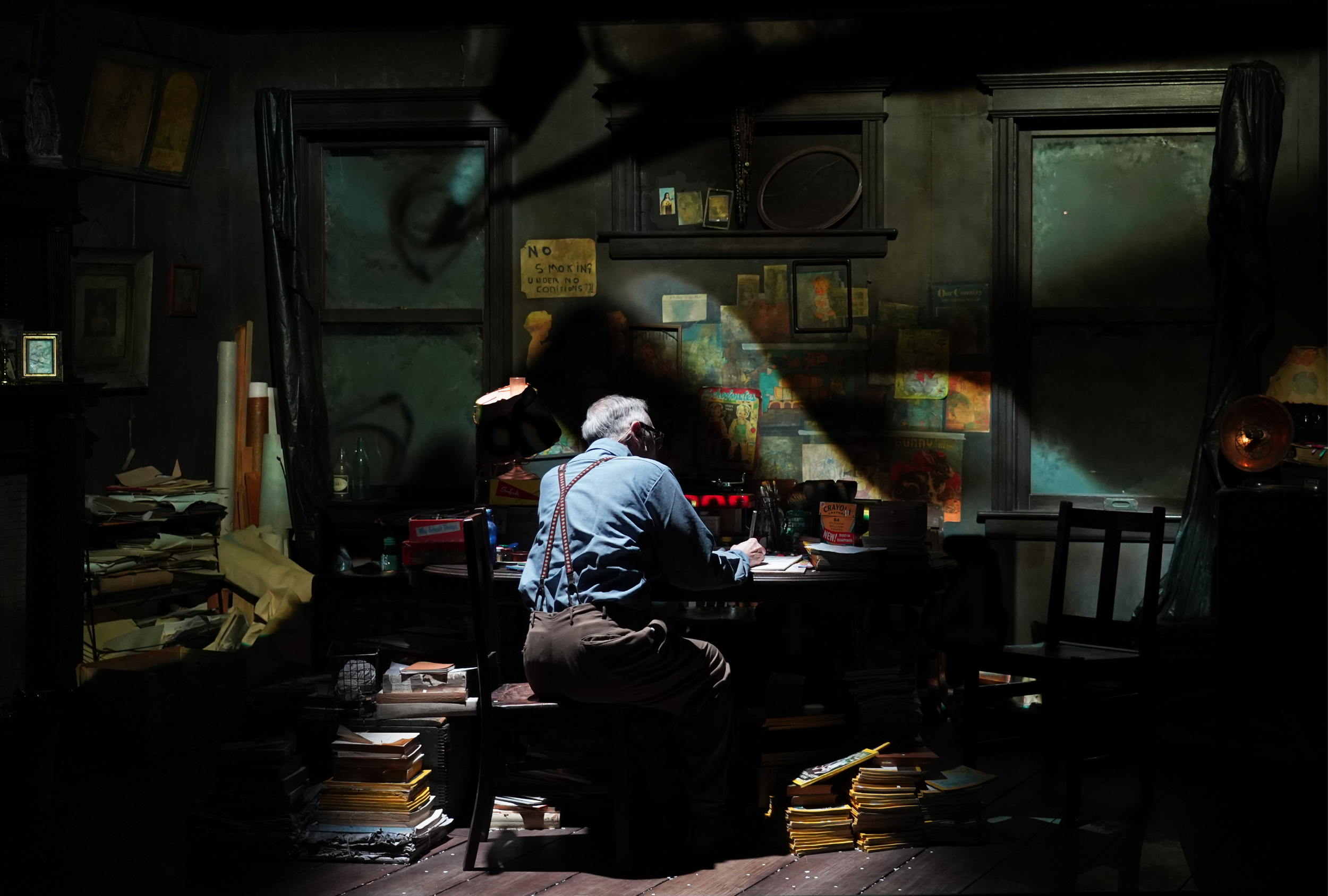
John Kelly as outsider artist Henry Darger, a reclusive janitor who secretly created hundreds of paintings and a 15,000-page book in his Chicago apartment. Photo: Carol Rosegg.
Who gets to be a successful artist? Often it’s only those with formal training, wealth, or inside access to the art world. For those without connections or resources, recognition can take decades, if it comes at all. Such is the case with Henry Darger, a reclusive janitor and self-taught “outsider” artist best known for the immense body of art and writings discovered after his death in 1973. Darger’s art is equal parts striking and unsettling, with a rich, detailed style occasionally employed to portray children in moments of peril.
He’s an odd, controversial figure in the art world, but a fascinating one, the kind of subject scholars and artists alike would be lucky to sink their teeth into. It’s thrilling, then, to see him realized onstage in Vineyard Theatre’s Bughouse, conceived and directed by Martha Clarke. Even more so because Darger is portrayed by one of New York’s most intriguing experimental artists, John Kelly.
Kelly didn’t set out to make theater. He comes from the worlds of dance, visual art, and avant-garde performance. Yet there’s an innate theatricality to all his work, and while his preferred medium is always shifting, two themes are consistent across his over 40-year career: a deep love for art and a desire to embody artists.
“I began life as a visual artist,” Kelly says, “and then I got hooked on ballet.” When he was 17, Kelly received a scholarship to the American Ballet Theatre, where he studied for six years. But starting as a teenager put him behind: “It was really too late for me to be a prince. So I abruptly abandoned that and went to art school.”
Studying at Parsons School of Design, Kelly developed an interest in Egon Schiele, the Austrian expressionist painter best known for self-portraits. Inspired, Kelly began experimenting in self-portraiture, primarily focusing on “self-scrutiny and investigation.” He realized that he had “gone from the mirror of the dance studio to the mirror of the self-portrait.”
Eventually, Kelly combined his interests in dance and visual art, performing at East Village nightlife staples of the 1980s like the Pyramid Club. His performances often consisted of Dadaist or punk-inspired drag, offering Kelly a way “to go back into performing without having to be utterly [himself].” Over his career, Kelly has created forty performance pieces, featuring a variety of characters that range from real figures, including Joni Mitchell and Caravaggio, to his own inventions, like Dagmar Onassis, a fictional daughter of Maria Callas.
“My work has generally wound up being through characters,” Kelly says, and “to some degree they’re all autobiographical.” When figuring out how to tell the story of an artist’s life, he tries to find key moments and “concoct the space between them, putting the lifeblood and soul into the piece.” Within this investigative process, he brings his own life experiences, and finds a “river of either catastrophe or possibility.” The artist seen onstage in Bughouse isn’t one of Kelly’s creations — the script is by Pulitzer Prize–winning playwright Beth Henley and features text pulled from Darger’s own writings, including lines from his 15,000-page epic. But his background makes him a good fit for the role.

During his research for the role, John Kelly says he developed “enormous compassion” for Darger. Photo: Carol Rosegg.
In fact, Martha Clarke reached out to Kelly directly to offer him the part. The two met in the mid-1980s, and first worked together when he joined the cast of her provocative dance-theater piece Miracolo d’Amore at the Public Theater in 1988. Clarke, too, is a multidisciplinary artist, often weaving dance and theater together into striking compositions. Like Kelly, she often finds her subjects in visual art, and is perhaps best known for her theatrical interpretation of Hieronymus Bosch’s triptych, The Garden of Earthly Delights. So it’s not surprising that while Kelly rarely works with collaborators or stars in shows written by other people, he says that he and Clarke are “cut from the same cloth.”
Kelly first had to figure out an entry point into Henry Darger. “This is an artist, and that I can understand,” he explains. Digging further into Darger’s history, Kelly realized that the artist “never had a break in his life, and his work was his one way of prevailing.” Though Darger is a complicated figure, Kelly says he “quickly developed enormous compassion for him.” He cites his own background as an outsider and a queer man as touchstones, referring to himself as a “long-term survivor.”
There’s a surreal quality to Bughouse, and to Kelly’s work within it. For nearly 70 minutes, he sits alone in a crowded, miniscule apartment (production design is by Neil Patel) whispering Darger’s words as though in a confessional. Darger’s art blossoms on the walls around him, courtesy of John Narun and Ruth Lingford, the show’s projection and animation designers. Taken together, Kelly’s performance and the design have the effect of a living museum installation. Kelly also notes that the physical language that he and Clarke have developed comes from a “cinematic reality,” and cites performers in silent films as inspiration for the way their interpretation of Darger walks and holds himself.
In Kelly’s words, he’s “not an entertainer.” He needs to “engage and communicate with audiences,” but his goal isn’t necessarily to please them. With Bughouse, he wants to peel back the sensationalist veil around Darger, so that audiences can “witness him as a human being.” He hopes that visual artists come to the theater, and conversely, that theater regulars find their way to visual art. And if there ever was an artist to guide those worlds and help them merge, John Kelly would be the one.