

Susannah Perkins and Celia Keenan-Bolger on Mothers, Death, and Dissolving the Self
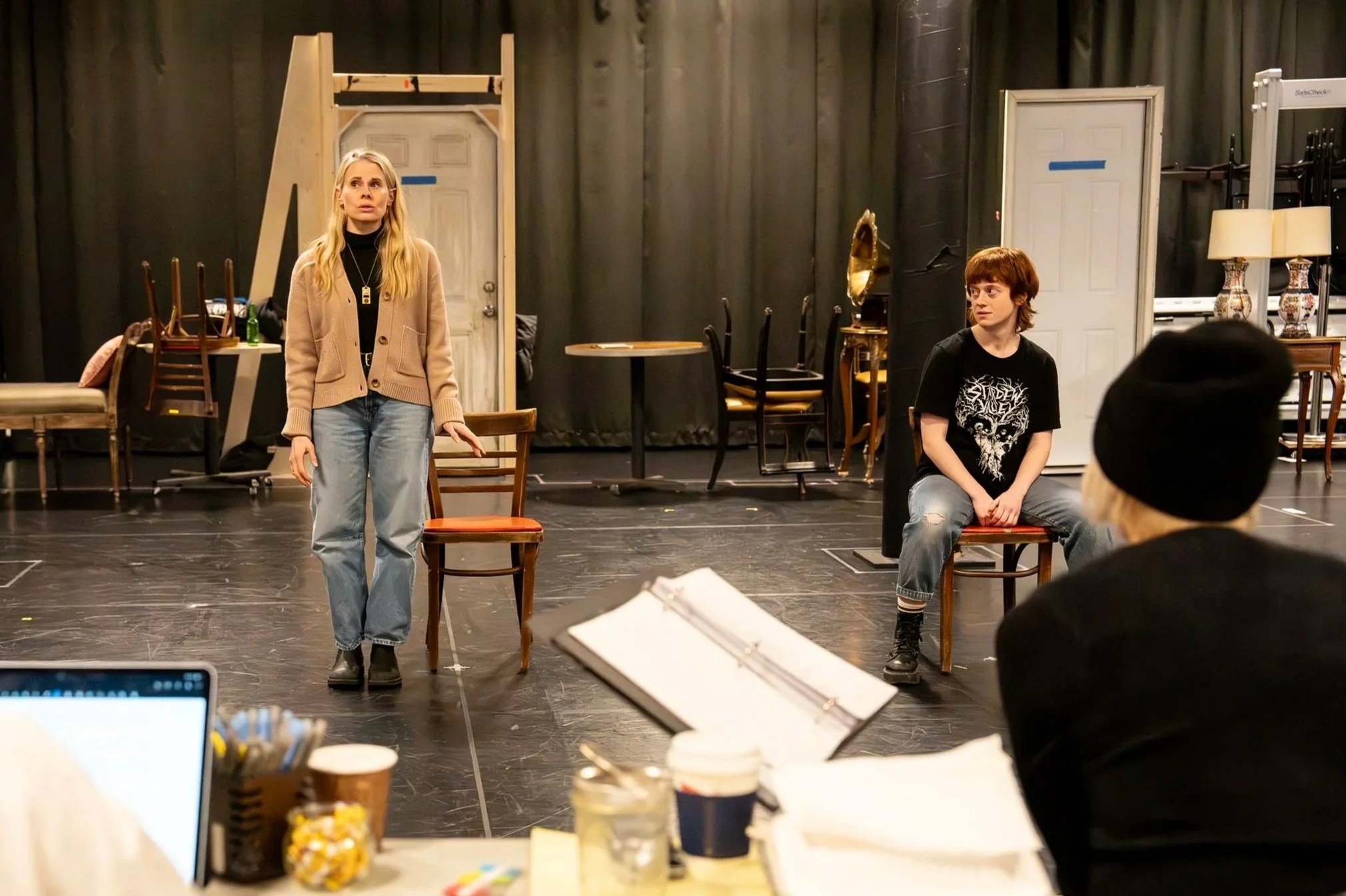
Celia Keenan-Bolger and Susannah Perkins in rehearsal for Antigone (This Play I Read in High School) by Anna Ziegler and directed by Tyne Rafaeli. Photo: Joan Marcus.
How do birth and death recalibrate ambition? How can an actor survive a long theatrical run? And where do people put their grief?
Susannah Perkins and Celia Keenan-Bolger want to talk about it all.
First, though, they really wanted to do a play together. Antigone (This Play I Read in High School) — Anna Ziegler’s radical reworking of the Greek tragedy — finally brings them to the same stage. Directed by Tyne Rafaeli and running at the Public Theater through March 29, the production reframes Antigone’s defiance through the lens of reproductive autonomy.
Not exactly the lightest topic, but neither actor has ever been afraid to get deep. Perkins, who interviewed Keenan-Bolger over their lunch break during Antigone rehearsals, begins with a joke, then their intimate conversation pivots into a wide-ranging meditation on acting, motherhood, spiritual longing, and dissolving the ego.
They laugh, cry, debate the moral implications of Instagram, and remind each other — and us — of the eternal nature of the people we love.
SUSANNAH PERKINS: Hi, Celia.
CELIA KEENAN-BOLGER: Hi, Susannah.
PERKINS: Here we are in the coldest room in 440 Lafayette. You’re eating a bowl of chicken noodle soup. Did you make that or...?
KEENAN-BOLGER: Sure didn’t.
PERKINS: Awesome.
KEENAN-BOLGER: Got it at Wegman’s.
PERKINS: So proud of you.
KEENAN-BOLGER: Where my face was taken into somewhere... they have like analytics ...
PERKINS: I didn’t know about that.
KEENAN-BOLGER: It’s not great.
PERKINS: I’m excited to experience that for myself. Welcome to the surveillance state. Speaking of which, you are playing the Chorus in Antigone, and the play begins with you reflecting on ways your character has felt haunted by Antigone the play and the person over the course of her life.
And I was thinking about your career and the many different women throughout history that you’ve played, and that I’ve had the pleasure to watch. Scout Finch [To Kill a Mockingbird] and Laura Wingfield [The Glass Menagerie] come to mind. And I’m curious if there are themes you’ve felt haunted by that have repeated for you over your lifetime as an actress, whether that be types of people that you’ve played or events that have shown up again and again in those fictional works over the arc of your career. I wonder if anything floats to the top of your mind?
KEENAN-BOLGER: I really love this question. The first thing that comes to mind, which actually just feels as much about my own personal life as it does about the characters I’ve played, is this theme of mothers. And the first show I ever did on Broadway I was a little girl whose mother lived in an ashram in India.
PERKINS: Oh wow.
KEENAN-BOLGER: And then Scout Finch does not have a mother. Laura Wingfield has a very aggressive mother. I played a mother in a Sarah Ruhl play called The Oldest Boy [at Lincoln Center] when I happened to be pregnant and was becoming a mother. I think this play very much has a lot of themes about motherhood inside of it. And I was just ... we’re about to go on a tiny detour.
PERKINS: I want it.
KEENAN-BOLGER: I was just listening to this interview with Michael Pollan and he was talking about consciousness. And after my mom died, people would ask me all the time, do you feel her? And I was like, I sure don’t.
PERKINS: Really?
KEENAN-BOLGER: Yeah. I was like, I just don’t. The place that I feel the closest to her is when I’m on stage. And my husband John was just telling me that they did a study on actors’ brains to see what happened to their brains as they were becoming other characters, and they thought what would happen would be like a creative part of the brain would fire, but instead what happened was that the sense of self diminished.
And I was like, well, of course. On stage, when you get to really be and flow, this sense of self dissolves. Of course it would make sense that my consciousness would maybe be able to commune with the consciousness of my mother who feels very, very far away, and I wonder if somehow I am seeking out slash attracting these roles in an effort to be in proximity to my mother.

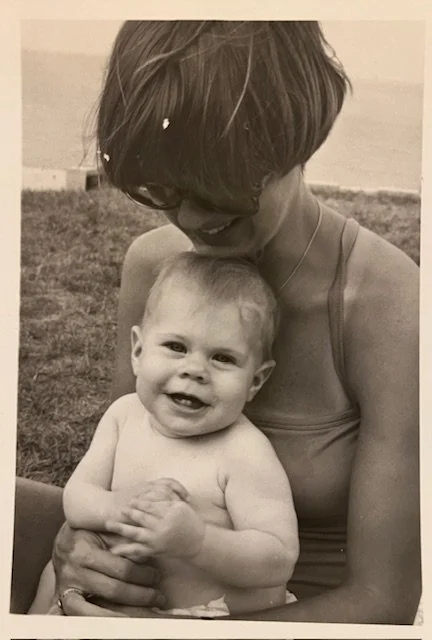
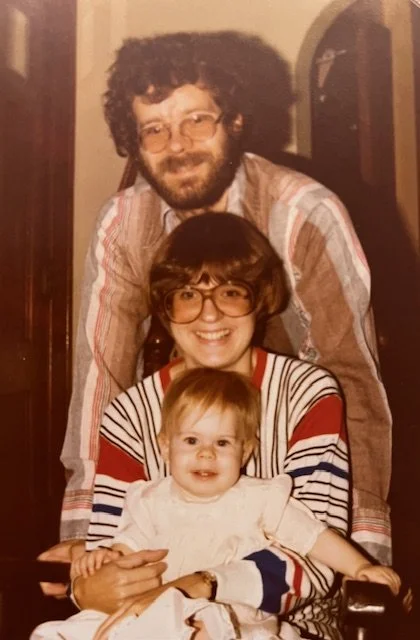
Snapshots of family life: Celia Keenan-Bolger’s mother, Susan Keenan; with a young Celia; and with Celia’s father Rory Bolger. Photos courtesy of Celia Keenan-Bolger.
PERKINS: When the play that you recently did called, in fact, Mother Play [by Paula Vogel], came across your desk, that must have felt a little on the nose.
KEENAN-BOLGER: Correct.
PERKINS: In such a prescient, almost psychic way, you answered one of the questions that I was going to ask but I think it works as a segue, too.
So I’m gonna maintain my question, which has to do with that mind-blowing bit of information you just revealed about the actor’s brain losing its sense of self on stage. In the past few years, you have spoken multiple times beautifully and publicly about a very literal disintegration of the self that is coming for us all and scares the shit out of a lot of people, which is death.
And our play, of course, is an adaptation of an ancient Greek play and has so much to do with mythic forces like death and the gods. And it makes me wonder about what your relationship is with the divine. Is that something that’s been present for you when you consider what it means to die or to lose someone? Does it have any place in your work as an actor? And of course, I’m also curious, as someone who has lost a parent recently, about your experience from beyond the veil, of feeling her or not. Because people do ask that a lot.
KEENAN-BOLGER: Mm-hmm.
PERKINS: And I had a lot of fears about that. When my mom died, in the few weeks afterwards, I did not feel her at all, and had a lot of fears about where she might be. And I think a Catholic upbringing puts a lot of cartoony images of hell and the devil in your mind. And I went through a brief period of intense paranoia that my mother, who was an angel, had been consigned to the fires of hell. And telling that to a good friend and hearing her laugh in my face about it was really, really useful. It is a big question, but I guess I’m just curious about Celia Keenan-Bolger and the Divine.
KEENAN-BOLGER: I also grew up Catholic and to this day, to walk into a church and smell the incense and see the stained glass evokes a kind of coziness in me that I’m able to separate from everything else that the Catholic Church says. When I have gone back and thought like, maybe I’m gonna revisit this, as soon as they open their mouths, I’m like, absolutely not.
I’m so interested in the Buddhists and there is something about Buddhism that feels a little bit sterile to me, that is about emptying out, about non-attachment. When I think about the divine, I think about the coziness that I feel in this sacred place that I went to for many Sundays. My dad played the organ and so I didn't have to sit at church. I would be in the choir loft and I would just like crawl on the floor through the pews and be in my own, entirely made up world, not really engaged with what was being said.
But my relationship with the divine, or even my acknowledgment of or understanding that there might be something bigger, is somewhat new to me. My best friend, who I went to college with and lived with for four years after I graduated from college, was extremely spiritual. He also grew up religious, was gay, had such trauma from the church, but had somehow managed to build a spiritual scaffolding. I would watch him talk about God or talk about the divine in a way that I was like, what must that be like to feel all that, to move with that? And then he died at the end of 2024. And there’s this quote that Andrea Gibson has where they say that they know that the best part of themself will be reincarnated in the people that they love.
And I feel like I totally have this new spiritual scaffolding that was transferred to me as Gavin [Creel] was dying, and that as he was dying, I became very interested in what it meant to try to communicate with him beyond. As he was dying, I was like, okay, I’m gonna try to turn that radio dial to a different channel while you’re still here and see if I can’t reach you. And there was something about doing it and then feeling this profound connection to him in death, that has opened up so much for me. Like the real theater nerd that I am, I always return to that line in Our Town. He’s like, “There’s something in all of us that’s eternal.” That to me feels absolutely true. And do I understand it? If I start to question it too much, does it all fall apart? Yes. And also I feel it around me and beyond me in a way that honestly I would say in the last year and a half is the most I’ve ever felt it in my life.
PERKINS: Oh, wow. Thank you for saying that. And for the record, like two actors in a room, we are both crying. I just wanna have that down in the transcription for The Hat. That is so beautiful and so huge and beyond our abilities to understand, which makes me think of something that the 12th-century Rabbi Maimonides said, which has to do with his conception of the Jewish idea of heaven or the afterlife, is that it is possible that it is so wonderful that it is beyond our capacity in our human bodies and minds to understand what it might be, which is something that I’ve found comfort in and that what you’re saying makes me think about.
To completely change gears, the first time I met you, it was about 10 years ago at a beer garden in Brooklyn, and your son William had just been born. I don’t have kids, but am lucky to know so many actor parents and artist parents. And I’m curious how creating a person changes or does not change your relationship with making art?
KEENAN-BOLGER: I think it is still evolving. I remember hearing an interview with Ellen Burstyn talking about motherhood, and she said, you know, they give you a baby. You have that baby, they put it on you, and they’re like, and now you're a mother. And she said, I’m slow in my life to grow into things. And I was slow to grow into being a mother.
I found that so comforting because I think the main reason I wanted to have a baby had to do with making my world bigger. I think for myself, it felt easy for the ambition and the moving the goalpost and wanting more and things never being enough, that I wondered if a child would give some perspective to my career and my relationship to being an actor, which let me just say, being an actor is my favorite thing in my whole life, although now I would say being a mother is pretty close.
But I did not feel that at the beginning. And so many people said to me when I was pregnant, like, oh my God, it’s gonna be so amazing when you have this baby because you just won’t care anymore. You won’t get caught up in all of that nonsense. And it just really helps you prioritize what is important.
And I will tell you that was absolutely not my experience. That I still wanted all the jobs, that I sometimes felt so sad that I couldn’t be acting all the time because I was taking care of a baby and that made me feel like a very particular kind of monster.
When my son was 18 months old, I was a part of a production that was a total shit show. And most of the people in the cast were in a real state of despair. And that was the first time that I was ever like, Guys, I’m just so happy to be here. It’s gonna be fun. It’s like a mess. It’s not good. And we still get to do it. And that is a marked difference than how I would’ve felt before having a child. Somehow the thing that I had been hoping for, my world getting bigger, was possible.
I struggled so much for many years in early motherhood, and then around the time my son was six, like Ellen Burstyn said, I grew into it. I don’t really think it was about him, I think it was about me. He has always been this pure embodiment of goodness and newness and wonder. And it was all just like lost on me. I think because I really missed my mom, because I had some postpartum depression, because I really wanted to be acting. There was just a lot to try to sort through. And now I think my work for the next 10 years is to try to integrate these two selves, the self that is trying to birth creativity and that is trying to nurture a small person. I think there is this similarity where the Venn diagram overlaps, which is you are trying to meet the piece or the person where they are and not impose all of your needs and stuff onto it, and also make sure that you are interrogating it and living it to the deepest degree possible. But I think I’m still very early in that process of trying to merge the two selves, the mother self and the actor self.
PERKINS: It occurs to me that compared to many children that I know, William is very lucky to have a mother who is so thoughtful about the selves that she is meeting him with.
Birth and death are such huge perspective shifts. Before my mom died, when I felt like a play was bad, I would sit on the subway on my way home thinking maybe this isn’t worth it. And by this, I actually mean life. It was so huge to feel like I had failed or had a bad show. And I won’t say that feeling is gone from my body now, but I feel really lucky to be here in a way I’m not sure I did before she passed. And to be clear, to have it on record for any higher power that’s listening, I’d trade it for my mom.
KEENAN-BOLGER: One hundred percent.
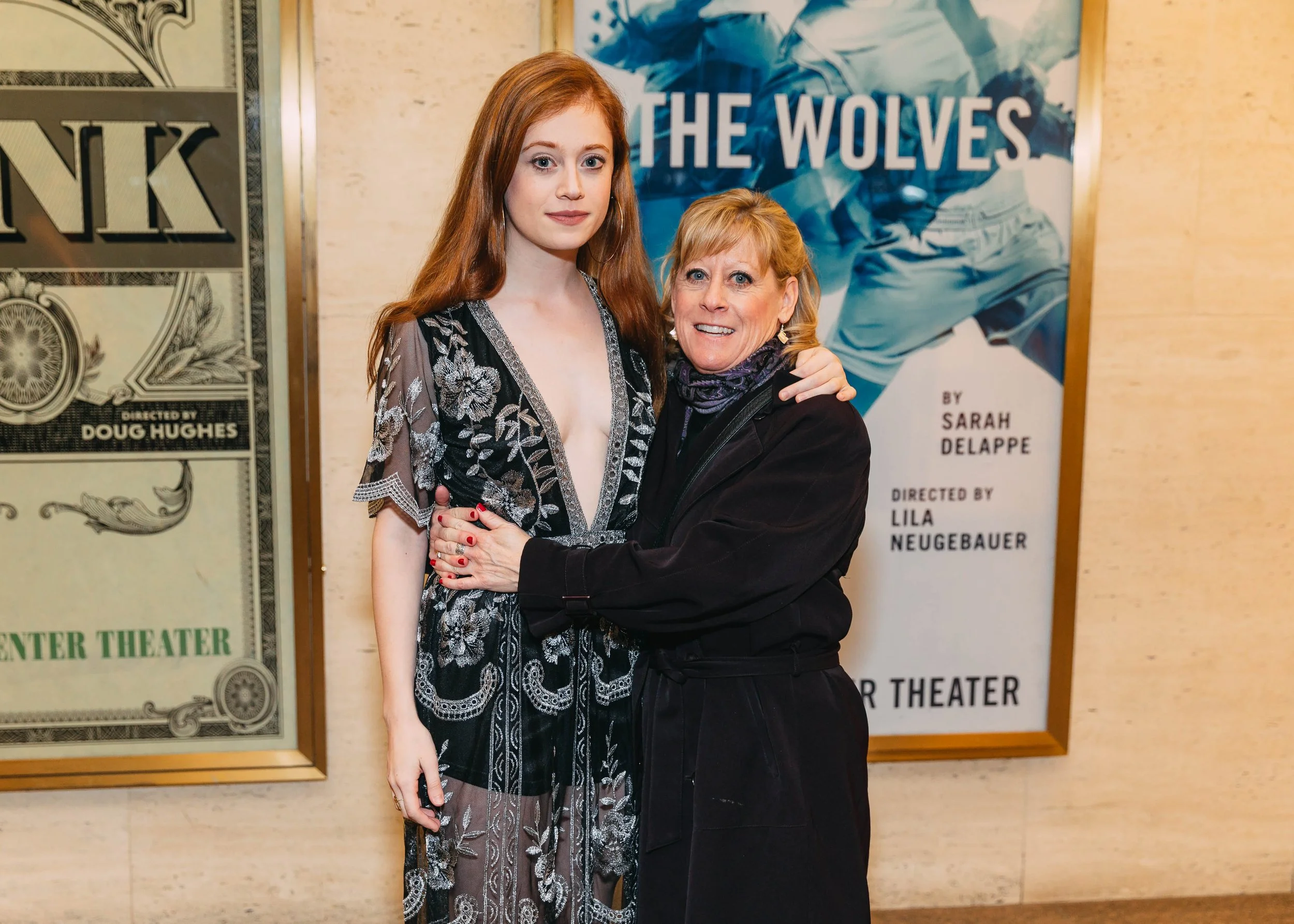
Susannah Perkins and their mother Leanne Perkins at the premiere of Sarah DeLappe’s The Wolves at Lincoln Center Theater’s Mitzi E. Newhouse Theater on November 20, 2017. Photo courtesy of Susannah Perkins.
PERKINS: But the feeling I’m definitely grateful for. Our play feels very lucky to me in this moment. I feel very lucky to be in it in this moment for so many reasons. But one of the primary reasons is that it has so much to do with what it has meant to be a woman over the course of human history and what it has meant to be a mother and what it has meant to have or have had mothers. And I was wondering if, for the record, you could say your mom’s name.
KEENAN-BOLGER: Susan Keenan.
PERKINS: Susan Keenan.
KEENAN-BOLGER: What was your mom’s name?
PERKINS: Leanne Perkins. Leanne and Susan. Do you have an object in your house that makes you think of her particularly, or anything left of hers that comes to the front of your mind?
KEENAN-BOLGER: There was so much of her stuff that I was like, you know, we live in New York City, I can’t take all this.
PERKINS: These apartments are small.
KEENAN-BOLGER: Correct.
PERKINS: A reason that I thought maybe I can’t have kids in the future is because I did have to get rid of a bunch of my baby clothes, and the idea of having a kid that doesn’t get to wear the, can I just say, gorgeous clothing that my mother dressed me in when I was a child is almost too much to bear.
KEENAN-BOLGER: You were just a tiny Alaskan baby.
PERKINS: Oh, I looked amazing.
KEENAN-BOLGER: I know you did.
PERKINS: Leanne had drip in a pretty profound way. But please continue, I interrupted you.
KEENAN-BOLGER: I remember when my mom was pretty sick a friend brought over this little dish that had some rocks on it that had different sayings that were just like “love” and “support,” which did not really seem like her jam.
And she loved it so much and I was like, this is so interesting. We didn’t have a lot of tchotchkes in our house and it felt tchotchke adjacent, but also very beautiful. And I have that little dish. I don’t have the rocks. I don’t know where they went. But I have that dish now where I have started to make a little altar.
PERKINS: Awesome.
KEENAN-BOLGER: My son is extremely into gems. We go to the Natural History Museum. He always wants to go to the gem room and then go to the gift shop. And so we have these gems, but I also have started to make a little ofrenda, where you just have pictures of people who have died and little meaningful objects, but like the whole foundation is this little dish that my mom had. It’s like she’s there sort of holding all of it in that way, but also it’s close to my bed, and I just try to kind of check in with it. But that again is pretty new.
PERKINS: I wonder with that and this idea of collecting things from our dead people, if you feel, and these are early days, so no pressure to answer if the answer is in the negative, if there’s anything of your mom that has made its way into our play yet? The answer might be no.
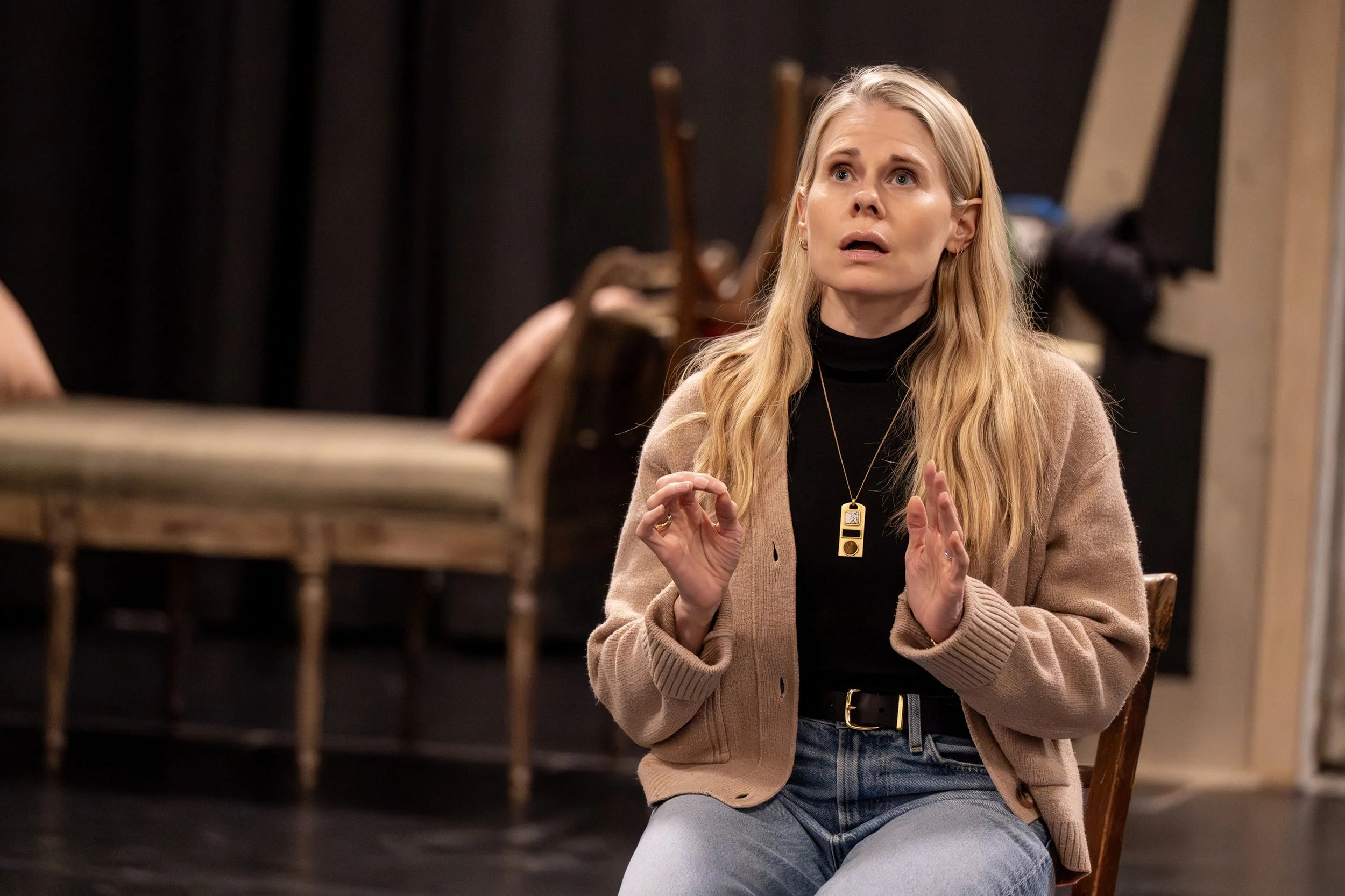
Celia Keenan-Bolger plays the Chorus in Antigone (This Play I Read in High School). Photo: Joan Marcus.
KEENAN-BOLGER: I don’t wanna say too much to ruin us.
PERKINS: No spoilers.
KEENAN-BOLGER: But I have always wanted to do a play with you...
PERKINS: Celia.
KEENAN-BOLGER: It’s just the truth. You know it and I know it.
PERKINS: Alright.
KEENAN-BOLGER: And that you lost your mom.
PERKINS: Yeah.
KEENAN-BOLGER: And that we are doing this play together. I am just like, she’s already here. I just feel like we are exactly where we’re supposed to be right now. And that wherever or however that works, that energy, Leanne and Susan, are just gonna be like bouncing around. And I feel like we’re gonna catch their tails or their jolts throughout this process. And if we don't, then you can come back and do an amendment of this interview. But I think there are times in this rehearsal where I’m so overcome and I’m like, you have to get yourself together. And I’m like, what is that? What is working through you? That feels less tangible but it feels like presence in some sort of mysterious way.
PERKINS: I know what you mean. And there’s a temptation not to want to talk too much about it — or not a temptation, but I feel my superstition sort of creeping in. Max von Sydow gave this interview where he was asked about his work with the filmmaker Ingmar Bergman, who had passed away. They were very, very close. And he said that Ingmar was going to send him a sign from the other side to let him know if there was an afterlife. And then many years later Max von Sydow was asked by another interviewer if he had been sent a sign and he said, yes, but I’m not going to tell you about it, which makes me think of this now.
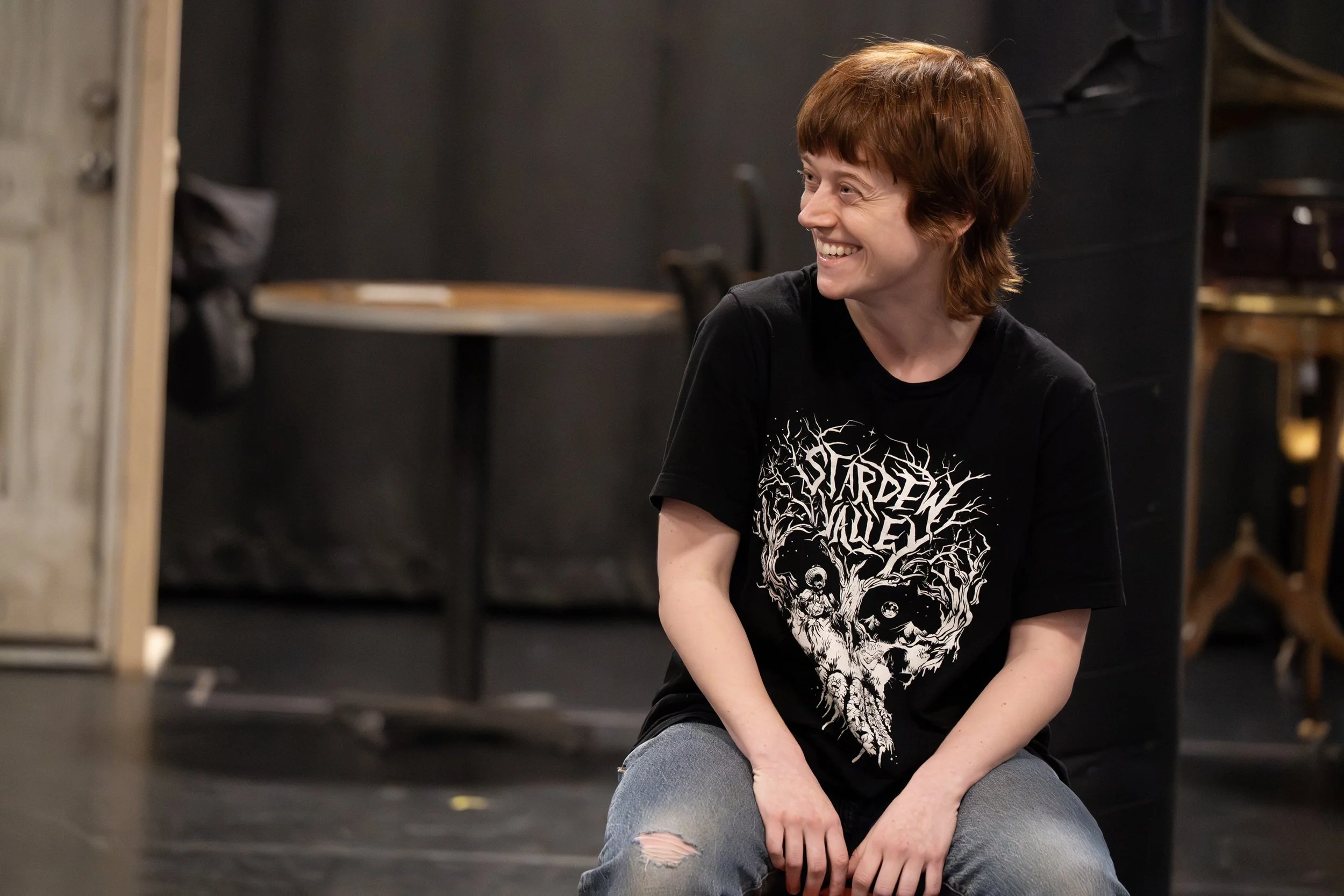
Susannah Perkins plays the title character in Antigone (This Play I Read in High School). Photo: Joan Marcus.
But Celia, I’ve always wanted to do a play with you, we both know it. You are also about the same height as my mom. You have very similar hair color, very similar eye color, and there are moments when I look at you from across the fluorescent-lit rehearsal room and I feel like I’m catching her tail.
And I have a Gavin object that I’m now thinking of that’s in my room, which is this dress that I had from back in my she/her days that I wore to a reading we were both in. And he said, I love that dress. And I said, thank you. And he said, I wish that they made dresses like that for people my height. And we had a conversation about nonbinary and androgynous fashion. It was the only conversation we ever had, but I have not been able to get rid of the dress.
KEENAN-BOLGER: Maybe I’ll wear it to opening.
PERKINS: Maybe you’ll wear it to opening. They’re all around us, our beloved dead people are all around us with their objects.
I’m so excited to ask this question because this one is purely selfish. This one is just for me. I am always curious about how other actors deal with the roller coaster of the run of a show. And you have done long runs. How long did To Kill a Mockingbird end up being, because I know it was bifurcated by COVID.
KEENAN-BOLGER: Maybe like 13 months. And then my contract was done and COVID happened. And then they asked if I wanted to come back for three months and then I did it again for three months.
PERKINS: That is a long time to be one person.
KEENAN-BOLGER: I really don’t recommend it. [Laughs]
PERKINS: To that note, what is your relationship to having had a “bad show”? What does that feel like for you, and what does that feel like for you after, on the subway home? I’m always curious about how people deal with it, whether they even have a concept of having had a “bad show.”
KEENAN-BOLGER: It’s so powerful, that feeling. And I think it’s not always wrong, but I think very often it is wrong, especially early on when you’re still finding your footing and you’re like, oh, I dropped the ball in a few places where the play needed the ball to stay in the air. In a long run, I just remember being so desperate to try to listen and you’re like, I don’t understand how to listen to something that I’ve heard 400 times. And there’s that feeling of I’m present, but I am in so many other places. And then getting on the train and feeling really, really bad. And sometimes those would last for two weeks.
PERKINS: Absolutely. There’s cycles and phases.
KEENAN-BOLGER: But like so many things in life, my sense is that on the other side of those really boring, really difficult, I am barely here weeks, there was something that opened up the tiniest bit. I would be able to zoom out a little bit, even subconsciously, and feel like, oh, I know what I’m doing again, and actually I never thought about this part in this way. I don’t know that that always happens.
When I was doing To Kill a Mockingbird, there was a crazy event where they thought there was a mass shooting happening in Times Square and people rushed into our theater screaming, and I was on stage at the very, very end of the play. And the next week when we were performing, I had a panic attack on stage and stayed on stage the whole time, but felt out of my mind crazy. And Kim Grigsby, she played the organ on stage, happened to be watching the show that day, and I saw her and was like, can you believe what I just did on Broadway? And she was like, I have no idea what you’re talking about.
After that I thought, if I can have a panic attack on stage and somebody who has watched this show as many times as she has didn’t know it, then I’m allowed to have a show that I don’t feel good about.
I remember in To Kill a Mockingbird, Gbenga Akinnagbe had never done a show for a long run, and he said, Oh, this is like yoga. You show up on your mat, you do the same poses every day, and sometimes your body is like, oh my God, I feel so fucking great, I’ve got all of this, I have all the breath, I have all the expansion. And some days you’re like, I cannot even stand on one leg. Like I can’t bear to do this goddamn pose again. And the point in yoga is just for the union of breath and body of presence. I would think about that all the time, especially during the bad shows when I feel bad going home on the subway.
PERKINS: That is so useful and I hope that you will thank him for saying that from me because I am tucking that away in my back pocket. I also have a meme that I will send you later. Chloë Sevigny did a play and she posted something on Instagram that was predictably iconic. The caption was something like, “when you’re in previews and you’ve had a bad show, but everyone you love is there in the audience,” and it’s this disgruntled looking white cat with a party hat on and it says, “Fuck.” And I think about it all the time. I will be sending that to you.
KEENAN-BOLGER: Oh my God.
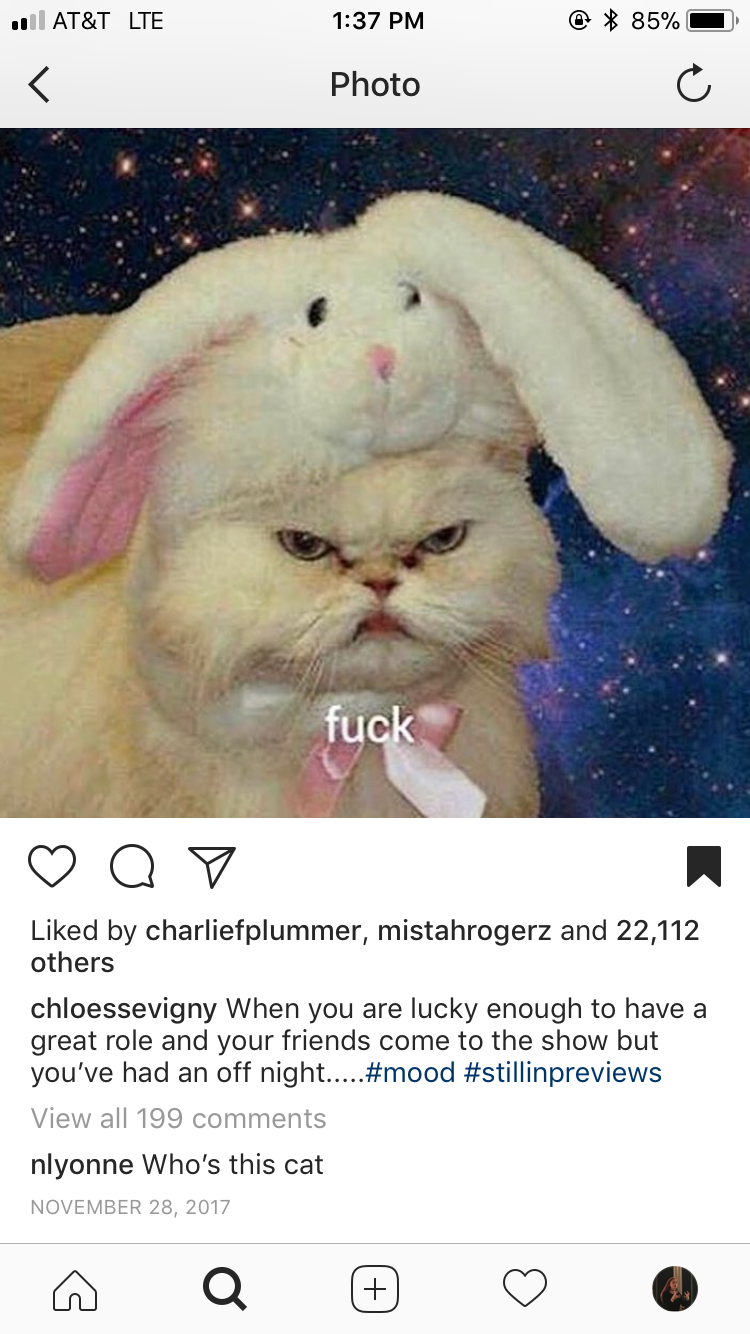
The meme Susannah Perkins can’t stop thinking about.
PERKINS: One final question. When will you follow me back on Instagram?
KEENAN-BOLGER: Oh my God. Wait.
PERKINS: Your husband follows me on Instagram.
KEENAN-BOLGER: This is what I’m gonna tell you about Instagram.
PERKINS: I’m listening.
KEENAN-BOLGER: I am really trying to get off of it.
PERKINS: You’re so noble.
KEENAN-BOLGER: I mean, I feel like it is...
PERKINS: It’s a moral bad. Do you know what I mean? There is nothing about it that I feel good about. When I think about it I feel sick about who I might be in the world. And it’s actually not even on my phone right now.
KEENAN-BOLGER: I wonder if a part of it is that my Instagram account has become so ... I feel like I used to be very socially and politically engaged on that account.
PERKINS: I think of you as being very socially and politically engaged in person.
KEENAN-BOLGER: Well, that was why I stopped. I was like, I think I am using Instagram as an avatar for actual engagement.
PERKINS: Yes.
KEENAN-BOLGER: I don’t even think I’ve seen that you followed me, but if I did, I feel embarrassed that my account now is basically just professional ... that you would look at it and be like, “ew.”
PERKINS: That’s not what I felt. I feel like I’m supposed to tie this back into Antigone somehow and be like, and what would the Chorus’s Instagram account be like? What would she post? But maybe she doesn’t have an Instagram. I think Antigone has an Instagram, but it’s private.
KEENAN-BOLGER: One hundred percent.
PERKINS: And has nudes. Though I don’t actually know. Can you post a nude on Instagram? I think you cannot on Mark Zuckerberg’s Instagram.
KEENAN-BOLGER: Yeah, I think that’s right. Like no nipples.
PERKINS: Yeah, they would take it down. There was a whole thing about nipples.
KEENAN-BOLGER: But not men’s nipples.
PERKINS: Not men’s nipples.
KEENAN-BOLGER: Wait, can I ask you a question, Susannah?
PERKINS: You bet.

The cast of Anna Ziegler’s Antigone (This Play I Read in High School). Photo: Marc J. Franklin.
KEENAN-BOLGER: Do you feel like the quality of making this play is different? What is striking you about making Antigone?
PERKINS: Anna’s language is not something I feel like I have encountered very often in the new play space. It’s pretty, and also what she has challenged herself to do in writing this play, in what the relationship between our characters represents, which is this union between history and the present moment, is so gigantic in its scope. And that actually has an effect on the way that it feels to act it. There is nothing about this play that feels quotidian or casual, which is very exposing.
KEENAN-BOLGER: Yes.
PERKINS: Particularly because one of my primary interests as an actor, at least right now, is how to say things the way that a person would say it, and how to figure out how to say things and mean them.
And there are some things in this play that are crazy to say and mean, which is a really exciting challenge. And also means that when I go see other plays after we have spent eight hours in rehearsal, I am a little bit asleep. Sorry to all of my friends whose plays I’ve seen over the past few weeks. But it’s an intellectual challenge in a pretty profound way, that I feel definitely grateful for and also totally scared by.
KEENAN-BOLGER: Same.
This interview has been edited and condensed.