

Moooving with “Athleticism, Brutality, Sweetness” in “Calf Scramble”

Maaike Laanstra-Corn, Elisa Tarquinio and Gabriela Veciana in Primary Stages's Calf Scramble, written by Libby Carr and directed by Caitlin Sullivan. Photo: James Leynse.
The Houston Livestock Show and Rodeo is the biggest livestock exhibition in the world. Hosted at NRG Stadium — where the NFL’s Houston Texans play — the annual show draws tens of thousands of spectators, and megastars to entertain them.
“A friend invited me to see Hannah Montana at NRG,” playwright Libby Carr said, but equally memorable was the preshow: “the calf scramble.”
Carr grew up in Houston, Texas, and attended the rodeo each year, and while a Miley Cyrus (as Hannah Montana) concert offered a formative memory, it was the rodeo events that stuck most — and are now dramatized in Carr’s Off-Broadway debut, the dark comedy Calf Scramble.
The calf scramble is a rodeo competition where calves are released into the arena, high schoolers chase them, and those who catch one are given money to purchase the animal to raise and begin a farming career. Thousands cheer on this annual tradition, which dates back to 1942.
“I remember being really in awe of the athleticism, the brutality — and this real sweetness, too,” Carr said. “I worked on a horse ranch in college and had this growing understanding of how people have relationships with animals; that reflection is where the start of the play came from.”
In Calf Scramble, produced by Primary Stages and now playing at 59E59 Theaters, five high-school girls tend to their captured calves, growing alongside them, and — in a shining theatrical touch — they also perform as one another’s calves.
“I was really curious about using those relationships” between owner and animal, Carr said, “and how they mapped onto human bodies.”
The play depicts a unique relationship between girl and animal, something rarely seen on stage and which Carr uses as a vehicle to explore coming-of-age, competition, and the girls’ increasingly nuanced understanding of imprisonment — within their domesticated calves and their own conservative Christian lives.
Theatricalizing humans as animals — including an entire, riveting calf-scramble sequence — presented exciting challenges.
“My first response to reading the play was, one: I have no idea how you stage this, and two: I will die if I am not the person who gets to figure this out,” director Caitlin Sullivan said.
In their script, Carr uses large point size and multiple columns to telegraph the vigor of a rodeo. It is reminiscent of the writing of one of Carr’s inspirations, Clare Barron’s 2018 play Dance Nation, which also examines young female competitors. But that style also speaks to how young playwrights try to communicate their work and make it stand out in an underfunded landscape where opportunities for productions are scarce.
“This is a big, physical event that bookends this show, and it felt important for me to try and express that on the page,” Carr said. “And also, my friends and I talk about that plasticity on the page as something that is developed among young playwrights who don’t get to see their work as much — it is trying to explore what the play really sounds like when that is sometimes less available.”
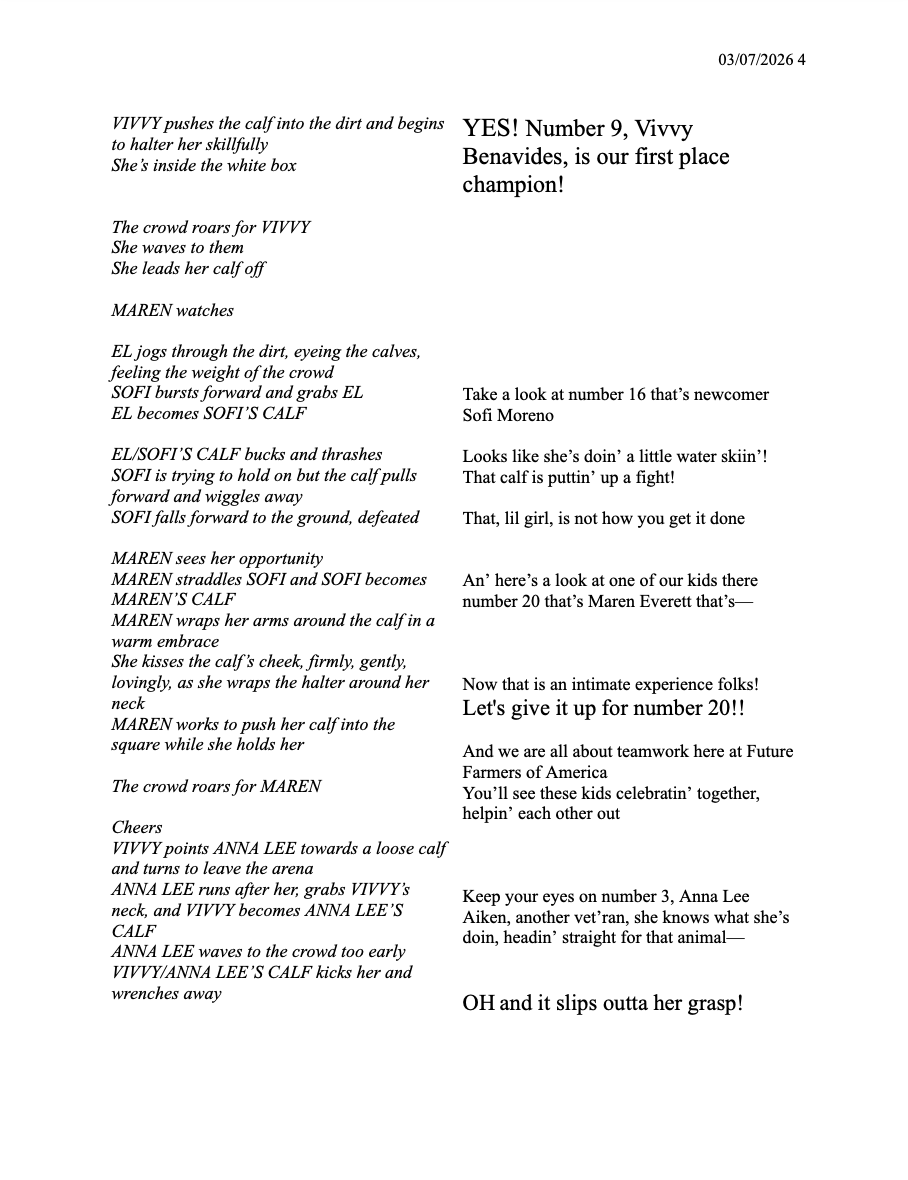
An excerpt from Calf Scramble by playwright Libby Carr, in which they use varied font sizes and multiple columns to bring the rodeo to life.
Carr now has a partner in Sullivan to execute their ambitious stage directions. They had seen Sullivan’s staging of The Good John Proctor by Talene Monahon at the Connelly Theater in 2023. Sullivan is from Boston, and Monahon’s play offered a contemporary riff on the Salem witch trials; Carr examines their own local lore through the rodeos and how they impact female friendship. Though set time zones and centuries apart, the plays “had some DNA overlap,” Carr said, “so Caitlin and I had a meeting.”
Considerable time and collaboration was spent on the actor doubling. “We’re not looking to do a literal illustration of a cow — you’re not going to see anyone on all fours,” Sullivan said.
But figuring out the movement would nonetheless require some fancy footwork. “I am not a choreographer, but I love to make really physical work,” Sullivan said. “More so than plot, I think about a play’s emotional and embodied logic. I love collaborators, and I feel most confident and safest when I have a lot of people in the room who know more about what I know less about.”
Sullivan and Hannah Garner, hired as the show’s movement director, got to more deeply explore “what Libby’s play is driving us to think about: what is the relationship between a human and a domesticated animal?” Sullivan said, noting she, the cast, and creative team spent time watching videos of calves to study their behavior and movement. “What are the echoes in our own bodies, and where does a calf have power and strength, and how does that help us access the emotional reality we are after?”
Another reality the play explores is containment. Calf Scramble is set in Huntsville, Texas, which one character calls “the core of evil”: the city is home to multiple prisons, including the state’s execution chamber.

Ferin Bergen and Marvelyn Ramirez in Calf Scramble, currently playing at 59E59 Theaters. Photo: James Leynse.
“Texas incarcerates and executes the most people in the US, so that was always really present in that town when I was there, and I was interested in how a system of power like that impacts young women who can’t control it but are deeply affected by it in their families, in their consciousness,” Carr said, noting such systems allow for “a learned cruelty, and I was curious how these young women digest it and how they enact it” — on each other and their livestock.
Given the girls’ steps toward understanding and womanhood, it was key that “the actors feel young, whatever that means,” Sullivan said. Most actors in the show are making their Off-Broadway debuts. The characters navigate the world with “the tools they’ve been given,” Sullivan said, which leads them to also ask: “I don’t necessarily like the consequences, so what else can I do? What else is there?”
Carr added, “I start writing a play because I don’t understand something. This is not an original thought, but there is something in the world I’m really struggling to figure out, and I have worked my way through those feelings in this play — and it’s been amazing to have Caitlin put language to these questions I’m trying to ask.”