

In “My Joy Is Heavy,” The Bengsons Bring Radical Access Center Stage
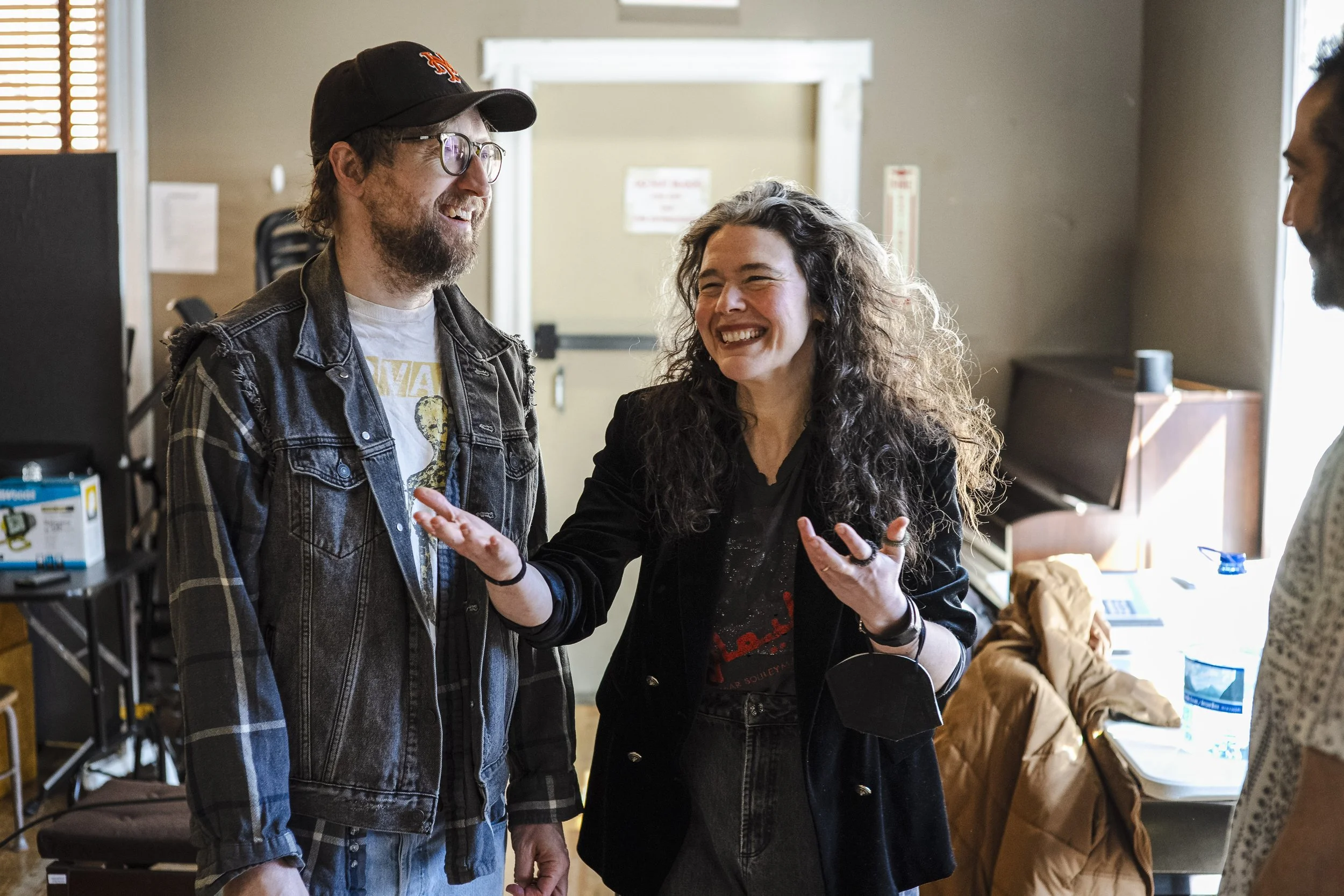
Shaun and Abigail Bengson in rehearsal for their new show, My Joy is Heavy, at New York Theatre Workshop. Photo: Marcus Middleton.
The married composing and performing duo Abigail Bengson and Shaun Bengson, known as The Bengsons, created their latest show, My Joy is Heavy, early in the COVID pandemic. Abigail had been ill, though not with COVID, and went through a period of misdiagnoses and harmful medications. During this time, they were trying to have a baby and were both struggling.
“We thought it was our job to fix ourselves and get better, that it was our fault that we were not doing well,” Abigail said in a joint Zoom interview with Shaun. “We bought into the wellness culture thing that we hadn’t realized our greatest potential as humans and that’s why we were really sick. And boy was that wrong. I think our souls knew it was wrong.”
Shortly after, My Joy is Heavy was born. Commissioned by Molly Smith, then the artistic director at Arena Stage in Washington, DC, My Joy is Heavy was part of Arena’s filmed musical series, Arena Riffs, in March 2021, when theaters were still shut down. The 27-minute digital version showed The Bengsons contending with a miscarriage but finding joy despite pain and sadness as they stayed at a family home in Vermont.
Five years later, the full-length show is now at New York Theatre Workshop, currently running through April 5. The production is not just an expansion of that earlier film but an evolution of The Bengsons’ understanding of disability and their embrace of radical access to theater.
Theater organizations often describe theaters as welcoming places, but barriers to joining the communal experience persist: high ticket prices keep many people away; older, historic buildings may not be usable for people with mobility issues; there is a risk of contracting illness at an indoor space. Theaters have started offering accessible performances (ASL interpreted, open captioned, or mask required), but that puts the onus on the theatergoer to be able to attend that one specific performance, as well as to choose which accessibility option. If they need a mask-required and open-captioned performance, for example, those are often on different dates.
With the concept of radical access, The Bengsons have embarked on removing some of these barriers. In the years since Abigail’s illness, both Abigail and Shaun have come to identify as disabled themselves. Shaun has the hearing disorder tinnitus, which was incorporated into their piece Ohio, which played at the Edinburgh Fringe Festival last year, followed by a run at the Young Vic in London. It was with that piece that the pair first officially worked with access dramaturg Alison Kopit, who is also on board for My Joy is Heavy, and who describes her work as incorporating access into performance creatively and collaboratively at all levels of the production. “What I do is work as connective tissue between various departments and try to make everyone a little bit of an access worker,” she explained in a Zoom interview.
Kopit served as the access dramaturg for Ryan Haddad’s Dark Disabled Stories, which played at the Public Theater in 2023 and laid the groundwork for what radical access in theater could look like. Open captions, audio descriptions, and American Sign Language were available at every performance, integrated into the artistry of the show, and many performances had additional access accommodations.

The cast and creative team of My Joy is Heavy, which began five years ago as a digital performance during the pandemic. Photo: Marcus Middleton.
Dark Disabled Stories made an impact on The Bengsons, particularly Shaun. “It was years since I was really able to follow plays very well because I was missing so much,” he said. “And then we saw Dark Disabled Stories, and for the first time I was able just to be there and I was just able to absorb the show in a way that I hadn’t in years and years.”
My Joy is Heavy also has open captions at every performance, and for autistic people, neurodivergent people, and people with sensory and communication disorders, every performance is relaxed — meaning, according to the NYTW website, that “the house lights will be dim and audience members are invited to express themselves and come and go as they please.” The show plays on a monitor in the lobby for those who may need some time outside the theater, and there are shelves in the back of the house that have a variety of access tools like fidgets and ear plugs. Audience members are invited to use them and feel comfortable. There are also three mask-required performances, as well as a variety of other access accommodations, including providing childcare for families.
The Bengsons are committed not only to making their shows accessible but also to making this access work an inherent part of their artistry. “We were always making art from an access-centered point of view, but we didn’t understand that, we didn’t really know,” Abigail said. “[Alison] gave us language for it and names for it, which changed our art, but also changed our understanding of ourselves.”
They are still learning, now with more people in the room. “When we made that original piece we were fundamentally alone and we were sending this out into the world to un-alone ourselves somehow,” Abigail added. “And now we’re in this room of 50 collaborators. It’s not about us anymore; it feels like it’s about all of us now. It feels like such a relief to get to be in community with it and not just hiding in our little room.”
Kopit acknowledged that the relationship aspect is key. “I think of relationship as the most powerful access tool that we have,” she said. “And [The Bengsons] are just so rich in the ability to build authentic and affirming relationship.” She added: “They came into disability identity when they already had a following and body of work and so it’s big to start thinking in this new direction.”
My Joy is Heavy is helping to pave the way for more access in theater, which The Bengsons say can be a battle even when institutions are on board. “There’s a lot that needs to change, but I think there’s also a lot of hope and curiosity about how to change it,” Abigail said. “The more artists who are outspoken about their own real needs, the more our unions can support those real needs, the more possible it will be for things to get better for everyone.”
And the more radical access, the more joy.