

What Do Indie Bookstores and Off-Broadway Theater Have in Common?
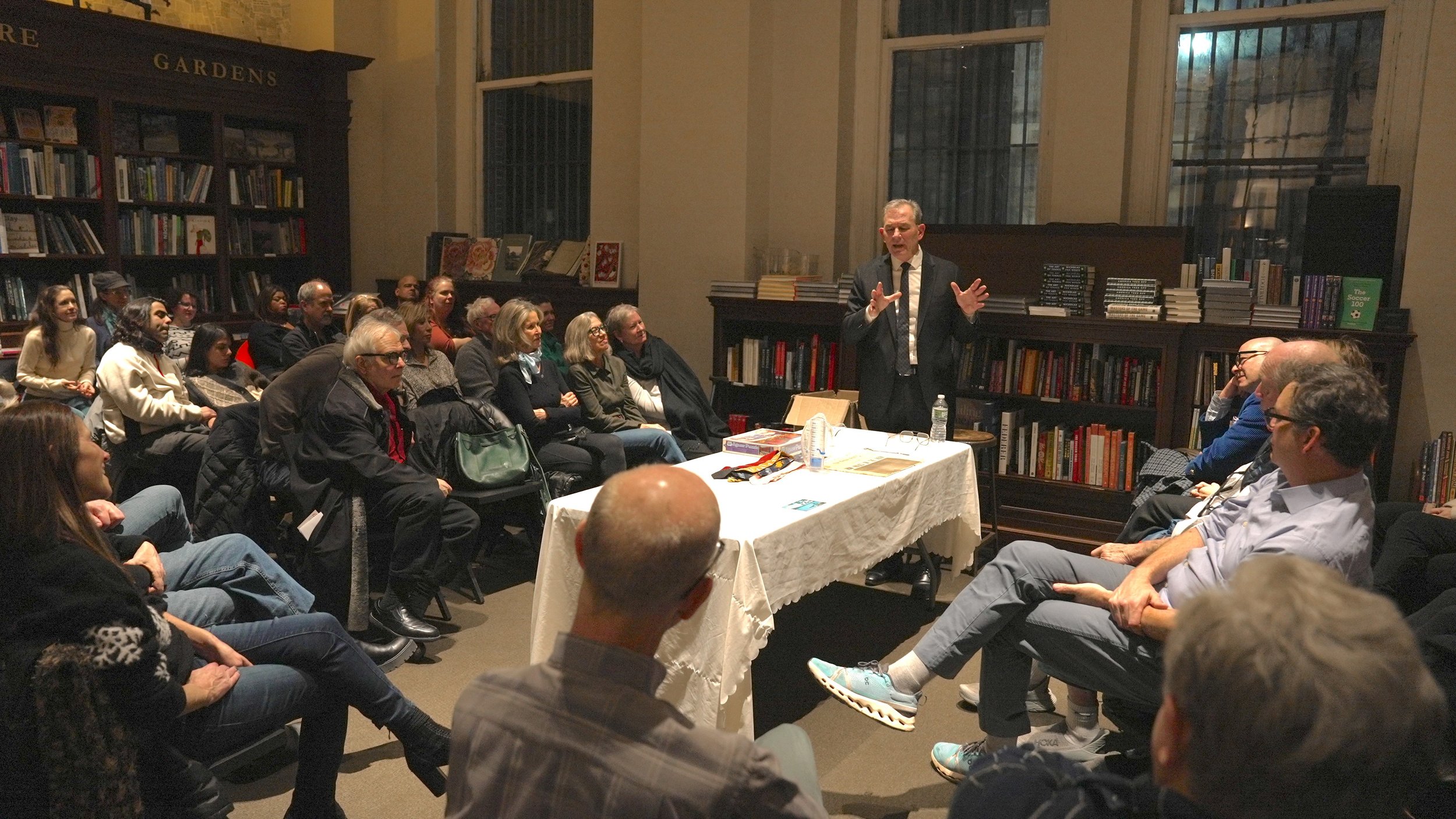
Ed Schmidt performing in Edward, a site-specific play set in bookstores around New York City (here at Rizzoli). Photo: Emma Callahan.
One of the 27 objects in Ed Schmidt’s interactive one-person play Edward, now playing at bookstores around New York, is a beat-up copy of The Catcher in the Rye. Edward, whose life is narrated through a series of his belongings, was a high-school English teacher. Over the course of the evening, several objects — an Arthur Miller playbill, The Complete Works of William Shakespeare, a hotel ashtray — demonstrate, in his words, “the vital role that reading literature plays in the development of a well-rounded life.” Audience members, seated among the shelves of The Strand, McNally Jackson, or (the night I saw it), The Mysterious Bookshop, only have to glance around to see what he means.
Edward is not the first play to consider the connection between literature and theater, but it may be the first to take it to the extreme: placing the performance in bookstores, where audience members are physically surrounded by a reminder of that link. Schmidt’s piece is the most recent and creative example of a media-wide “bookstore trend,” as cozy novels and warmhearted movies use the aesthetic to paint an idyllic portrait of literary life. At the bookstore I work in, Westsider Rare and Used Books, customers love to show us copies of The Storied Life of A.J. Fikry by Gabrielle Zevin or Jenny Colgan’s The Bookshop on the Corner. People often think Westsider, nestled across from Zabar’s on Manhattan’s Upper West Side, was the real-life inspiration for You’ve Got Mail.
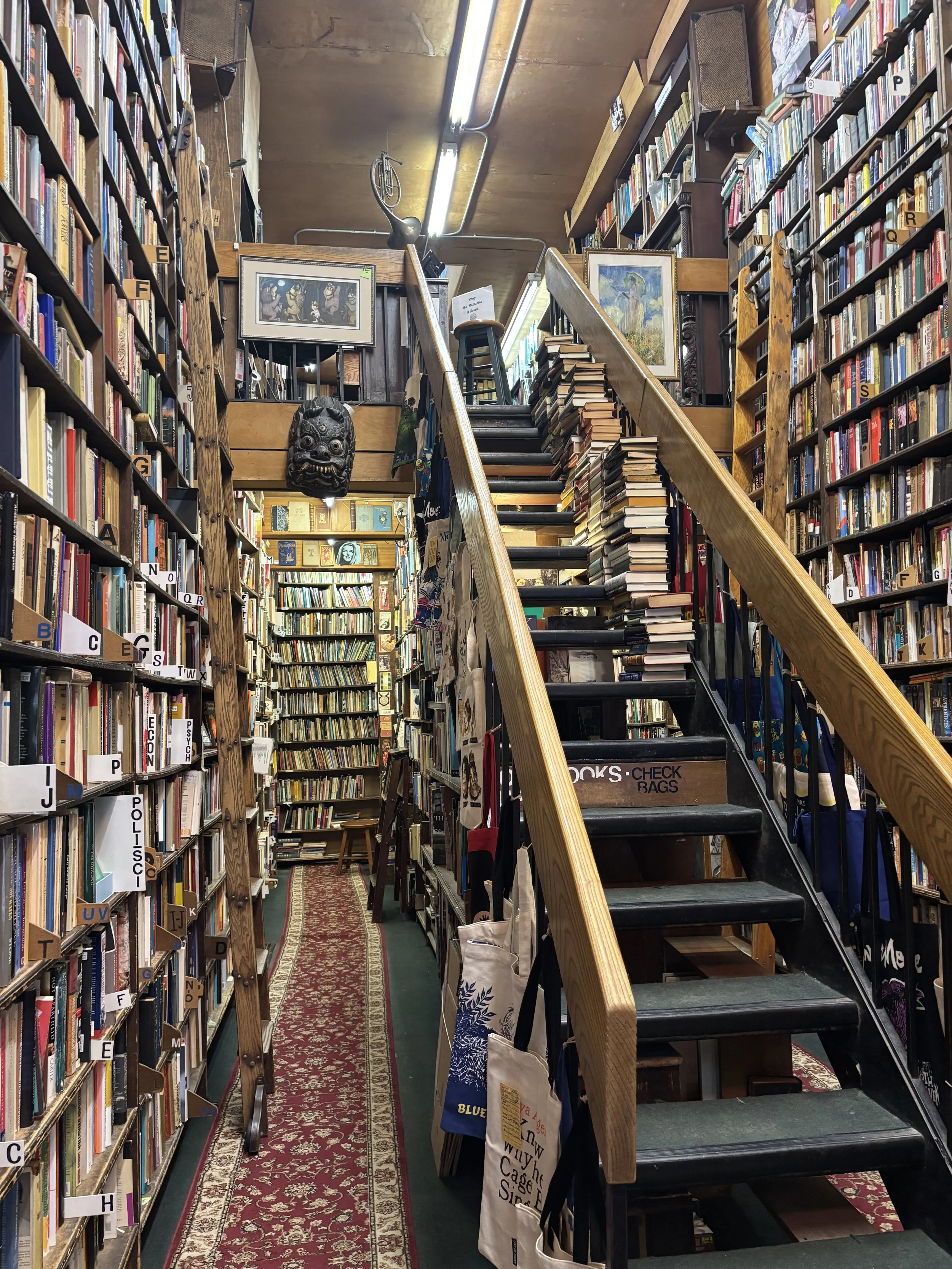
Westsider Rare and Used Books, established on Manhattan’s Upper West Side in 1971. Photo: Catherine Sawoski.
The Bookstore (written by Michael Walek and recently having concluded a run at 59E59 Theaters) explores this phenomenon in a more traditional, proscenium manner than Edward, but both gesture at the same concept. There’s a transportative quality to bookstores, which have a romantic hold over our collective imagination. As a bookseller, I’ve seen it every day for the past year. These plays, part of a recent upswell, ask if that power can be harnessed in the name of theater.
The Bookstore leans heavily on this romanticism to carry it through. The play chronicles a year in the life of store owner Carey (Janet Zarish) and her two employees/surrogate daughters. While there’s little plot or discussion of bookselling life — this despite the show’s nominal partnership with local stores like McNally Jackson and Argosy — the characters speak in bookish banter, quipping about Edith Wharton’s nicknames or Virginia Woolf’s family drama. This, an audience member could think, is what it would be like to live in a bookstore, spending your days entrenched in literature and restocking Jhumpa Lahiri on the shelves.
Schmidt takes a more intimate approach, not writing explicitly about bookstores but using them as a way to explore the materiality of physical objects. The audience for Edward, which stars Schmidt himself, is capped at 25 people, who sit around a table of objects the fictional Edward O’Connell left behind. Each audience member chooses one of them, prompting Schmidt to deliver a different story or vignette from Edward’s life. These anecdotes range from funny to heart-warming to regretful, creating a complex portrait of a character who loves literature in a deep and realistic way.
Edward started out in apartments before being moved to art galleries: the bookstore setting of this most recent iteration was not baked into the conceit of the play. It does, however, unlock a new dimension of meaning. Schmidt, who used to be an English teacher himself, has a history of using literature within his innovative, site-specific work. His most recent piece before Edward, My Last Play, took place in his apartment. Every night, he would give away one of his theater books to an audience member. The show ended when he had no more left to give.
“More than almost any other physical media, books are a representation of who we are. There’s a reason that we keep accumulating them and put them on shelves full of uncracked and unread volumes. Each title is a small proof of what we’re interested in, the type of person we believe ourselves to be. ”
“Those books I had accumulated over thirty years or so,” Schmidt told me. “Those were self defining in a way that books and objects can be. And part of the question was, ‘Who will I be if I get rid of all books?’”
Edward is interested in how our objects create us, using a puzzle box or tie collection as a way to get to the core of who someone is. Three of Edward’s objects are books (four, if you count a car manual). More than almost any other physical media, books are a representation of who we are. There’s a reason that we keep accumulating them and put them on shelves full of uncracked and unread volumes. Each title is a small proof of what we’re interested in, the type of person we believe ourselves to be. This, perhaps, is one reason bookstores have such a grip on contemporary society: as a place with infinite possibilities to define yourself. Edward, which places the objects physically in front of you, uses theater to capture this in a way impossible in any other medium.
***
People tell me all the time how lucky I am to work at a bookstore. They gasp as soon as they enter the shop and see shelves that stretch to the ceiling, complete with rolling ladders and book piles on the stairs. They also, however, usually whip out their phones. We’ve had to institute a rule against taking photos in the store because of the throngs of influencers coming to pose in front of the colorful spines without actually reading what they say.
The Bookstore cares about the visual, and, in doing so, does capture an important aspect of why we love these spaces. The set, designed by New Jersey Repertory scenic and prop designer Jessica Parks, features dark wood bookshelves and warm fabric chairs. You can see yourself there, because it’s identical to a dozen other shops you’ve been to before. A bookstore is an instantly recognizable place, where you can feel comfortable no matter where in the world you are. This, perhaps, contributes to the warmth of most bookstore narratives: there’s a timelessness about them, a sense that we’ve returned, in some respect, home.
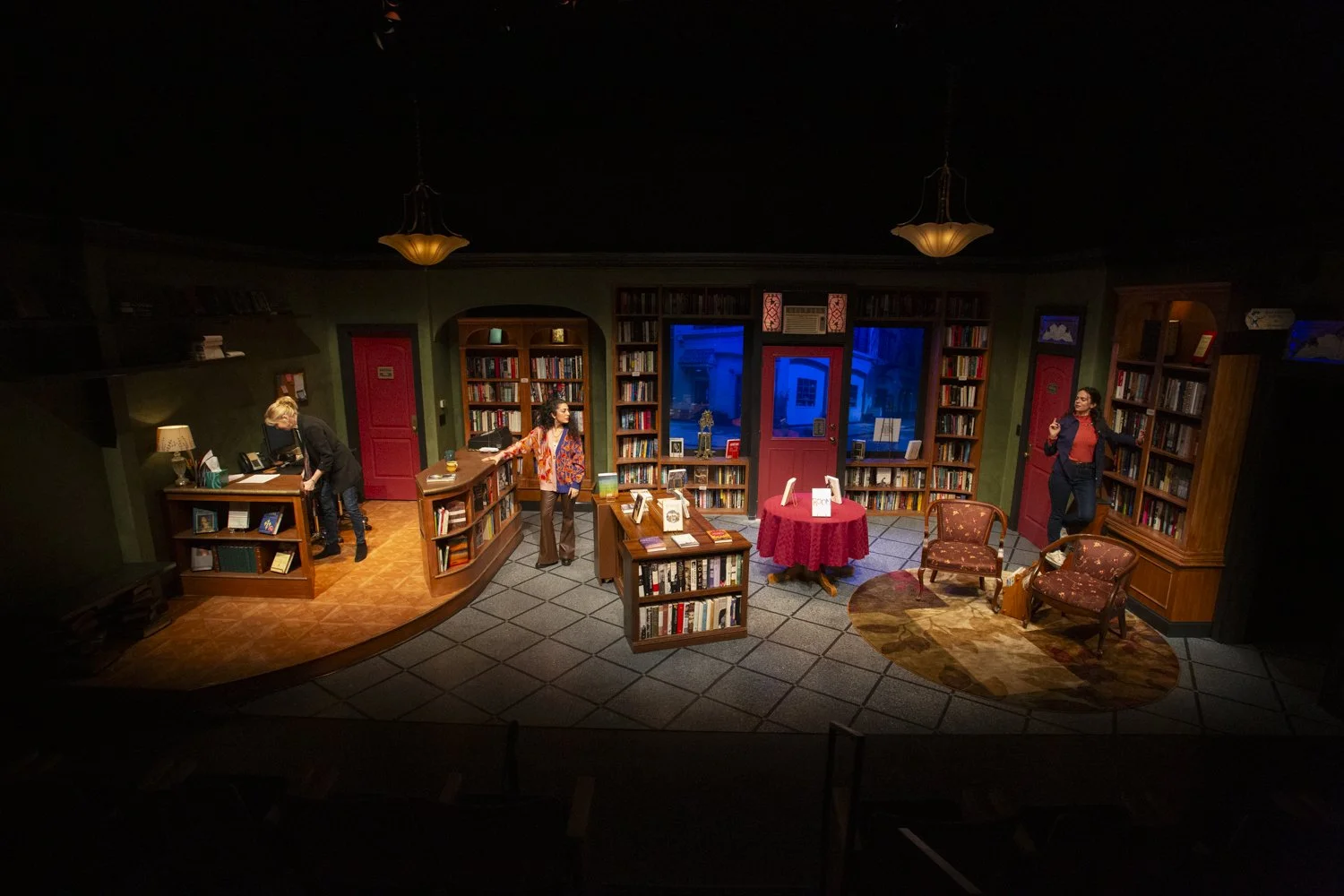
Janet Zarish, Ari Derambakhsh, and Arielle Goldman in The Bookstore at 59E59 Theaters, with set design by Jessica Parks. Photo: Hunter Canning.
But the aesthetic alone cannot paper over the realities of operating an independent bookstore. The program gestures to how, in this online era, “bookstores are under threat and books are viewed as archeological artifacts,” but The Bookstore never shows any sign of struggle. The blocks around Westsider used to be filled with eight different bookstores; now, along with Barnes & Noble, we’re the only ones left. Westsider itself almost closed in 2019, but a community fundraising effort was able to pay off the back rent. This, perhaps, is too much to fit in an Instagram caption.
No bookstore has ever won an Oscar or an Emmy. One has, however, received a Tony Award for excellent contribution to the theater: Drama Book Shop, a longtime home for theater artists. Lin-Manuel Miranda famously wrote In the Heights on the piano in the basement, and, when the store threatened to close in 2020, it was so important to director Tommy Kail that “the thought of it not existing was painful.” To Kail, the space was so much more than a pretty backdrop — it was a site of community and creation, where he could be a part of the librettos that sat on the shelves. The books there were not only alive, they were essential for the next generation of theater.
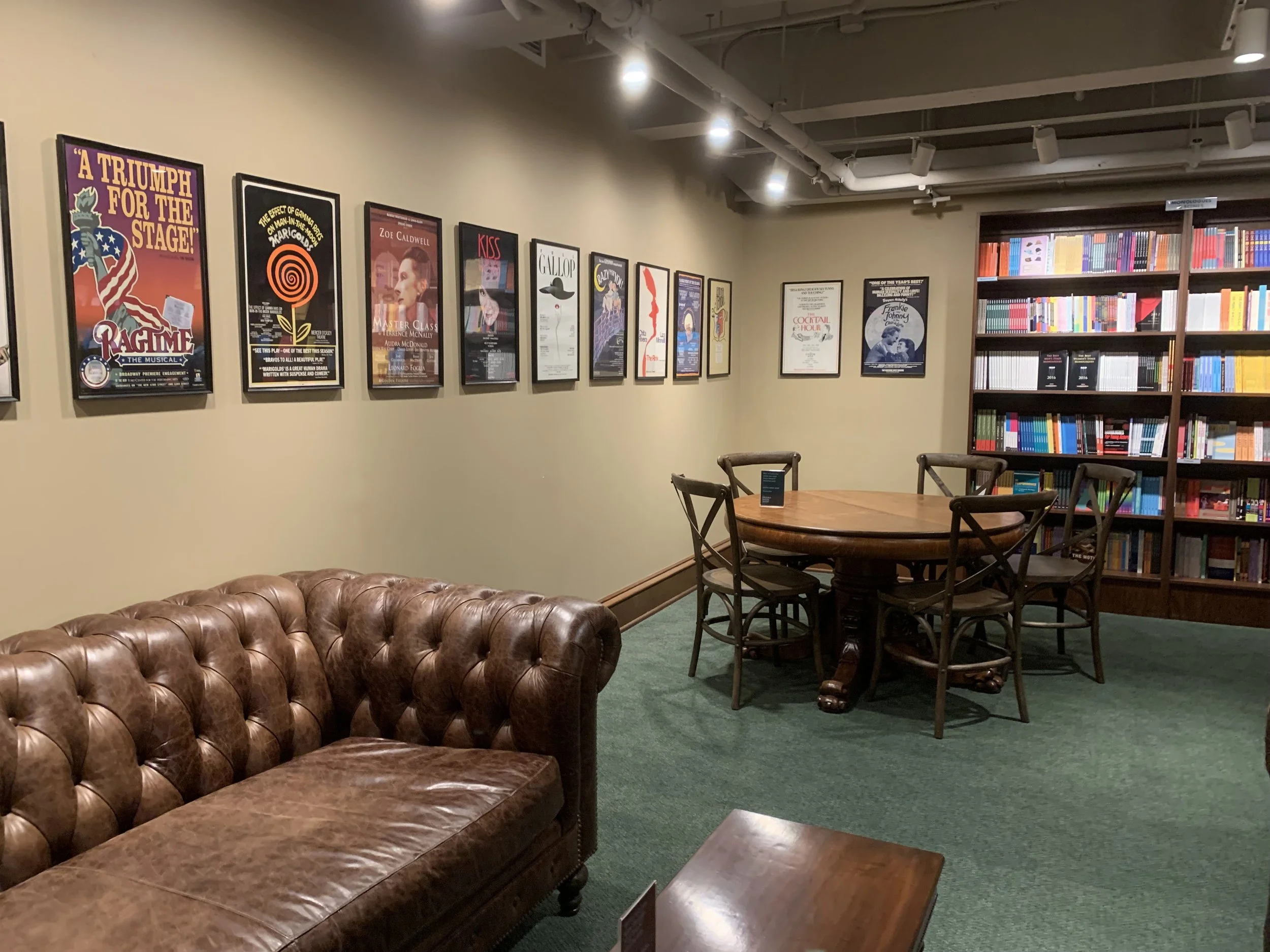
A corner of Drama Book Shop, which reopened in 2021 on West 39th Street, spearheaded by Hamilton’s Lin-Manuel Miranda, Thomas Kail, Jeffrey Seller, and James L. Nederlander.
Edward comes close to capturing this specific symbiosis between theater and bookstores. By focusing on how objects — including books — define us and create meaning through their physical presence, Schmidt understands something essential about both mediums. Theater, like bookstores, is about materiality, about human curation, about the irreplaceable experience of being physically present with something carefully chosen. The Bookstore, for all its charm, treats bookstores as set dressing for a fantasy.
At my bookstore, the magic I see everyday isn’t in the aesthetics. It’s found, instead, in the conversation I have with an actor buying a new play to rehearse, or the ecstatic discovery of the exact directorial biography someone was searching for. Maybe the next bookstore play will take a leaf from Edward’s book: paying attention to what draws us in and keeps us coming back.