

The Barrow Group’s 40-Year Experiment in Realism
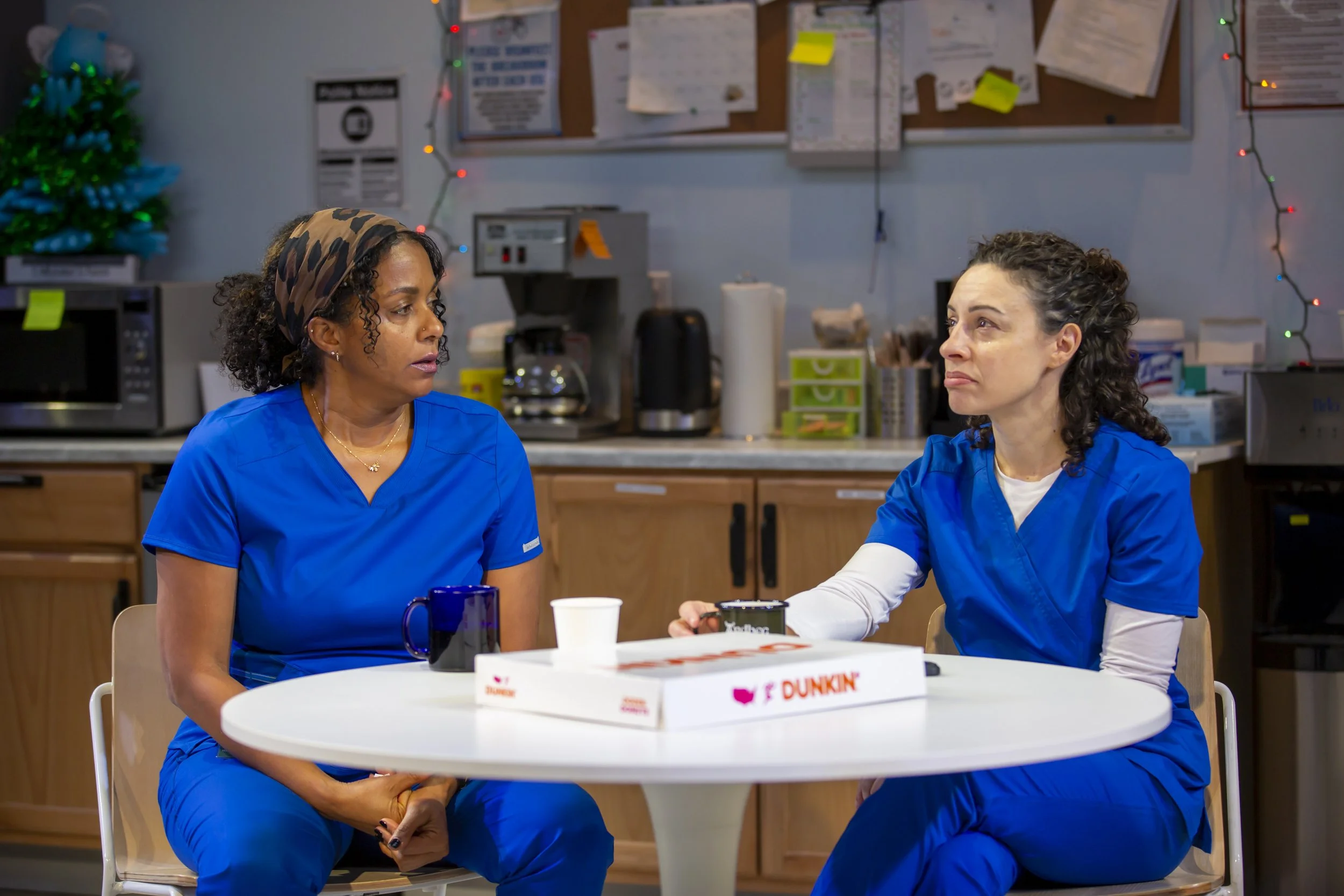
Thaïs Bass-Moore and Tricia Alexandro in the Barrow Group production of Scott Organ’s Diversion, which drops audiences into a hospital break room. Photo: Edward T. Morris.
When Seth Barrish was an undergrad at UCLA, he saw a student production of The Transgressor that left him mystified: most of the cast seemed not to be acting at all.
“I just didn’t feel like they were saying lines or anything was scripted, nor did it feel like it was carefully crafted in any way. I felt like, these are real people going through real things, saying this stuff,” Barrish says. “I felt like a fly on the wall. And the result of all of that was the story itself stayed with me in a way that I had never experienced in theater.”
Naturally, Barrish wanted to make such impactful theater himself, and when he moved to New York City, he did just that. Along with his friend Nate Harvey, Barrish brought together a group of theater-makers to study “non-acting acting,” a practice grounded in spontaneity, realism, and authenticity.
Though their cohort was never intended to be a theater company, in time it became one as its members grew interested in production. In 1986, the Barrow Group was officially born, named after the street that Barrish and Harvey lived on in Manhattan.
“It was a title that we all pinned as, ‘This is temporary. We’ll get a much better name,’” Barrish says. “And then by a twist of fate, we did something that got a lot of attention early on”—a workshop of Craig Lucas’s comedy Blue Window—“and all of a sudden we were like, ‘Uh oh, we might be stuck with this.’”
Nearly 40 years later, they are, in fact, stuck with it. In 2025, the Barrow Group strikes a rare balance in the theater industry, being equally as known for its productions as for its educational programs. Barrish is still at the helm, now a co-artistic director of the company alongside his wife and longtime collaborator Lee Brock.
“From a material standpoint, we tend to do stuff that has some sort of socially responsible message,” Barrish says, while the goal from a performative standpoint is to “give people an experience where it feels less like they’re watching crafted performances, and more of an experience of just being in a room with a real person who happens to be doing a real thing. The idea being if they see something that feels real, that their experience is more recognizable and compelling and it tends to stay with them much longer.”
Around the midpoint of the Barrow Group’s history, a new player entered its ranks: actor and playwright Scott Organ, who was invited to a Barrow Group performance by a young woman he was dating at the time (a woman who’s since become his wife, he adds with a laugh). There, he experienced the same wonder Barrish had at UCLA two decades earlier: amazement at the natural acting on stage, and a desire to make that same kind of theater himself. “This is not only my aesthetic as an audience member, but these are the people I want in my plays, if I can,” Organ recalls thinking at the time.
“That saying ‘God is in the details’ applies so much to what we do.”
Since then, seven of Organ’s plays have been produced through the Barrow Group under Barrish’s direction, culminating in this month’s New York City premiere of Organ’s latest play Diversion. The show follows a group of ICU nurses in the midst of a routine investigation for drug diversion (the illegal use, theft, or sale of prescription medication by medical professionals). The situation, of course, doesn’t stay routine for long, putting the group’s morals and unity to the test as the truth comes to light.
Organ comes from a family full of nurses: throughout the production process, he’s relied on his sister, her wife, and his niece for insights about their shared career.
“I’m constantly texting them in rehearsal and going like, ‘Would you have rubber gloves in the break room?’” Organ says.
The production also received input from nurse and influencer Hannah Fernando, a.k.a. @thatnursehannah on social media, who fielded questions from the cast and creative team on everything from nurses’ day-to-day equipment to a very specific holiday tradition—namely, crafting Christmas trees out of inflated surgical gloves. The cast made one themselves, which, given Diversion’s holiday-season setting, ended up as part of the play’s set. It’s another example of the Barrow Group’s philosophy of realism in practice, ensuring that its storytelling is as authentic as possible.
“It’s this incredible detail,” Barrish says. “That saying ‘God is in the details’ applies so much to what we do.”
“Just as we are interested in having grounded, real acting, and just as we’re interested in making sure the story is clear, we’re also very interested in making sure that it feels real, given that world,” adds Organ.
Barrish and Organ are both key players in the other side of the Barrow Group’s operations, the Performing Arts Training Program. Both teach classes across theatrical disciplines. Organ specializes in playwriting and acting, while Barrish teaches directing, professional acting, solo-show workshops, and more.

Connor Wilson and West Duchovny in Diversion. Photo: Edward T. Morris.
The Barrow Group’s curriculum also encompasses filmmaking, improv, musical theater, and business. Its educational component was sparked by organic interest: as the company started mounting productions in the late ’80s, Barrish was fielding questions about how the Group’s actors achieved their non-acting acting. In the ’90s, the company shifted its structure, leaving the concept of a closed ensemble behind in favor of open-door education.
“Somewhere in there we went, ‘You know, let’s disband the notion of a resident ensemble and let this be the malleable kind of ever-growing community that it seems to want to be,’” Barrish explains.
“Flash forward, here we are, and we serve, I think, four to five thousand people a year. Over the course of time, we’ve had well over 100,000 people come through our doors,” he continues.
“Actors are encouraged to live in the moment and not feel beholden to any given blocking or direction. ‘The whole goal is spontaneous, real behavior,’ says Scott Organ.”
In 2022, the Barrow Group expanded into a new performance space in Midtown, where Diversion opens on December 4. During previews, the play has evolved in conversation with its audience, say both Organ and Barrish. That flexibility is another product of the Barrow Group’s working practices: chiefly, that just as real life is ever changing, actors are encouraged to live in the moment and not feel beholden to any given blocking or direction.
“The whole goal is spontaneous, real behavior, and as a result, no one’s really locking anything in,” says Organ. “And so every night it’s vibrant, and every night there’s an interaction with the audience. There’s no, like, ‘We’re set in stone.’ It’s, ‘We’re just going to go out there and be honest every night,’ and they are, and as a result, I think the audiences are seeing that and appreciating it and responding to it.”
That means embracing spontaneity, even when things veer far from how they went in rehearsals. Take a recent preview performance where an actor’s phone fell from her pocket, disconnecting her headphones and blasting her music onto the stage.
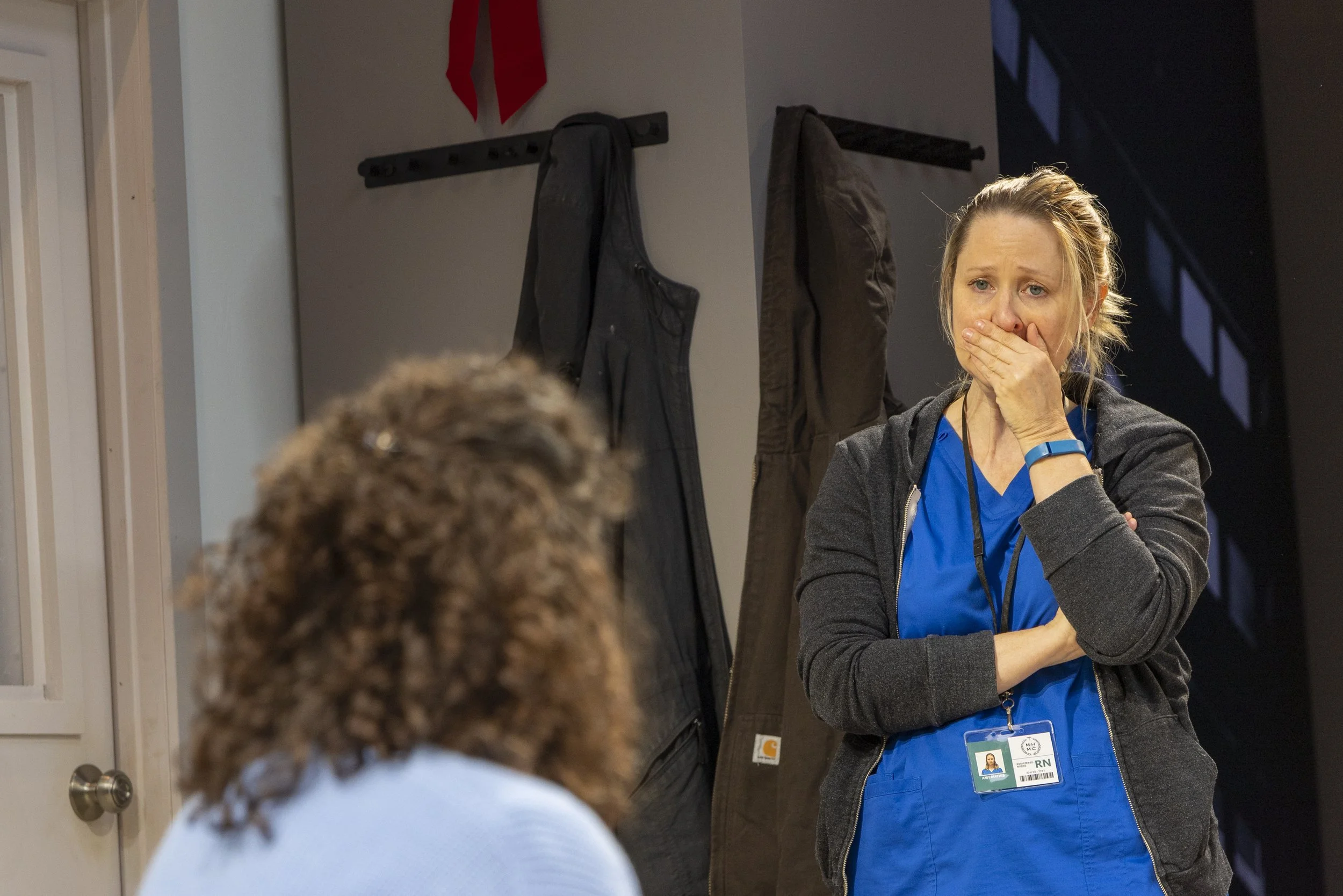
Tricia Alexandro and DeAnna Lenhart in Diversion, which follows a group of ICU nurses. Photo: Edward T. Morris.
“Suddenly, Sabrina Carpenter was playing loudly on the set in this great moment,” Organ says. But even through the chaos, the actors didn’t miss a beat: “It was very much a happy accident and very funny, and it absolutely fit the scene.”
It’s those human moments that make Diversion a textbook Barrow Group production. The six-person cast strives to leave all pretense backstage and simply be on stage, as Barrish has strived to do for the past 40 years. He hopes that Diversion’s audiences have a reaction much like the one he had back at UCLA—he wants the play to challenge their notions of what theater could and should look like.
“I think that they’re likely to have an inspiring human experience that shines a light on all of our fragility and all of our ability to participate in healing each other,” Barrish says. “The play has a call to action that is inspiring people to do just that, to look around them, help, and make people’s lives better.”