

Francis Jue Plays the Voice of Reason in a World That Won’t Listen
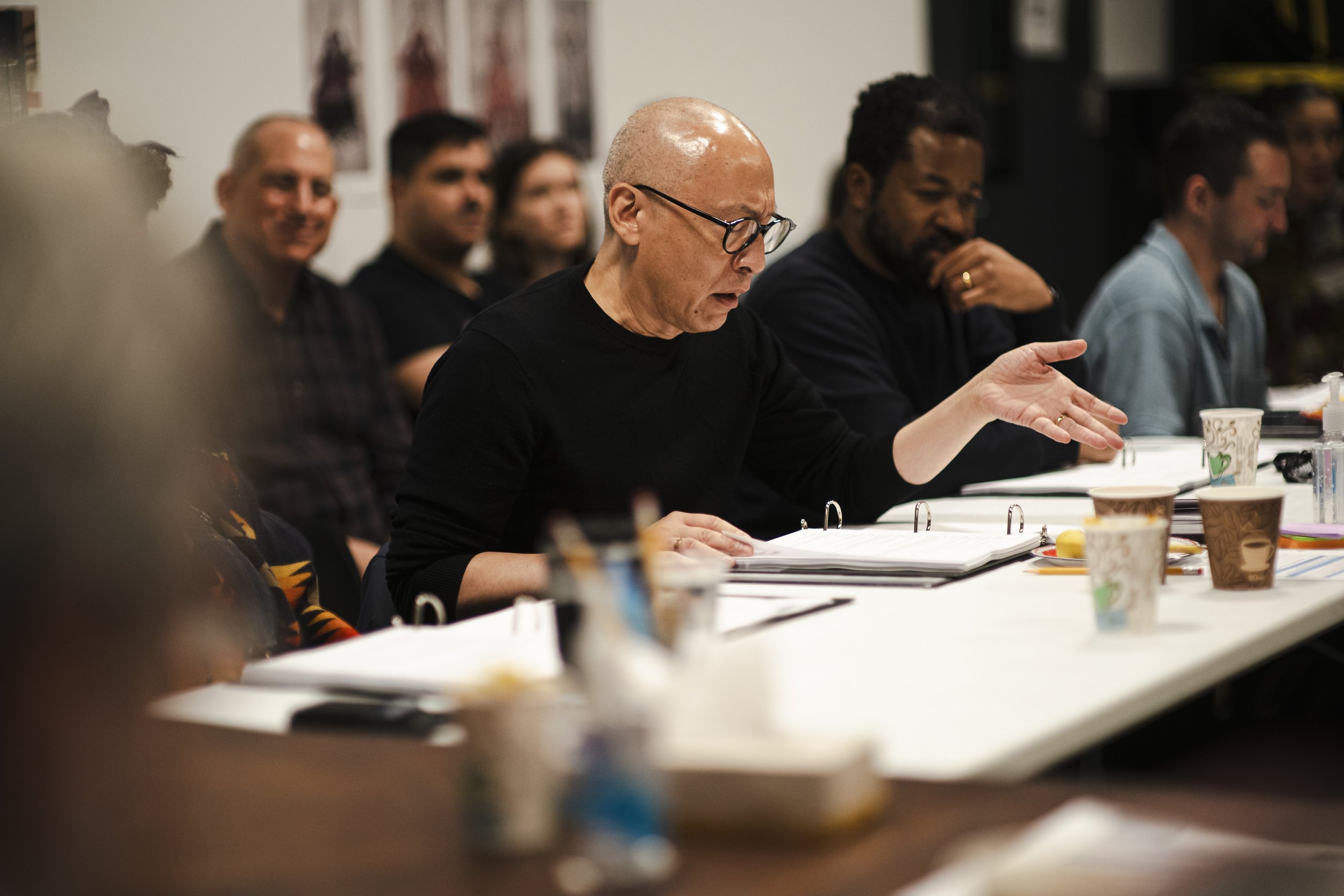
Francis Jue during rehearsal for Lucas Hnath’s adaptation of Molière’s Tartuffe at New York Theatre Workshop. Photo: Marcus Middleton.
Francis Jue said no to the offer to play Cleante in Tartuffe twice, until he met with Sarah Benson, the director of Lucas Hnath’s new adaptation of Molière’s 1664 play at New York Theatre Workshop.
“In five, ten minutes, she convinced me,” says Jue, speaking from his home the day before tech rehearsals begin.
What Benson pitched was a Tartuffe that speaks to Jue. Hnath’s adaptation maintains the essence of Molière’s iconoclastic comedy while making the language feel contemporary. And Benson’s vision emphasizes something Jue couldn’t ignore: the danger in the house. Not the farcical inconvenience of an unwanted houseguest, but the real threat of someone who will take things away from you and destroy your relationships with your loved ones and assault your freedoms and sense of self.
“In a lot of different ways, we’re all feeling that now,” says Jue. “It feels good to laugh about how ridiculous all of this is, and at the same time, sort of peg exactly what is going on.”
Now playing at NYTW through January 24, 2026, Tartuffe features a stellar cast that includes Matthew Broderick as the titular hypocrite, David Cross as the duped patriarch Orgon, drag superstar Bianca Del Rio as Mme Pernelle, Amber Gray as Orgon’s wife Elmire, and Jue as Cleante, who is Orgon’s brother-in-law and the play’s voice of reason.
“A friend recently texted Jue: ‘Cleante is one of those infamously difficult roles.’ In the mad-dash world of Tartuffe, Cleante has a moral center—he represents people who think that what they believe in ought to be true.”
Tartuffe marks Jue’s return to a classical role after a streak of contemporary work, including his Tony Award-winning turn in David Henry Hwang’s Yellow Face last season.
A friend recently texted Jue: “Cleante is one of those infamously difficult roles.” In the mad-dash world of Tartuffe, Cleante has a moral center—he represents people who think that what they believe in ought to be true. “You know, like ‘we ought to be a democracy,’ ‘we ought to value freedom and liberty,’” Jue explains. The problem, of course, is that the world doesn’t work that way. “And we often behave in ways that contradict all of those values that we say we believe in.”
It’s a tension Jue knows deeply. He uses social media for political advocacy, sharply commenting on the grimness of the real world, and then goes onstage and finds the comedy in confronting exactly those contradictions. He leans into what makes Cleante funny: his frustration, his befuddlement, his exasperation at a world that refuses to be reasonable.
There’s a particular scene with Broderick’s Tartuffe where Cleante lays out the facts, presents the objective truth, and believes that if he just explains clearly enough, Tartuffe will see reason and correct his behavior.
“We have tried that in current events,” says Jue, “to just give people the chance to do the right thing, and they continue to not do it, to deny even the facts.” The scene becomes both hilarious and devastating, a brick wall of deception, self-interest, and greed that no amount of reason can penetrate. “It’s a great and hilarious example of the kind of forces that we’re up against right now.”
With a long resume and that newly minted Tony statue, Jue still humbly considers himself a student, though he didn’t go to school to study acting. Early in his career, an audition for Richard II opened his eyes. While he had worked on the monologues all night, the casting director gave him a smart adjustment during the audition: imagine the two of them were in church sitting side by side, and do the monologues again. “I realized as I was doing it that there are so many different ways to do anything,” Jue recalls.
At his callback with the director Stephen Berkoff, multiple candidates were tasked to perform the same monologue together and cut in whenever there was an opening. Facing mostly experienced drama-school graduates, Jue dared to interrupt mid-line with a new thought, jump on a breath, and disagree with what someone else was saying. He got cast.
Both his student mentality and willingness to take chances have defined Jue’s career. He’s played a North Korean father, an Austrian composer, the Emcee of a Weimar Republic cabaret, a reporter in 1920s Kentucky, among many other distinctive roles. He approaches each project, be it an intimate play or a flashy musical, with fresh eyes and boldness.
But there’s a lesson he has to keep learning over and over: “I have a right to be there.”

The cast of Tartuffe, which runs through January 24, 2026 at New York Theatre Workshop. Photo: Marcus Middleton.
Growing up without seeing enough representation of Asian Americans on stage, film, or TV, Jue acknowledges that the instinct to perform for acceptance, to earn permission to exist in the space, runs deep. The industry, he thinks, still has a long way to go. Though young Asian American actors he knows today don’t face the same obstacles he did, statistics still show how underemployed they are, how few of their stories get told, how rarely they’re considered for roles that simply take place without making the story “about” Asian Americans.
He’s thankful for having worked with many Asian American playwrights and for being looked up to by younger Asian American theater artists. At a recent AANHPI artists and creatives gathering at Signature Theatre, organized by playwright Lauren Yee, whom Jue has worked with in Cambodian Rock Band and King of the Yees, Jue was enthusiastically approached by admirers. He greeted each one of them, myself included, with grace and genuine curiosity about their own projects.
His advice? Understand why you do what you do. “It’s been about my heart and just the things that matter to me and have something to say.”
Jue points out that with Tartuffe, Molière was commenting on living under the authoritarian rule of a God king in France. Cleante, as an outsider invited into the house by his sister Elmire, has a unique vantage point. He has the conscience that many other characters lack. He offers perspective and can see the big picture. When we laugh with Cleante’s frustration, we’re also invited to question what it takes to be the voice of reason, even when no one else is listening.
Especially when no one else is listening.