

For Kramer/Fauci and The Ford/Hill Project, a tiny piece of technology known as the in-ear monitor is pushing actors—and text—closer to the truth.
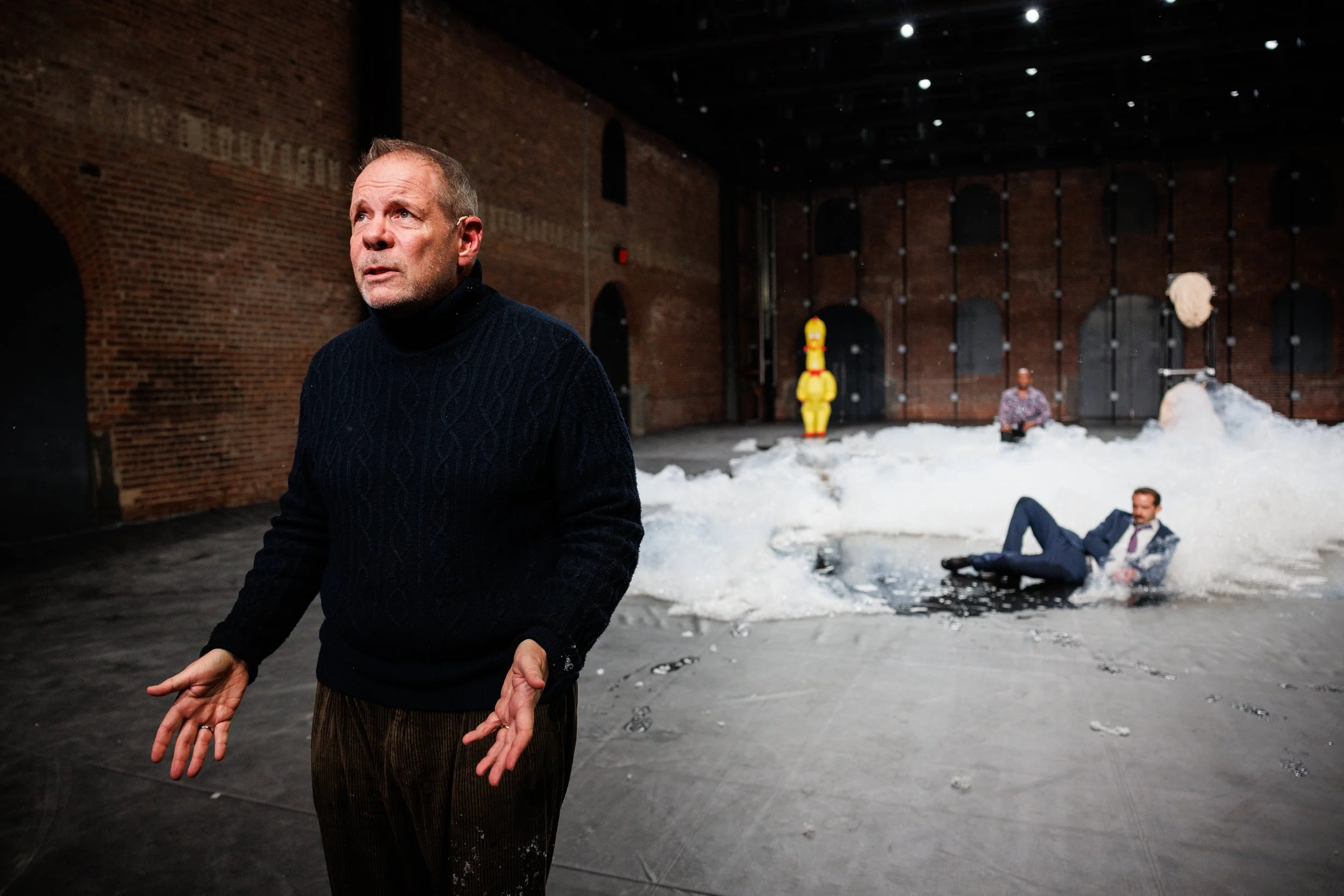
Thomas Jay Ryan, Will Brill, and Greig Sargeant in Kramer/Fauci at St. Ann’s Warehouse. Photo: Maria Baranova.
“I can’t hear you very well, and this earpiece is circa 1920.”
— Larry Kramer, C-SPAN call-in broadcast, November 30th, 1993
Theater and democracy, both forged in the same ancient Greek fire, share a core strand of DNA: dialogue. At their best, they both assert that listening to one another can change the world. American democracy is floundering and American theater—on Broadway, anyway—is struggling to respond. We have lost the ability to listen meaningfully to one another. But this fall, two Off-Broadway productions are using verbatim text to engage both performers and audiences in active listening with help from a miniscule secret weapon: the in-ear monitor.
Daniel Fish’s Kramer/Fauci, which dramatizes a confrontational C-SPAN conversation about AIDS between Dr. Anthony Fauci and activist-writer Larry Kramer, premiered at NYU Skirball earlier this year and has just finished a run at St. Ann’s Warehouse. Elizabeth Marvel and Lee Sunday Evans’s The Ford/Hill Project, which premiered in 2024 and concluded a run at BAM earlier this fall, also uses C-SPAN transcripts, taken from the confirmation hearings for Justices Clarence Thomas and Brett Kavanaugh, and the testimonies of Anita Hill and Christine Blasey Ford. In both pieces, actors wear in-ear monitors (IEMs) and are listening to the verbatim, C-SPAN text while they are performing. This invites audiences to really absorb—and, perhaps for the first time, hear—the past.
IEMs, a specialized earphone connected to a small audio receiver, are not entirely novel in theater. First developed for use by rock musicians, IEMs cropped up alongside the standardization of amplified sound in Broadway musicals with rock scores. Downtown, IEMs have long been used in more creative ways. With their 1984 production of L.S.D (... Just the High Points …), which will return in January 2027, the Wooster Group started using IEMs to feed text to actors, and later, to incorporate live direction into performances.

Elizabeth Marvel and Gabby Beans in the verbatim theater piece The Ford/Hill Project, chronicling the testimonies of Anita Hill and Christine Blasey Ford. Photo: Rebecca Smeyne.
What is novel, however, is the way that both Kramer/Fauci and The Ford/Hill Project are using this technology to engage with contemporary questions of truth. In a moment when the factual record is treated as a matter of opinion, the textual accuracy enforced by the devices functions as an argument for preserving the truth of what was really said, how, and by whom.
The actors who have used them describe IEMs as enabling a nearly egoless state of performance, allowing them to relay words from the past without interference or judgment.
In Eliya Smith’s Two Girls, running at Cherry Lane Theatre, two performers wearing IEMs are fed verbatim dialogue compiled from interviews Smith conducted in order to reconstruct the influence of the viral shock-porn video “Two Girls, One Cup” on the budding sexualities of young men raised on the internet. Two Girls uses verbatim, IEM-fed theater to communicate the fallibility of human memory and the imperfection of the historical record, an illuminating contrast with Kramer/Fauci and The Ford/Hill Project, which are more explicitly in conversation with American history.
With IEMs, the technical work of acting is compounded by a twofold challenge: listening actively to both the audio feed and to one’s fellow actors, and keeping pace with the recording, which creates an inflexible container for the performance. Many of the actors confessed to having initial concerns about the way this would change their work. Thomas Jay Ryan, who plays Larry Kramer in Kramer/Fauci, recalled his initial fear that “it would limit my creativity, and that I would be hemmed into certain rhythms and patterns.” Once he warmed to the idea, he realized that it keeps the “incredibly fast” pace at which Kramer and Fauci trade barbs, “but it in no way forced me to repeat the original dynamic.”
Gabby Beans, who played Anita Hill during the BAM run of The Ford/Hill Project, said, “Acting is always about listening. In a verbatim piece like Ford/Hill, where the explicit aim is to render the words of living people with a high degree of energetic and historical fidelity, the listening becomes far more athletic.”
This active, athletic listening creates a heightened sense of presence, the actors say, and a surrender to the flow of IEM-fed text. “It’s really about removing oneself from the equation,” said Jennifer Seastone, who plays nearly a dozen C-SPAN callers in Kramer/Fauci. “How can you be so present that you can communicate this ghost of somebody else? You’re just a vessel for it.”
Greig Sargeant, who plays moderator Steve Scully in Kramer/Fauci, learned how much information about character can be gleaned from a voice recording: “When you hear somebody else speak, the motivations and the intonations are in the voice, and so when you're hearing that, it steers you in the direction you emotionally need to go.”

Jennifer Seastone and Greig Sargeant in Kramer/Fauci. Photo: Maria Baranova.
These vocal clues led the actors to their portrayals of these real-life figures, rather than a typical process of table work and research. By listening with their bodies, and receiving the flow of sound and text, the actors become lightning rods. Faithfully depicting every stammer, hesitation, and slip-up results in speech more fallibly human than even the greatest fictional dialogue.
Kramer/Fauci and The Ford/Hill Project take different approaches toward making their audiences aware of the IEMs. The Ford/Hill Project makes the technological choice explicit: “We built an opening sequence of watching the actors put in their in-ears, right in front of the audience,” said director Lee Sunday Evans. “We hope that it never comes across as an esoteric performance device that you have to have a lot of literacy with experimental performance to be able to understand, but actually is seen as a practical tool that many people could relate to because we often listen to podcasts or news on our ear phones.” Kramer/Fauci uses the devices in a subtler and less obvious way, and Ryan doesn’t want the IEMs to detract from the raw energy of the performance: “I want [the audience] to connect to the people and the event, and be surprised or indifferent to the use of [IEMs].”
The staging of the two plays is also radically different: Kramer/Fauci, its four actors dwarfed by the cavernous St. Ann’s Warehouse, features roller skates, an inflatable chicken suit, and a foam machine—all items absent from this (or any) C-SPAN broadcast. The Ford/Hill Project is more spare, with actors in business-casual clothing circling a ring of nine chairs, which represent the Supreme Court.
Whether or not the audience is aware of them, the IEMs are both a prompting device and a dramaturgical hurdle. The actors can easily get tripped up by the rapid, complicated dialogue replete with “ums” and false starts—which, if they do, threatens to derail the entire company, since it’s nearly impossible to get back on track when there’s a precisely timed audio feed underlying their speech. That risk re-creates the high-wire act of the original speakers during these televised, career-defining moments.
As Evans puts it, “The stakes of how language was used in those hearings is incredibly high. It brings a different kind of electricity to the act of listening. When the actors are under the pressure of trying to repeat what they’re hearing, without being in control, that creates a different kind of pressure that is a roundabout way of bringing to life the pressure of the real life hearings.”
Both pieces examine watershed moments in our culture’s relationship to fact, and speak to the present. Kramer/Fauci stages a pivotal conversation in the AIDS crisis, one that foreshadows America’s present inability to engage with scientific and medical information, and depicts the hateful rhetoric around AIDS that presages the cruel oratory of Trump. Questions of accuracy run just below the piece’s surface: Fauci is quick to correct Kramer’s facts, and we feel the looming specter of the COVID-19 pandemic, foreshadowing Fauci’s status as a scapegoat in the disfigurement of the American relationship to scientific fact. The C-SPAN program features a call-in section, reflecting the kinds of misinformation, both malicious and ignorant, that existed during the AIDS crisis.
As The Ford/Hill Project emphasizes, the Thomas and Kavanaugh confirmation hearings were crucial moments in a culture that remains too often unconcerned with sexual violence against women. Both hearings played an outsized role in the present relationship to public trust and accountability.
By re-creating the language of these three influential moments as faithfully as possible, the two productions allow us to revisit the true moments buried under years of manipulation of the events depicted, and to remember the necessity of vigilance in the face of a culture that shows no sign of slowing its willingness to abuse the past.
The central questions of both pieces, underscored by the use of IEMs, said Jennifer Seastone, is “What is truth? And how can you communicate truth when there's no such thing as truth?” The answer, she posits, is something akin to “the medium is the message”: “Staying as close as possible to something seems like one way.”