

Eliya Smith Gets Outside Herself
In one busy year, the playwright has gone from the summer hit Dad Don’t Read This to Biography in Maine to Two Girls, now at Cherry Lane. Smith talks about verbatim theater, rural audiences, and the infamous viral video that inspired the play.
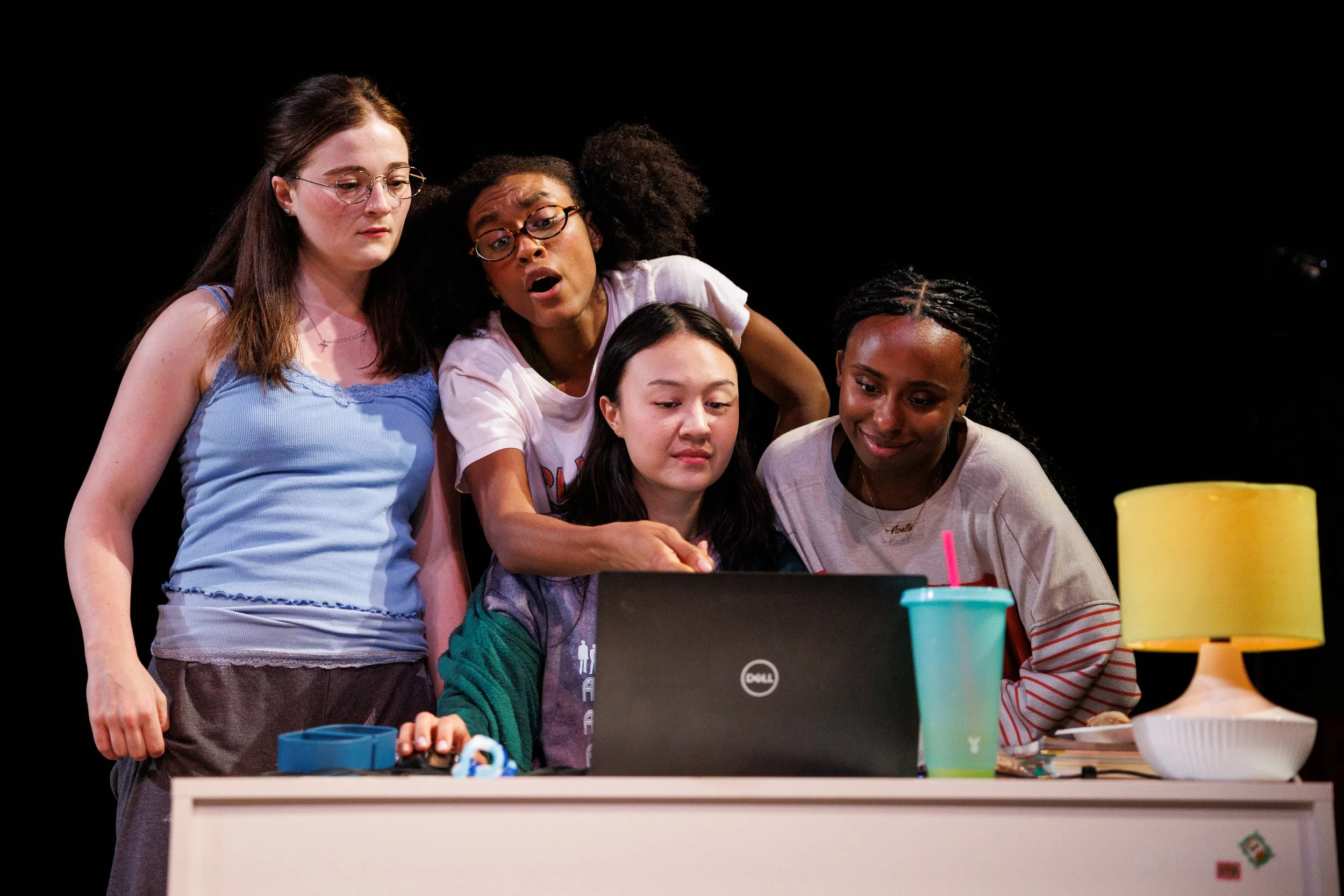
Sophie Rossman, Kayta Thomas, Amalia Yoo, Renée-Nicole Powell in Eliya Smith’s Dad Don’t Read This at Greenwich House Theater. Photo: Maria Baranova
The casts in Eliya Smith’s plays are shrinking.
First, Dad Don’t Read This—a New York Times Critic’s Pick about four girls trapped in the tempest of suburban adolescence—ran at St. Luke’s Theatre for most of May, and then extended at Greenwich House Theater from mid-June to mid-July.
Next, Biography, centering a trio of 20-somethings who’ve been relegated to the peripheries of their own lives, received a late-summer engagement with ISLE Theater Company in Maine.
Now, a two-hander. As we sat on the recessed outdoor bench of an ice cream shop in Brooklyn, I spoke with Smith about the benefits of a dumb phone, chatting Chekhov with middle-aged Mainers, and the fall production of her newest play called Two Girls, running from October 7 to November 29 at Cherry Lane Theatre.
Two Girls is not like other girls. Centering on the viral shock-porn video that came to be known in the internet streets as “2 Girls 1 Cup,” it’s Smith’s smallest produced play by cast size, and it’s her first professional foray into verbatim theatre: Smith conducted the interviews that form the basis of the script.
When she spoke with her interview subjects—men with some relationship to the source material—she made it clear that anything and everything could be redacted from the record. “I was like, ‘If you don’t want me to use this, I simply won’t.’”
Smith maintains this isn’t a reporting project. She says, “I really was never a serious journalist,” though she did find common ground between developing this play and working on her college newspaper. The central questions were the same: “What’s the story here and how can I piece something together based on the conversations I’ve had?”
After sifting through the transcripts, she discovered that her play, which “really could have gone in any direction,” would be about “gender and bodies and disgust and the formation of sexual desire, specifically in our generation.” “Our generation” for Smith, 28, being the upper limit of Generation Z: born into a pre-9/11 world, yet unable to remember anything before taking off their shoes in the TSA line or spurious claims about Iraqi weapons of mass destruction.
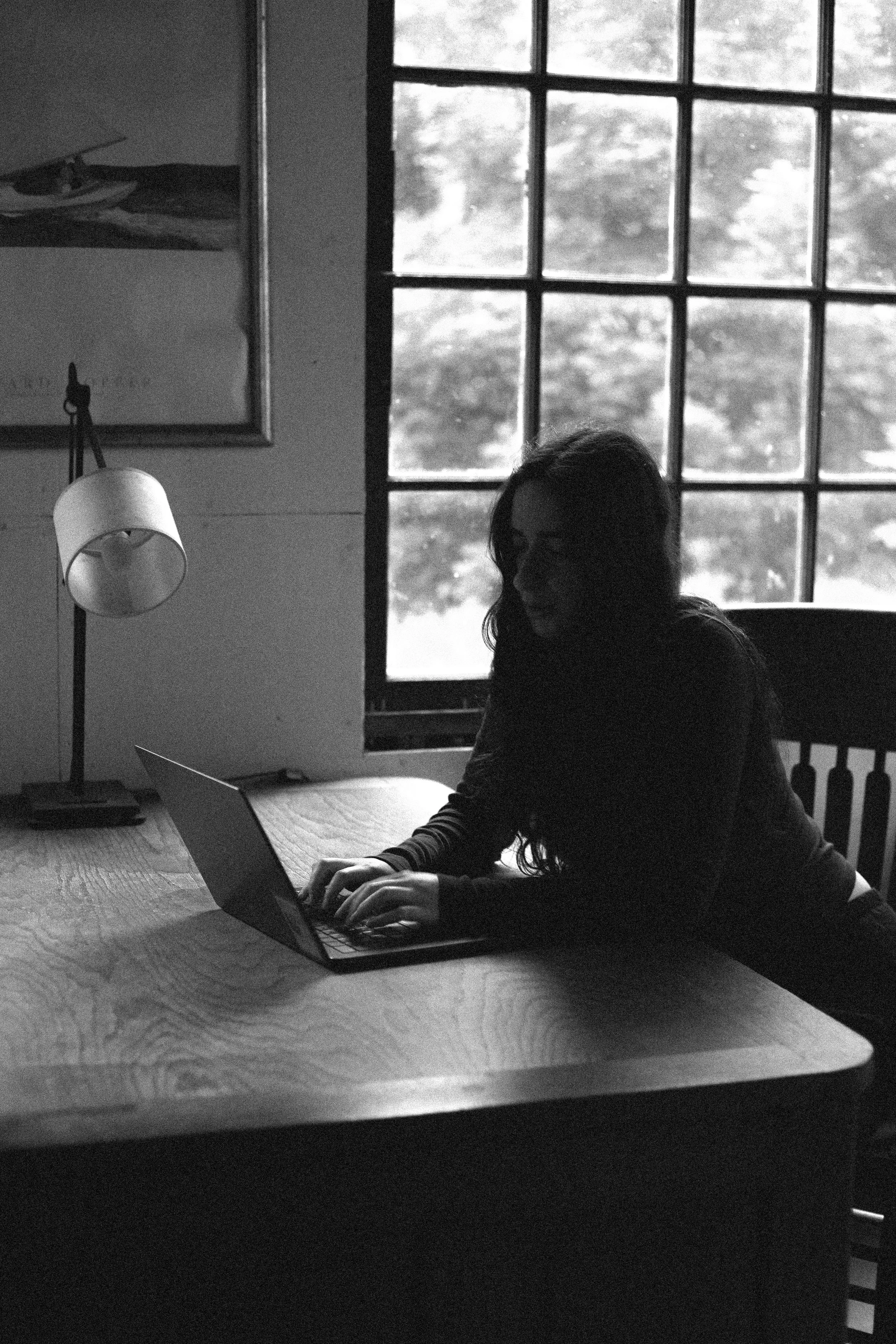
Eliya Smith working on her play Biography in the rehearsal space in Deer Isle, Maine. Photo: Amy Bolton.
That’s the world in which the 2007 entry put up Brunsonian numbers in public schools across America. Classmates, cousins, and coworkers were all subjected to footage of the cyclical expulsion and consumption of [redacted].
Not Eliya though—y’all stay safe.
Smith said, “I’ve never seen it, and now ... I’m like, ‘I never will.’ The joke that I keep making, but it’s true, I keep saying, ‘If I had known how gross the video was, I would never have started this project.’ I was shocked.”
And aware that the premise of her play is discourse bait, Smith says, “I think there’s been a little bit of a sense in the coverage of the play that like, ‘Oh, isn’t it so crazy that people made a play about this video?’ And I think my response to that is, ‘Isn’t it so crazy that this video had such a hold on people?’”
“I’ve never seen it, and now ... I’m like, ‘I never will.’ The joke that I keep making, but it’s true, I keep saying, ‘If I had known how gross the video was, I would never have started this project.’ I was shocked.”
Ultimately, both video and play are two peas in a zeitgeisty pod. The video is credited with inspiring a whole genre of virality-seeking online content—the reaction video. The play is authored by one of the city’s buzziest playwrights, developed in collaboration with another buzz-magnet in the Goat Exchange, and will run in the (largely self-proclaimed) “Birthplace of Off-Broadway,” Cherry Lane, currently owned by independent film darling A24.
Smith’s summer play Biography was different. Miles away from anything approaching buzz, Biography’s run in rural New England was a developmental workshop, during which the theoretical distinction between a “preview” and an “open rehearsal” was often immaterial. And if Two Girls is about what happens to unsuspecting audience members when a piece of media breaks containment, then Biography refocuses on art’s makers. To Smith, Biography is about “artists deciding whether or not to give up on their art, and it’s really about trying to live a meaningful life.”
Smith purposefully set that attempted meaning-making in Ohio, circa 2019—well into the state’s red and reactionary era, after several decades spent as a reliable microcosm for the country’s general political disposition. Knee-jerk political reactions and worst-case scenarios are familiar in Maine, where Biography went up, and where economic stagnation has led to semi-permanent alarm ringing about “brain drain” in the most demographically aged state in the country.

In Maine with collaborators Juliana Sass and Julia Greer. Photo: Eliya Smith.
The political precarity contrasts with the state’s environmental beauty, described by Smith variously as “stunning,” “magical,” “beautiful.” And Isle au Haut, a tiny island near a slightly less tiny island off the coast of the mainland—and the site of a day of Biography-related programming at the public library—was “so beautiful that you start creating fake memories imagining that you had a childhood there.”
But while Maine is transcendent in its natural beauty, it can’t compete with New York City’s quantity of cultural experiences. Smith found Biography’s audiences to be sweet and supportive, and suspects that artistic dearth is a major reason. Regardless, this generosity took the pressure off Smith to have the play together—to “get it right”—right away. Maine became part playground, part laboratory.
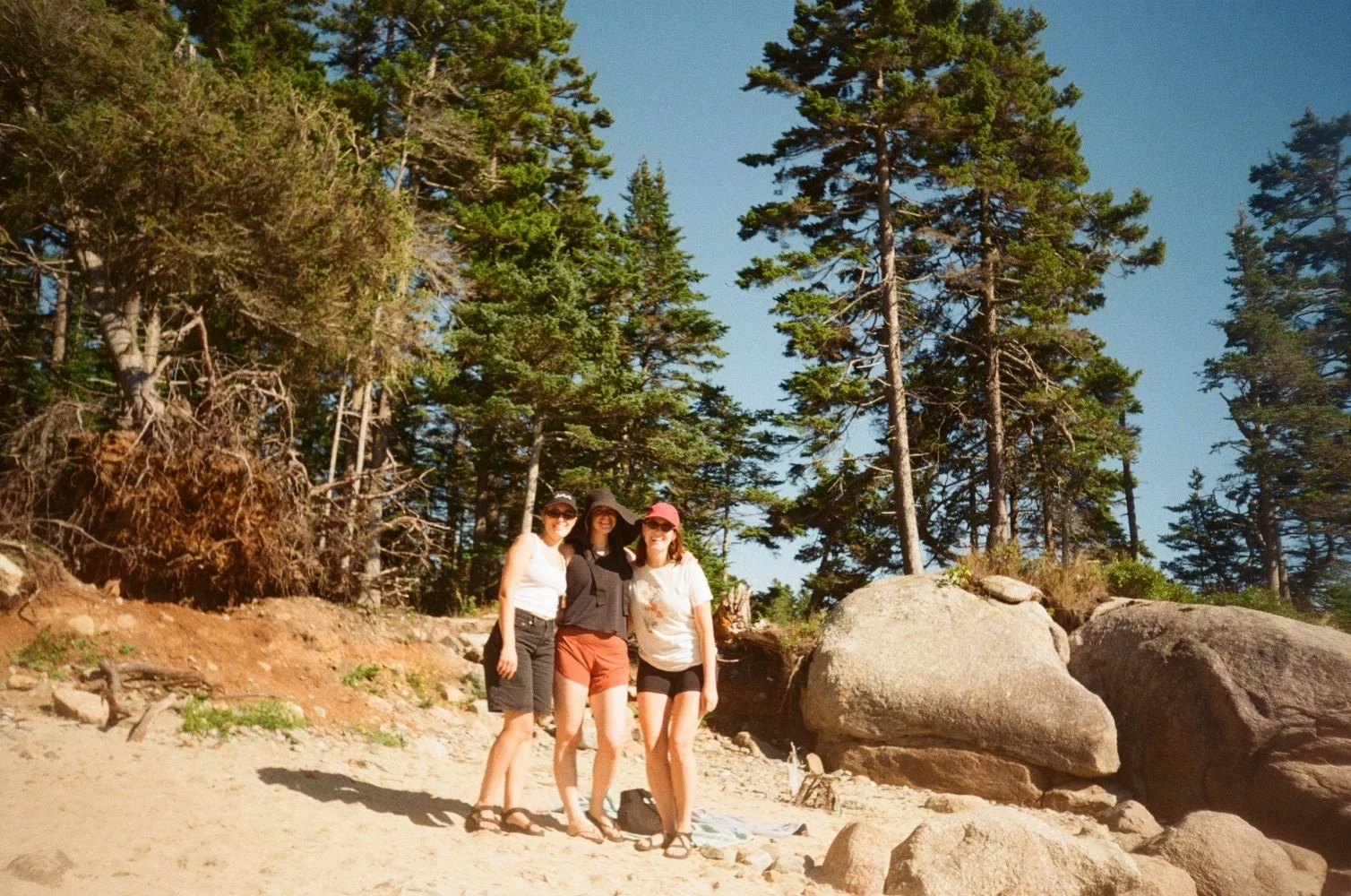
Eliya Smith in Maine with collaborators Juliana Sass and Julia Greer, where they worked on the play Biography, which is about artists “trying to live a meaningful life.” Courtesy of Julia Greer.
Biography’s team chose to add an act break to the play, even though the work runs around 90 to 100 minutes. Smith reports that, “We actually found that people enjoyed having an outing and being there. And actually, adding an intermission and extending the evening refreshed people when they came back for the second half. It felt like it allowed people to sit in the play and make an evening of it.”
Meanwhile, a play in New York is constantly trying to earn its place. “It sometimes feels like with a New York audience, you really have to win them over and sort of prove that the thing you’re making is worthy of people’s time,” notes Smith, who doesn’t exclude herself from this analysis—“which I get. I, too, am a New York audience member.
She wasn’t always. She was once a suburban community theater kid in Ohio. Those were the productions that taught her that theater isn’t just for the already-initiated insider. That this art form can also reach people outside of itself. In different ways, she attempted to crack open the dividing wall between “in” and “out” with both Dad Don’t Read This and Biography, and it’s a goal to do so with Two Girls as well. It’s also something she feels doesn’t happen enough in the city.
As we sat on that recessed bench, submerged in Park Slope’s upper-middle-class soundscape, and within eyeshot of a frozen açaí bowl spot, Smith says, “I often feel like a lot of plays in New York are just made by and for the same people. There’s nothing wrong with that. There’s nothing wrong with the people who go see plays in New York.
But theater is the people’s medium, or should be, in my opinion, and I feel like we’ve kind of lost the ability to really use it as such. But I think we could get it back.”