

As the Apple Family gathers on the eve of the midterms at the Public Theater, the playwright and director discusses creating “little worlds,” the struggles of nonprofit theater, and why the same prop keeps showing up in his plays.
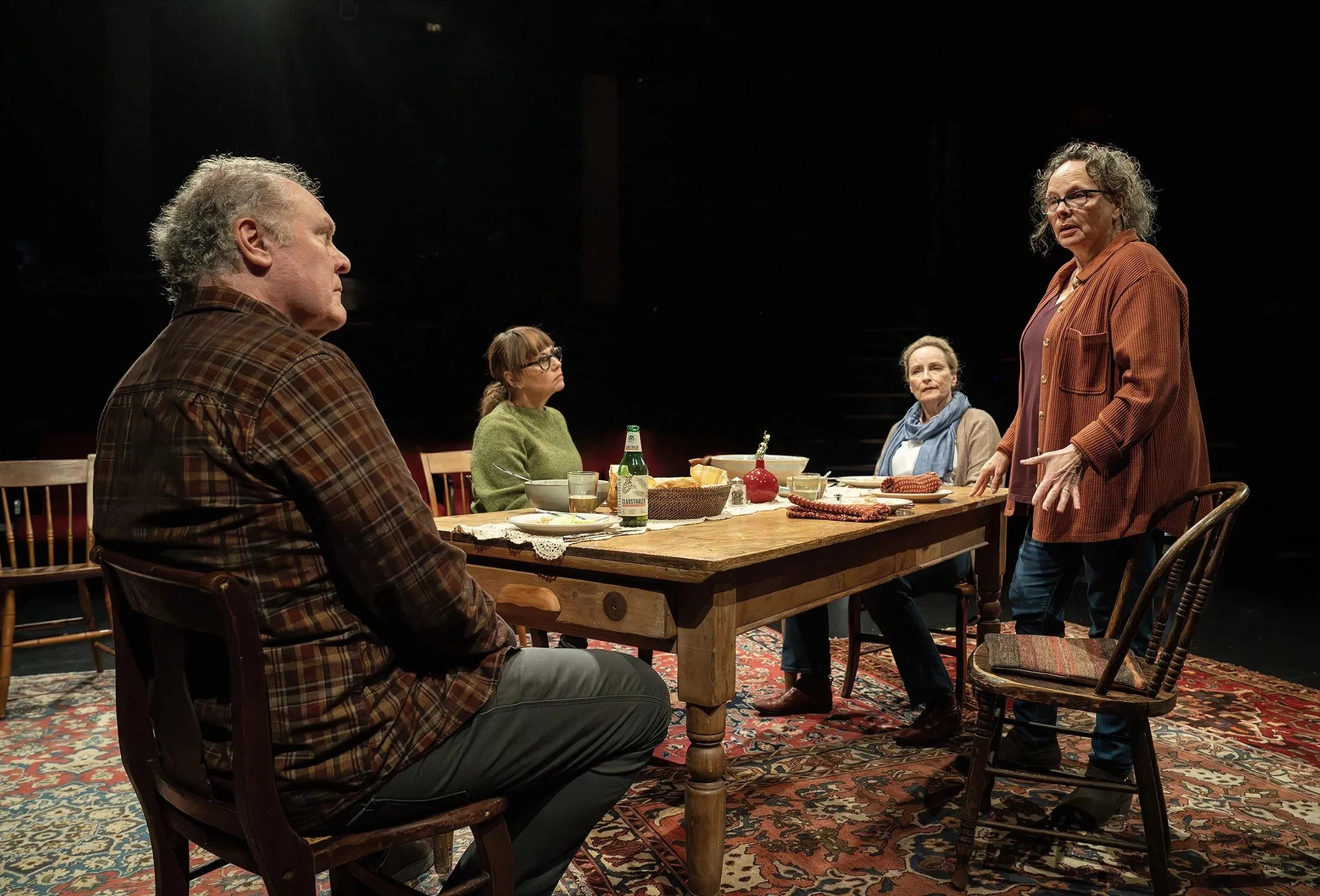
The Apple Family returns: Jay O. Sanders, Sally Murphy, Laila Robins, and Maryann Plunkett star in We’ll See, written and directed by Richard Nelson at the Public Theater. Photo: Joan Marcus.
Richard Nelson has returned to Rhinebeck. Well, he never really left. Since 1982, the playwright-director and his family have lived in the Dutchess County town of 7,658 souls. For 16 years, the upstate village has also been the setting for Nelson’s series of intimate family dramas, collectively known as the Rhinebeck Panorama. That 12-work chronicle continues as We’ll See opens the Public Theater on November 3, when audiences can catch up with the Apple family.
Since their debut during Obama’s first term, the Apples have endured as a politically engaged, liberal clan going through professional changes and personal tragedies—America writ small. In previous installments, the Apples congregated for dinner during midterm and presidential elections (That Hopey Changey Thing and Sorry), on the anniversaries of September 11 (Sweet and Sad) and John F. Kennedy’s assassination (Regular Singing), and, memorably, on Zoom during the Covid pandemic (What Do We Need to Talk About?).
Schoolteachers Barbara (Maryann Plunkett) and Marian (Laila Robins), writer Jane (Sally Murphy), and their brother, the lawyer Richard (Jay O. Sanders), talk politics, fret about aging, muse on art, and occasionally sing. Their accumulated history gives the seemingly incidental moments of everyday life a quietly epic weight.
As he has with each Apple play, Nelson sets the action on the day the production opens. That means previews roll to the present, the show opens, and the play immediately converts into a historical document. We’ll See takes place on Tuesday, November 3, the eve of the current midterm elections. Given polling in recent weeks, will the characters be tentatively jubilant or pessimistic? Let’s expect both.
Nelson sat for an interview in Martinson Hall at the Public early in the rehearsal process. Potential set pieces were arranged around the space: a well-worn kitchen table, a few simple straightback chairs, a side table. We sat and discussed returning to the Apples after the weird intimacy of digital theater in 2020, the “death” of American nonprofit theater, and how Nelson’s form of exposed-brick naturalism translates across the Atlantic.
DAVID COTE: Sixteen years after their first appearance at the Public, in this very space, and six years since they checked in on Zoom during the pandemic, did you imagine you’d still be following the Apples?
RICHARD NELSON: Initially, I thought That Hopey Changey Thing would be a one-off play, and then in the middle of that, I thought, maybe it’s a series, definitely with a time limit. Then it started to grow—into [other Rhinebeck families] the Gabriels and the Michaels, and the Zoom plays were a surprise. When I was doing Hopey Changey, I crossed paths with Oskar [Eustis, Public Theater artistic director] in the lobby, and said, “If another 9/11, or something of that nature happens, and we wanted to have a theatrical response, I have a way through the Apples.”
Is the second Trump administration that national disaster?
In recent years I’ve been working abroad in Europe, watching my country go through what it’s going through, wanting to feel American, to articulate feelings about what’s going on. A year ago, I was talking to Oskar and said, “I think the midterms are going to be interesting. How about one set on that night?”
Which brings us back to Hopey Changey, which coincided with the 2010 midterms. This cultural reference is older than both of us, but did you ever conceive this project as a contemporary version of the Living Newspaper?
Not really. The Living Newspaper came out of an ideological view of the world during FDR’s New Deal, wanting to make points, more like the opening monologue in late-night talk shows today. What I wanted was to put human beings on the stage and have them talk about how they see the world, or how they see themselves, all entwined together, and have an audience walk in, perhaps talking in the same way, or perhaps not, but hearing their thoughts articulated in front of them. It’s a very human-centered, actor-centered world.
What’s interesting about people is that our political views, our social views, our sex life, our family life, our artistic ambitions, artistic thoughts, what we love to read, everything—all are completely entwined, and the moment you pull one away and talk about it, basically you’re trivializing what it means to be a human being. I often quote Strindberg, in his preface to Miss Julie, he says the “multiplicity of motives” is indicative of our time. The “multiplicity of motives,” by which he means we as human beings do one act, but for many different reasons, sometimes contradictory ones.
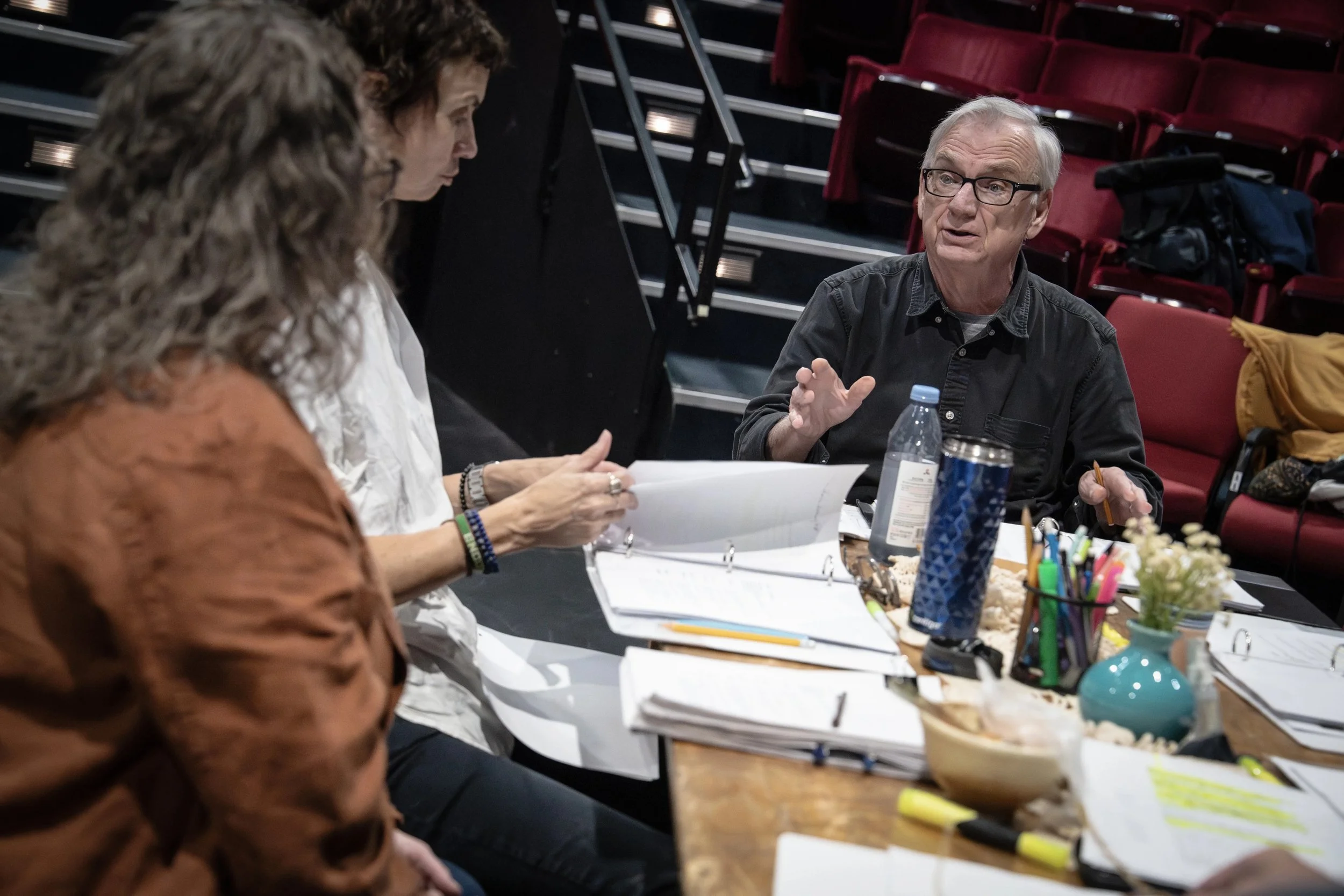
Playwright and director Richard Nelson in rehearsal for We’ll See. Photo: Joan Marcus.
I came to this interview full of questions about the characters: Is Richard still living in Rhinebeck with a girlfriend? Are Jane and Tim an item or not? Is Uncle Benjamin still in the nursing home? Like the TV recap voiceover: “Previously on the Apple Family Plays…” But after what you just said, they seem like soap opera concerns.
You know, I believe there are two kinds of plays. One in which an audience asks what’s going to happen, and the other in which the audience asks, what happened. And my plays are always the latter. It’s an unpeeling. That sustains it, hopefully sustains it, because nothing happens in the piece.
The people are the action.
Totally. Revealing their relationships, that’s the story. But I understand, because of the gaps of time, you might have an interest in knowing who’s where, and what’s happened to whom. In one of the Zoom plays during the pandemic, I strongly implied that Benjamin [uncle to the Apple siblings] had died. And Jon DeVries, who played Benjamin, refuses to believe that. [Laughs] How unusual for an actor! After the play ran, he told me, “So they gave away my clothes. So what? I didn’t need those clothes anymore; I’m in the nursing home.”
So no spoilers from you about We’ll See. Richard hasn’t gone MAGA?
We are six years later. People are different. My writing is different. We need to explore the play like a new play, not like season five of a series.
Your actors are very loyal, but of course they land different gigs here and there. Jay was an appropriately bombastic Falstaff in Henry IV at Theatre for a New Audience. How much effort is involved in getting the actors to that extremely naturalistic, almost hushed place?
It’s something you have to keep working at because I don’t write characters. I write relationships. And that means you can’t come in with your “character.” You need to find it in the relationship. So if this person has changed a little bit, that’s the discovery in rehearsal. That’s where the intimacy comes from. It needs to be discovered. It can’t be just brought to the table.
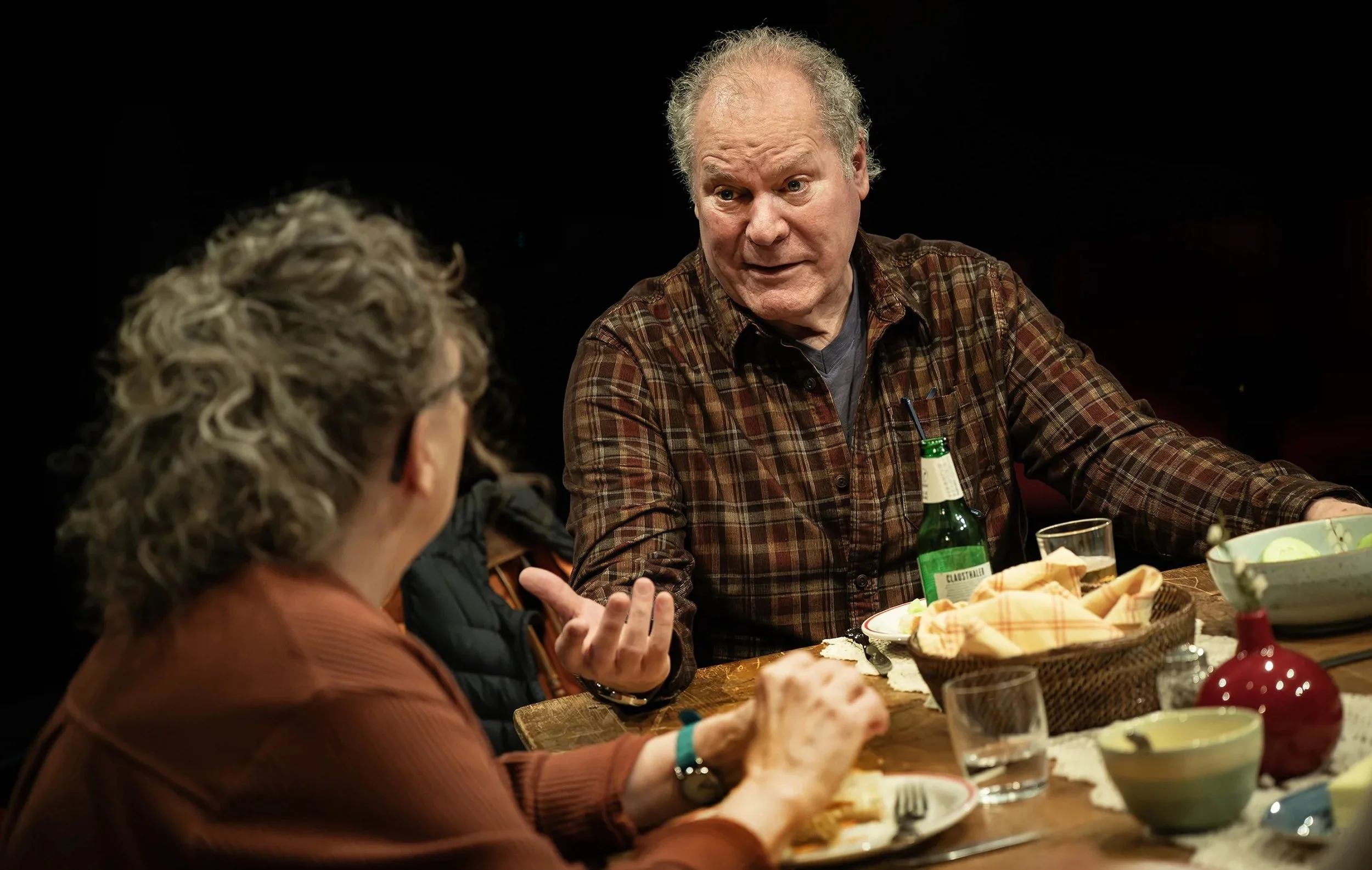
Maryann Plunkett and Jay O. Sanders getting to that naturalistic place, a hallmark of Nelson’s work. Photo: Joan Marcus.
Speaking of which: Are we now sitting at the same table, in Barbara’s kitchen, from 16 years ago?
We somehow lost that table. They bought me a new table, which I saw for the first time this morning. Which was too small. I thought it was one foot shorter than this. This is the same table that I initially used in Uncle Vanya [at Hunter Theater Project in 2018]. And then I used it again in The Michaels [in 2019]. And last year, when the Public brought over my play from Kyiv, When the Hurlyburly’s Done, we used this table. This is my old workhorse table, and now I’ve got a drawer on this side and a drawer on that side. Took me some years to get both of those drawers. I’m in discussion with my designer whether I can have this table or not because he liked the darker one, but I like this one, so we’ll find out. You don’t want [the actors] to feel squeezed. You want them to feel comfortable.
In July, Oskar announced that he’s leaving the Public in 2028, and he set off a passionate debate in theater circles when he told the New York Times, “The American nonprofit theater movement is over.” Basically the model is broken or dead. People were angry, defensive, and some agreed. What do you think?
Without any question, it’s been dead for a while. From an artistic point of view, we’ve completely lost our way. The theaters that the regional theater movement created were artist focused, artist driven. There were artists on the staff. Now it’s administrative theater, and the guests of the administration come do the plays. The message is: We’re the theater, you’re the guests. When, in fact, artists create the theater.
In my profession, if you had your play done at the Public Theater, that was a triumph. But we’ve come to a point where everything has to be a stepping stone. If your play doesn’t move, it’s not a success.
But a sustainable career as a playwright is pretty much impossible in this economy. Having a play produced in New York can be a stepping stone to getting work in television.
That is true. It’s gotten more like that because of the streamers. I guess that’s life. But every play doesn’t have to be on a commercial journey to Broadway. We’ve lost that vision, and it needs to be rekindled in some way.
Do your friends in Rhinebeck know that you’re writing plays about them?
They do.
Have they come down and seen them?
Some have. People I don’t know stop me in the street and say nice things. I don’t make a big thing of it.
I went to Bard College in the ’90s so I’m familiar with Rhinebeck. It’s gentrified, I assume.
We moved there in ’82 and it was depressed. IBM had just closed two major plants. Things were being boarded up. Houses couldn’t be sold. One of the pillars of the village was Beekman Arms—that stayed there—and Upstate Films, which was fantastic and held things together. It was very slow throughout the ’80s, even into the ’90s. Then early 2000s became a gold rush, and now it’s two cities: a wealthy place and a community that’s, you know, not. It’s no longer so pleasant to go into town, and the wealth is pretty apparent, but most weekdays it’s still pretty good. But it’s crazy wealth. We mention it in the play. [Former Google CEO] Eric Schmidt bought and renovated the Astor estate. He built a railroad on his estate with a trestle, so his guests could go building to building on a train. It’s like we’re living in the 19th century.
A new Gilded Age.
Totally huge new Gilded Age.
The early part of your career was tied to the Royal Shakespeare Company: you had ten plays produced with them in the 1980s and 1990s. I noticed recently you’ve been returning to England: two productions at London’s Hampstead Theatre: Springwood and before that An Actor Convalescing in Devon.
Yes, this past June I directed Springwood there, based on my screenplay for Hyde Park on Hudson. In 2024, I wrote An Actor Convalescing as a monologue for my friend, actor Paul Jesson.
How did that come about?
Paul is a very close friend. But he was also a big Shakespearean actor. I saw him play huge roles. He had cancer of the jaw, and had to lose part of his jaw, and was wondering if he could act again. So I said, “Why don’t I write you a play?” The goal was to get Paul acting—and that’s somewhat the story of the play.
Was the language circumscribed by any pronunciation issues?
No. Paul worked and worked. But it was a journey. We opened at Hampstead, and toured. It was at the RSC, one night at the Bath. Since then, he was in The Tempest with Kenneth Branagh at the RSC. And Paul’s starring in Tender Loving Care, the new Mike Leigh film.
You have to forgive me and my critic brain that needs to put things in boxes: In literary terms, how would you categorize your Rhinebeck Panorama plays? I mean, they’re naturalistic dramas, but also post-dramatic—to use an academic term. Are they allegories? Parables? Realistic situations with humans, but teaching us something?
They’re little worlds. Thomas Ostermeier, head of the Schaubühne in Berlin, came to see the Apple Family Plays and said, “I want to take him to Berlin.” I asked why. The first piece starts, “Fuck you, Andrew Cuomo!” and they don’t know who Cuomo is in Germany. Well, the plays did go to the Schaubühne, as did the Gabriels, and they toured the world and I realized something universal is in them. Ostermeier is a man of a certain kind of theater, which you would not associate with these plays.
Ariane Mnouchkine came, and since then, I directed a play of mine at the Théâtre du Soleil. Only the second time she invited a director to direct her company. Peter Brook came to see Uncle Vanya and he and I had a number of meals before he passed away [in 2022]. What did Peter Brook, Ariane Mnouchkine, and Thomas Ostermeier see in this work? This work, which some people call hyperrealistic or naturalism-plus? How can it be naturalism? There are no walls. It’s just a bunch of furniture. What I try to do is create something that actually happens, that is alive and real in front of people, where actors are talking to each other, listening to each other, overheard by an audience. Now, in a world of screens and phones and AI, this is very rare.
It’s radical candor. Plus ritual—human rituals, like making dinner and hanging out. Anything can happen. But I also feel like you’re writing a series of novels.
It’s the feeling of walking into a world, or the best of novels. You read Proust and you’ve got to give in. You’ve just got to give in.
This interview has been edited and condensed.