

The two writers, once artistic peers, traveled radically different paths. A consideration of The Verge and The Hairy Ape, now running in the same season for the first time in over a century.
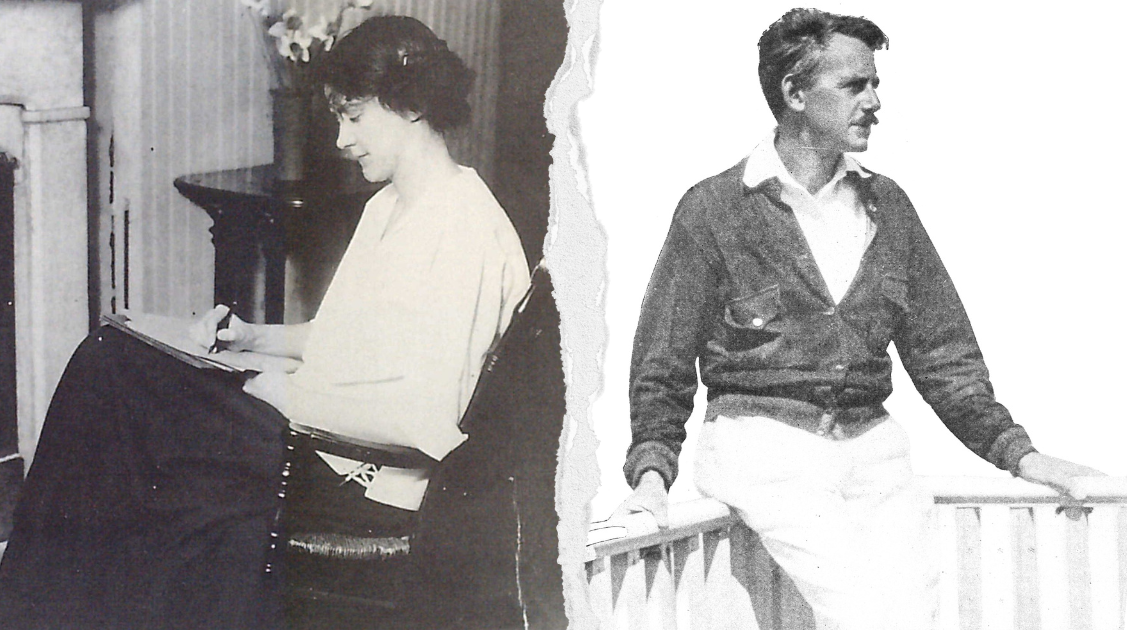
Playwrights Susan Glaspell and Eugene O’Neill. Photos via Wikimedia Commons.
Until this fall, the last time that Susan Glaspell’s The Verge and Eugene O'Neill’s The Hairy Ape appeared together during the same season in New York was in 1921–22, when both plays had their respective debuts. Glaspell and O’Neill were close friends and collaborators at the time: they were part of the collective called the Provincetown Players whose mission was nothing less than to foment a cultural revolution in America, one built on an ethos of lifting up the collective spirit, rebelling against commercialism, and expanding the boundaries of what theater can do.
The two plays, programmed as part of that season’s offerings by the group, were, each in their own way, incendiary attacks on the status quo. They were explosive, subversive, and shocking, together representing the apex of what the pioneering theater company had achieved to date. They solidified the standing of Glaspell and O’Neill as artistic peers, at the vanguard of American drama. And yet, because of philosophical differences and tragic circumstances, that season also saw the abrupt end of their personal and professional relationship, of the Provincetown Players, and of Susan Glaspell’s ascendent star as one of our greatest playwrights.
The Provincetown Players were founded in 1915 in Cape Cod, Massachusetts, by Glaspell and her husband, the author, teacher, farmer, and director George Cram Cook. The following year, the group heard about a young wastrel living in a shack nearby who claimed to have written a trunkful of plays. The 27-year-old Eugene O’Neill was invited to come and have one of them read aloud to the group, which included John Reed and Louise Bryant (a duo famously portrayed by Warren Beatty and Diane Keaton in Reds), the painter Charles Marsden, and author Wilbur Daniel Steele. O’Neill accepted. “Then,” Glaspell later wrote, “we knew what we were for.”
Glaspell and Cook were writing plays too (Trifles, an early one-act from Glaspell, remains a touchstone), and they quickly became O’Neill’s comrades, mentors, cheerleaders, and producers, presenting almost all of O’Neill’s early successes, both on Cape Cod and then in New York City, when the company moved its base of operations there (to MacDougal Street in Greenwich Village, at a venue now owned by NYU). Other notables would join the cause, including Edna St. Vincent Millay, Theodore Dreiser, Djuna Barnes, and Sherwood Anderson.
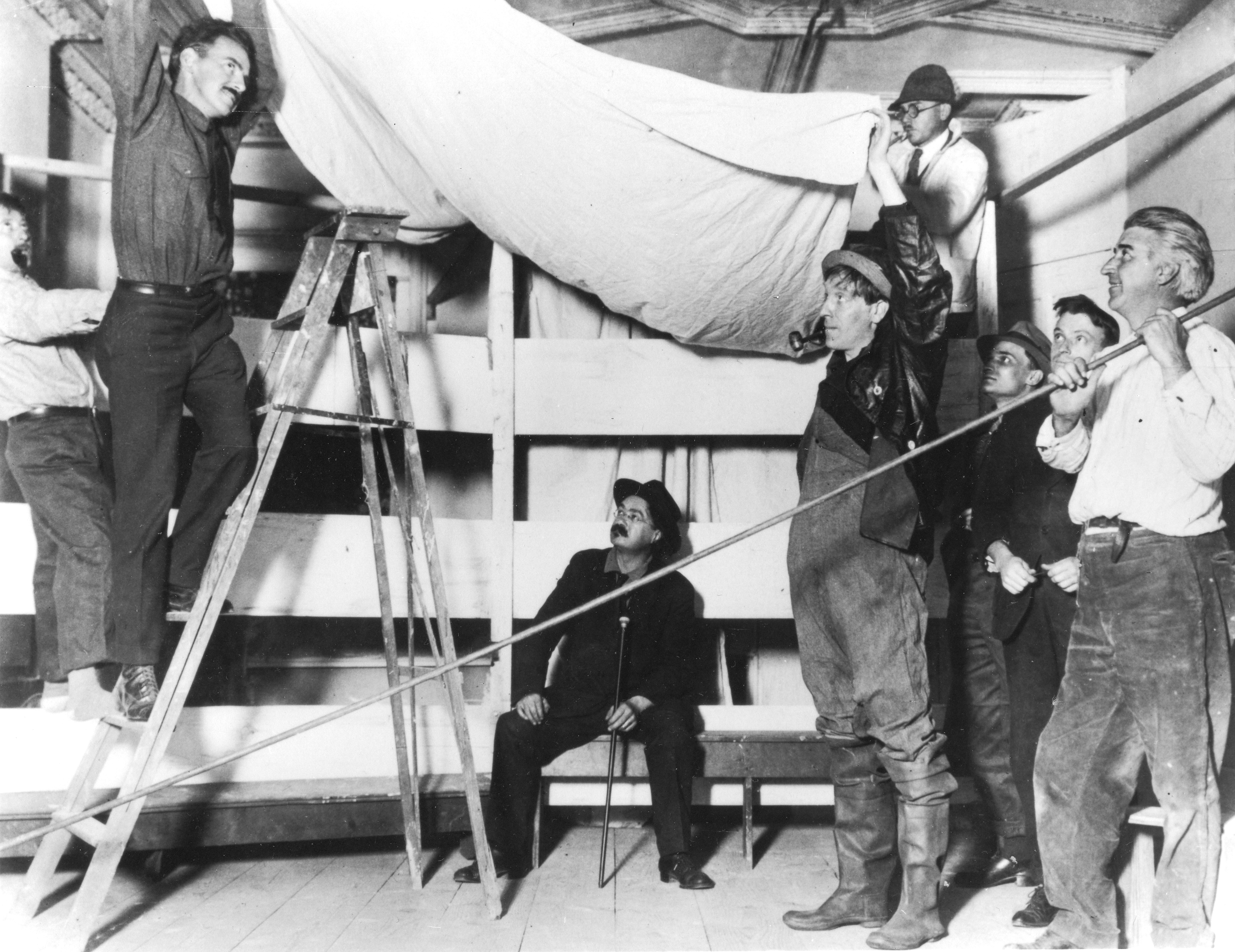
The Provincetown Players setting up for Bound East for Cardiff by Eugene O’Neill (far left) at the company’s first playhouse on MacDougal Street in fall 1916. Photo via Wikimedia Commons.
But O’Neill and Glaspell were the superstars of the group. They were gaining the greatest recognition both here and abroad, each of them contributing equally a new native art form built on wild experimentation, a guerilla, roll-up-your-sleeves production style, and bold ideas that spat in the face of capitalist, patriarchal values. It was more than just exciting theater; it was the beginning of a revolution.
Just prior to the 1921–22 season, the company made American theatrical history by casting a Black actor (Charles Gilpin) in the lead role of O’Neill’s The Emperor Jones—a tiny, no-frills downtown production that sent reverberations around the world. Glaspell, for her part, had just produced Inheritors, a searing indictment of white colonialism in America and a passionate defense of immigration and free speech (a play as relevant as ever today; it is long overdue for a major revival).
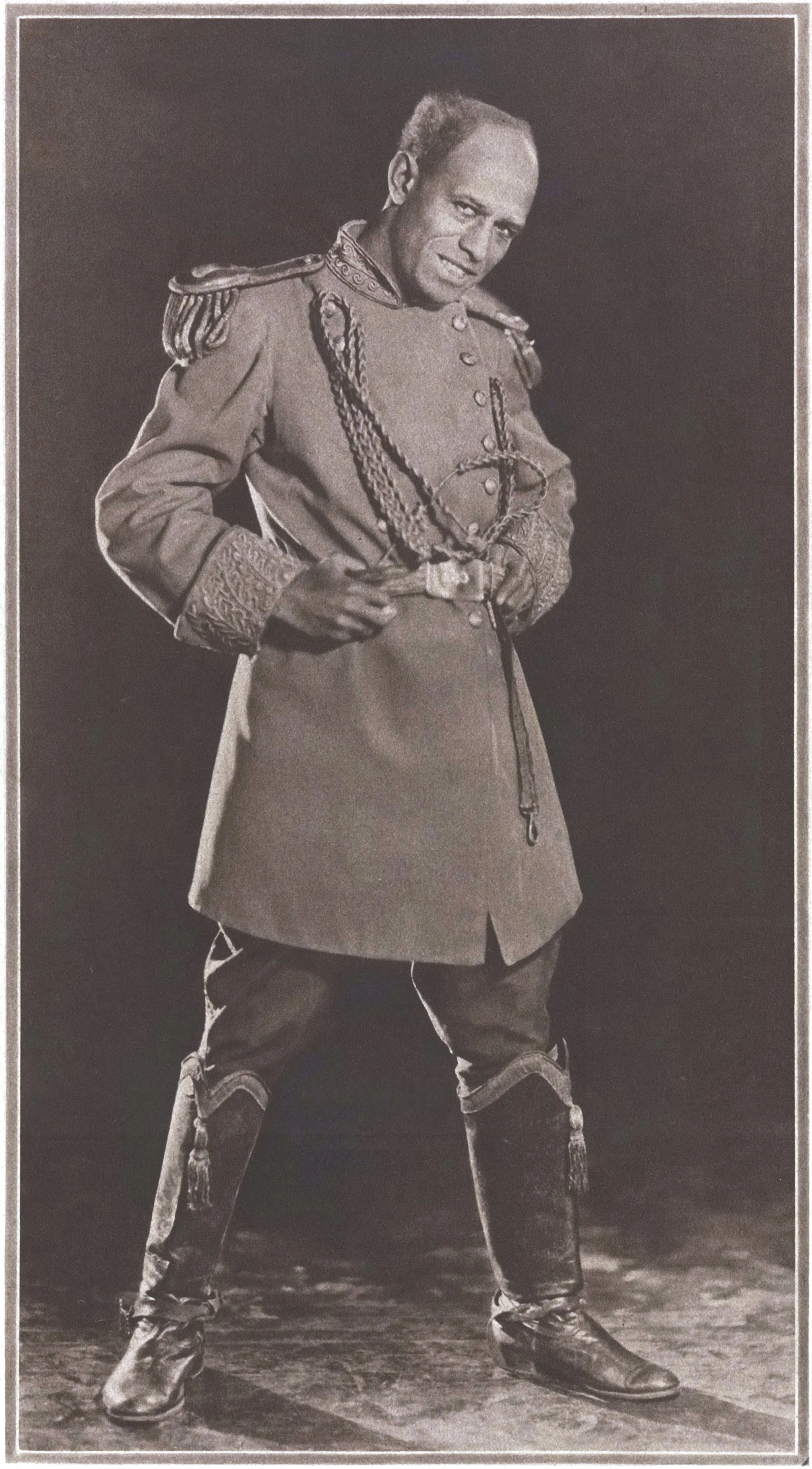
Charles S. Gilpin in the Provincetown Players production of Eugene O’Neill’s The Emperor Jones. Photo: James Abbe via Wikimedia Commons.
Then came The Verge and The Hairy Ape, arguably the two playwrights’ boldest work to date. Of the two, The Hairy Ape is the one known to contemporary New York audiences, having been revived in indelible productions by the Wooster Group (in the late 1990s) and by the director Richard Jones at the Park Avenue Armory (in 2017; a new revival is now running at the Irish Rep). It is the story of one man’s struggle (and failure) to belong in a modern world that wants no part of him. The play is a staged nightmare, a feverish tour through a reality its protagonist cannot understand, as evergreen and emotionally tumultuous today as it was a century ago.

Eugene O’Neill comes to the Irish Rep with a 2026 production of The Hairy Ape. Clockwise from top left: Hassiem Muhammad, Adam Petherbridge, Harrison Tipping, Jon Beavers, and Nayib Felix. Photo: Carol Rosegg.
The Verge, on the other hand, is a deep cut from the fiery dawn of serious American drama, rarely produced or referenced. It is a shuddery, otherworldly attack meant to shake an audience awake from its quotidian stupor, a play that asks us to consider the wild otherness always surrounding us, if we are but brave enough to look.
The Verge’s protagonist is Claire Archer, a botanist of a certain age who attempts to create life forms that have not existed before. Her mission is both an outgrowth of, and a metaphor for, her quest as a human being––to burst out of the hoary patterns circumscribed by civilized society.
Over three acts, representing roughly twenty-four hours, the play tracks Claire’s struggle to traverse the unpredictable wildness of the untrodden path. She has three men in her life (called, literally, Tom, Dick, and Harry): one a stable husband who loves but does not understand her; another a partner in what seems to be a clandestine but unsatisfying affair; and finally a long-standing friend, her soulmate, with whom she craves a union beyond the realm of earthly love.
A well-adjusted daughter, just returned from a trip abroad, horrifies Claire with her normality. A sister scolds her poor manners. A neurologist (or, as Claire calls him, “an insanity man”) is called in to try to help quell her “hysterical” ways. They all swirl and swarm around her, challenging her compulsions (scientific and otherwise) to ignore “what one does” and “what has been,” imploring her to stop her “queerness,” her “otherness.”
These words—“queer” and “other”—resound and repeat throughout The Verge. Today, they have such currency that, when I attended a staged reading of the production that just began performances at the Public Theater, gasps were heard in the audience. How was it possible that this play, written long ago, could be so prescient?
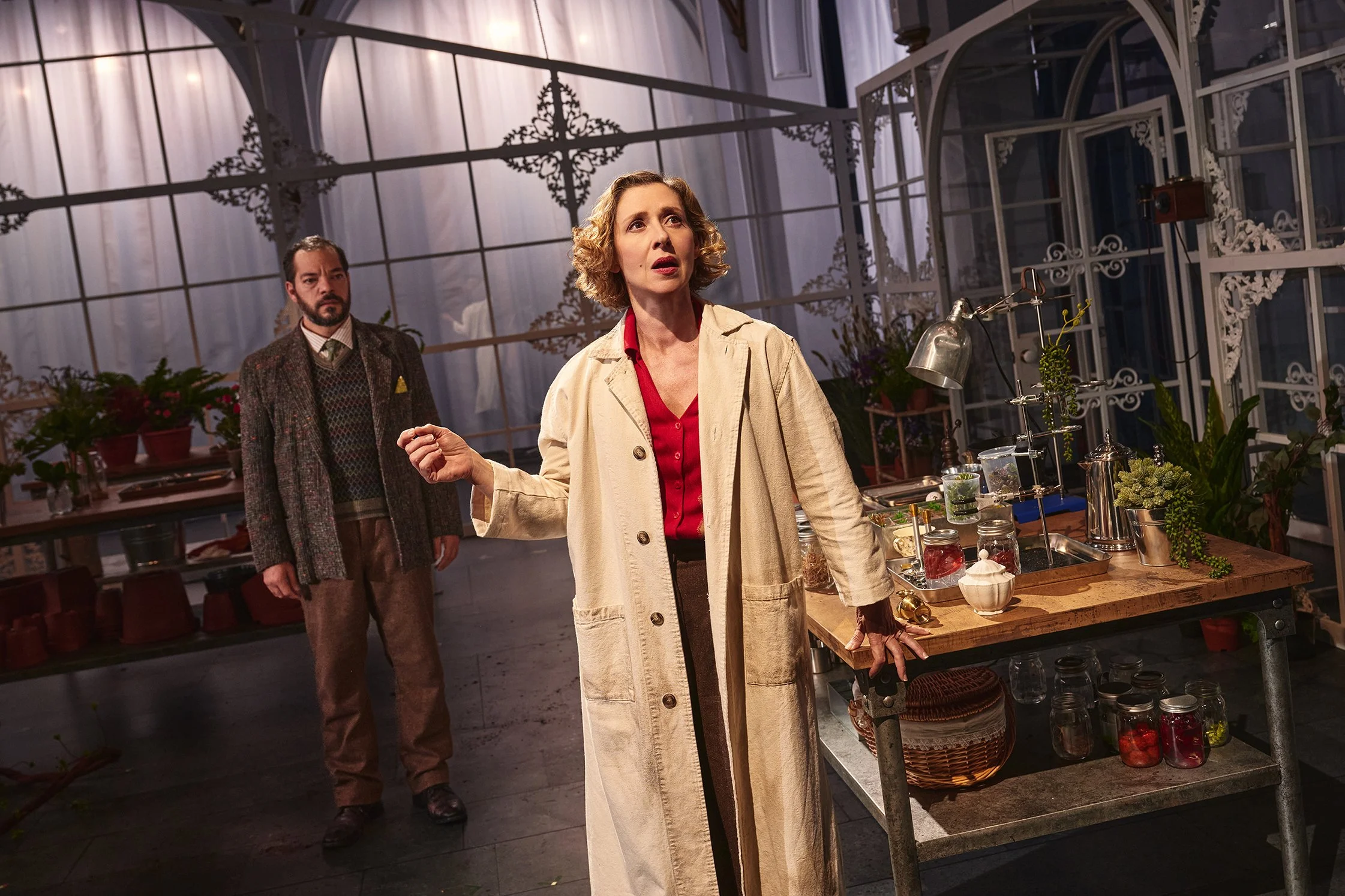
Miriam Silverman as Claire Archer in Fiasco Theater’s production of Susan Glaspell’s The Verge at the Public Theater. Photo: Valerie Terranova.
Though it’s tempting to point to The Verge as a harbinger of our moment’s obsession with identity, the questions that Glaspell is asking are larger: Why be beholden to a reality we’ve merely inherited, rather than create our own? Isn’t conformity a kind of living death? Are there ways to express ourselves that exist beyond the languages we know and use? What stands in the way of our being able to truly experience aliveness, and what needs to be destroyed?
Seated next to me at the reading was an older woman—well-dressed, well-mannered, polite. She’d never heard of Glaspell before, and seemed excited by the things that I, as a longtime devotee of Glaspell’s work, could tell her about the playwright before the reading began. But at intermission, she turned toward me with a scowl. “It’s not a good play,” she declared. “We have no idea who these people are, or why they’re saying these silly things.”
It wasn’t the performers she found fault with. What she seemed to be reacting to were the ideas that The Verge gives voice to. Because this play is more than a subversive questioning of the status quo. Glaspell’s Claire is not simply some other Nora who wants out of the house that Torvald has trapped her in. Her battle against convention is an affront to those who pay heed to it, an onslaught. She is a new kind of protagonist––feral, monstrous, fierce, in the most refreshing, welcome kinds of ways.
When she first enters, the playwright’s lone description of the character, written in the stage directions, is one blunt sentence: “With Claire in a room another kind of aliveness is there.” Sometimes, like a Cassandra, her words break down into a new kind of language, opaque to those who hear it:
But I must––put my timid hands upon you,
Do something about infinity.
Oh, let what will flow into us,
And fill us full––and leave us still.
Wring me dry.
And let me fill again with life more pure.
To know––to feel,
And do nothing with what I feel and know––
That’s being good. That’s nearer God.
The Verge is as shocking and avant-garde as anything created by Glaspell’s peers, including O’Neill (and later, Odets, Wilder, Treadwell, and Williams). It deserves to sit up there, alongside The Hairy Ape, as a paradigm-shifting classic.
At the reading I attended (fittingly hosted by the Brooklyn Botanic Garden), after Claire’s final words were spoken (and sung) by Miriam Silverman during The Verge’s shattering, ambiguous ending, many of the evening’s audience rose to its feet. I myself felt a burning in my chest, and tears of understanding and empathy running down my face, both for Glaspell’s artistic triumph, and for the way that it has, to date, been damned to obscurity. As the actors took their bows, I turned to the woman seated next to me. Surely, I thought, she had finally been moved by The Verge’s cumulative power?
I was wrong. Which perhaps made sense. Ideally, encountering The Verge requires a willingness to question every significant value, belief, and decision one has made in life. And, if that willingness is not there, the only other available response is one of defensive dismissal. The woman merely looked at me, shaking her head in disgust. “Pretentious,” she sneered, her sensibilities offended––proof, indeed, that Glaspell’s masterpiece remains as potent, and necessary, as ever. It’s hard to imagine its effect on audiences in 1921. Were they inspired to reassess their lives, or did they, like this woman, recoil?
***
The productions of these two plays should have been a moment of glory for both the Provincetown Players and for its two leading lights. Instead, they marked an unexpected crash and burn––not only for the group, but for Glaspell’s future as a dramatist. Rather than striding forward into the history books as the mother and father of the American theater, they became Eugene O’Neill, American’s greatest playwright, and … Susan who?
What happened was: during rehearsals for The Hairy Ape, O’Neill decided to fire George Cram Cook as director of the show, convinced that he needed someone more professional and more attuned to commercial concerns––reasons completely antithetical to the spirit of the company’s ideals. The Provincetown Players had always been about unity, about putting the needs of the many over those of the one. Working together, for and with each other, they were doing their small part to improve the world. O’Neill, breaking with this spirit, wanted only what was best for his play.
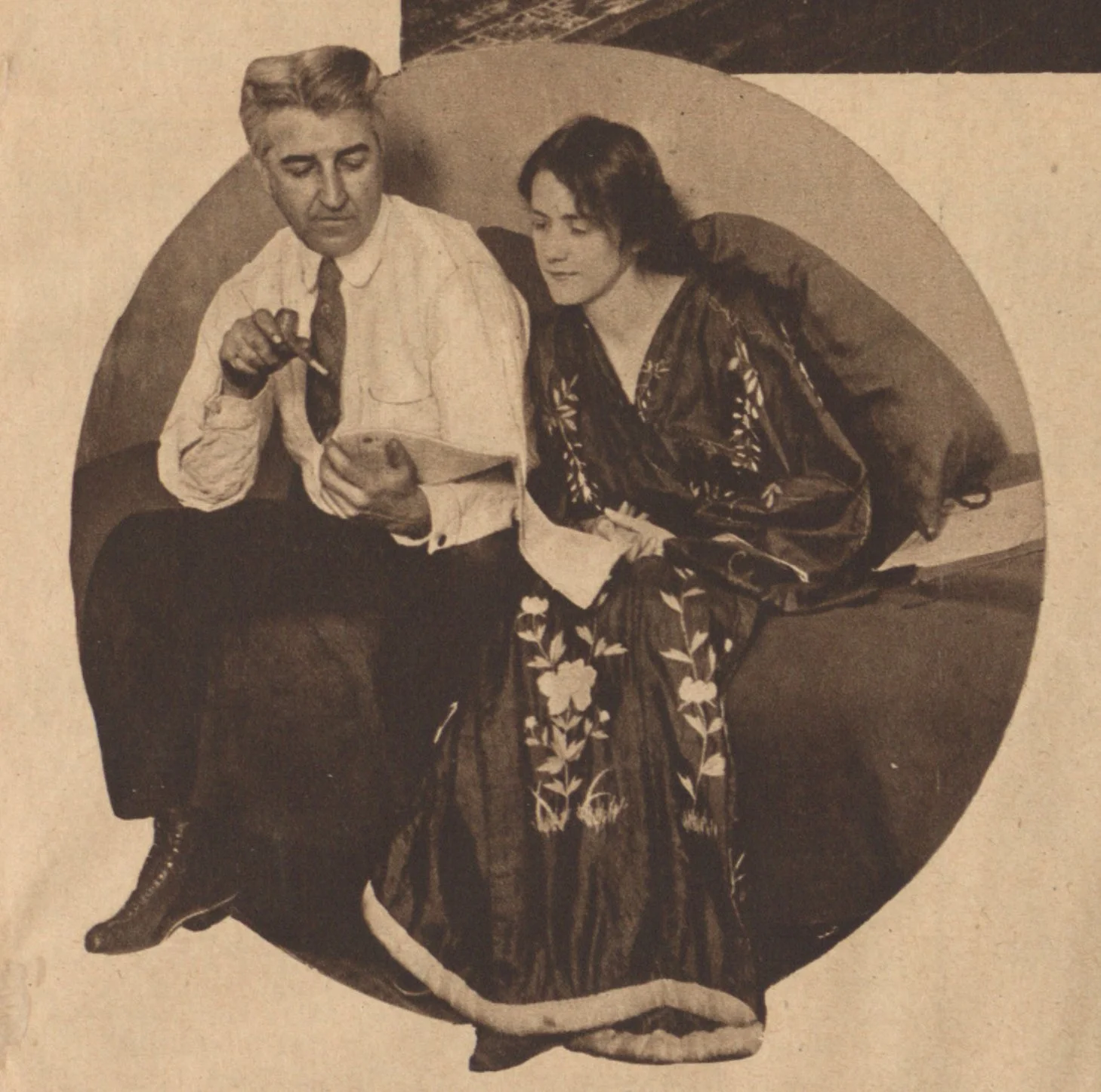
George Cram Cook and Susan Glaspell in 1917. Photo via Wikimedia Commons.
Bitter and heartbroken by O’Neill's betrayal, Glaspell and Cook suspended operations of the group. “Our individual gifts and talents have sought their private perfection,” Cook wrote in a note of farewell, pointedly implicating O’Neill. “We have not, as we hoped, created the beloved community of life-givers. Our richest, like our poorest, have desired, most not to give life, but to have it given to them. We have valued creative energy less than its rewards––our sin against our Holy Ghost.”
Then, in a radical move, Glaspell and Cook decamped to Greece, a place that Cook believed was his spiritual home, and where he hoped to start another theater company from scratch, working with locals. Glaspell, for her part, turned back to the fiction that had launched her career a decade prior, discouraged by what had transpired in New York. A little over a year after their move, Cook contracted Glanders, a rare horse disease, from their dog, and died a quick and horrible death.
Despite his co-founding of the Provincetown Players and his helping to discover and nurture and produce O’Neill, despite Glaspell’s memorializing of him in her book The Road to the Temple, and despite the Greek government’s unprecedented decree that one of the fallen stones from the Temple of Apollo be used for his gravestone, “Jig” Cook (as he was known), has been confined to the dustbin of history, a footnote.
Glaspell has fared only marginally better. She returned to Provincetown, where she lived for most of the rest of her life, writing quiet, introspective novels about intimacy and human relationships. She wrote one more major play (Alison’s House, winner of the 1931 Pulitzer Prize for Drama) and at the time of her death, in 1948, was dubbed by The New York Times “one of the nation's most widely read novelists”; but most of Glaspell’s work has been out of print ever since. There’s no evidence that she and O’Neill, once intimate friends and colleagues (by some accounts, she was a mother figure to him), ever communicated again.
O’Neill, of course, went on to greater glory and fame. He conquered Broadway, won the Nobel, and would come to be crowned the father of American drama.
As these two brilliant works from a century ago are revived, it’s worth wondering about what might have been. The Provincetown Players were at the height of their prestige and influence. The Verge, to some, had even positioned Glaspell as O’Neill's artistic superior. What might have happened had O’Neill not put the needs of his play ahead of those of the company? What if the Provincetown Players had continued to exist? It seems reasonable to imagine: Cook and Glaspell do not move to Greece; Cook does not contract Glanders and die; the Provincetown Players continue their pioneering ways, with both O’Neill and Glaspell at the forefront; Glaspell continues writing for the theater; she and O’Neill continue jockeying, inspiring, and compelling the other into greater (and more experimental) triumphs.
If only. If only that fateful 1921–22 season that included The Verge and The Hairy Ape had gone differently. And now, this season, we have the opportunity to consider these plays again, a bitter reminder of what was, what is, and what might have been, both in the American theater and in the careers and lives of these two titanic writers––one forever enshrined in the canon, the other neglected and long overdue for reappraisal.