

Turning “Picnic at Hanging Rock” into a Musical
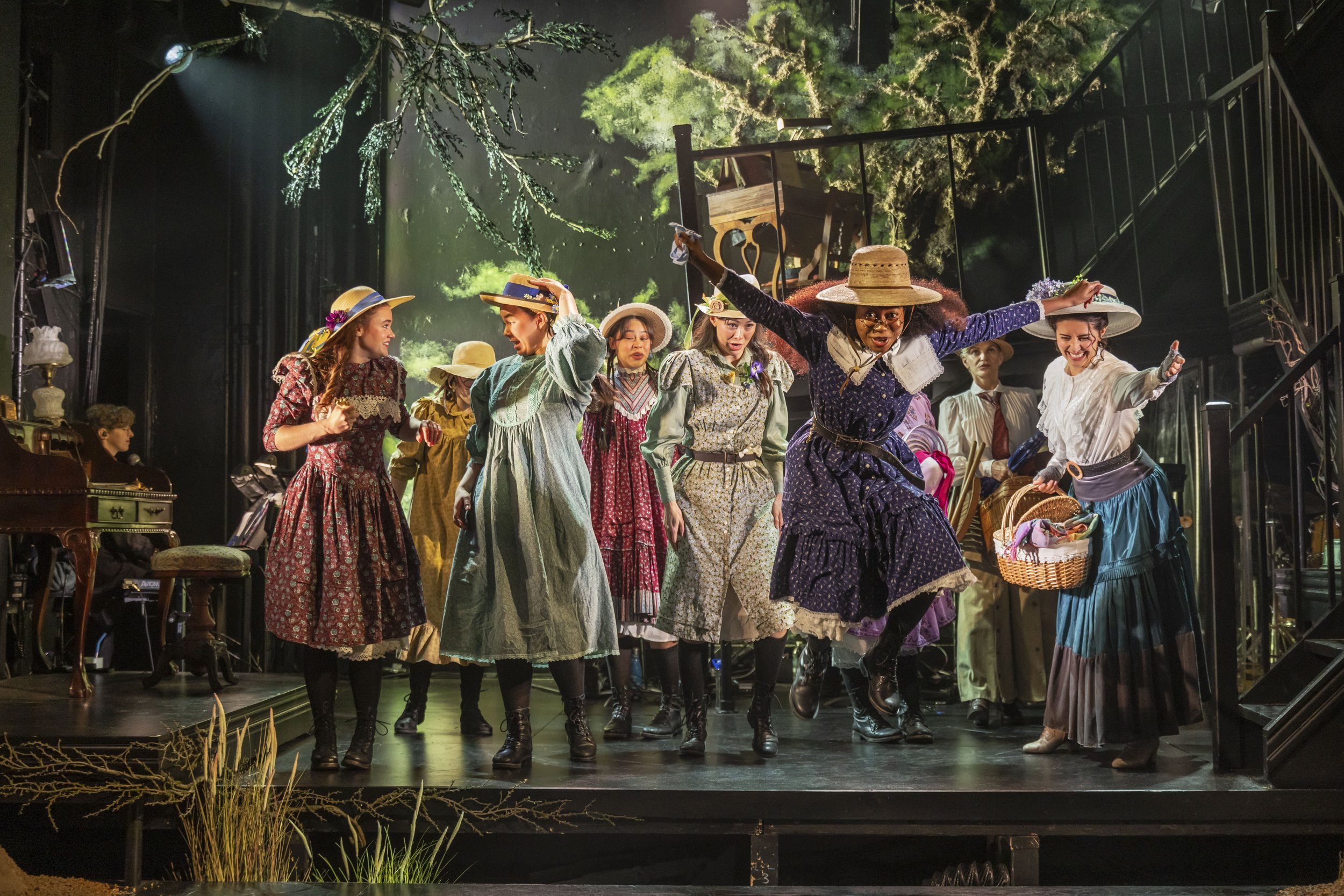
The cast of the new musical Picnic at Hanging Rock, with book and lyrics by Hilary Bell and music by Greta Gertler Gold, now playing at the Greenwich House Theater. Photo: Matthew Murphy.
Though not widely known in the United States, the 1967 novel Picnic at Hanging Rock, by Joan Lindsay, holds a prominent place in Australian culture, as does the subsequent 1975 film, directed by Peter Weir. Lindsay’s novel, a pseudo-historical account of a group of schoolgirls in 1900 who disappear during an afternoon picnic at the geological site Hanging Rock, is now a new musical by Australian writers Hilary Bell and Greta Gertler Gold, playing Off-Broadway at the Greenwich House Theater through January 17.
How did this Australian musical, with book and lyrics by Bell and music and arrangements by Gold, come to New York? Perhaps that story starts when Bell, born into a prominent Australian theater family, fell in love with musical theater and grew up wanting to write musicals. “I was one of those kids that, when you were sick and home from school, you watched the Golden Age of Hollywood musicals on television at midday,” Bell said in a phone interview during a break from rehearsals.
When she was around 12 years old, Bell discovered Stephen Sondheim and James Goldman’s Follies and, as she puts it, became a “die-hard Sondheim fan.” She even wrote to Sondheim and was invited to meet him at his home during a trip to New York in her early 20s.
Fast forward to 1996 when Bell came to New York to study playwriting at Juilliard, and met future collaborator Gold through a mutual Australian friend. They didn’t work together, though, until 2017, when Bell was commissioned to adapt a dark children’s book, The Red Tree by Shaun Tan, into a one-person play. “I thought, god, a one-person show about children’s depression and anxiety sounds like a pretty difficult sell,” Bell said. “But it would be leavened if there were music.”
After a successful collaboration—The Red Tree played in Sydney—Bell and Gold did another children’s musical based on one of Bell’s picture books called Alphabetical Sydney: All Aboard!, which toured Australia.
But they wanted to do, as Bell put it, a grown-up musical. In 2021 they looked at popular properties and settled on Picnic at Hanging Rock based on their love of dark stories. The novel had been adapted into the well-known film, as well as a play, an Australian television series, and another musical by Daniel Zaitchik. To their amazement, the novel rights were available, and even with all the adaptations, they had their own take on the material.
“We wanted to honor what it meant for Joan Lindsay to write this story that was about female struggle and navigating the future in spite of the patriarchy.”
Bell was particularly struck by Lindsay’s background: her research into the Australian author showed that she had written book and art reviews as a way to make money, not necessarily writing what she may have wanted to. Then, at the age of 69, she wrote Picnic at Hanging Rock based on a series of dreams she had.
“We wanted to honor what it meant for Joan Lindsay to write this story that was about female struggle and navigating the future in spite of the patriarchy,” Bell said.
Bell and Gold also introduce a new character who doesn’t exist in the novel or the film: the tracker, an Aboriginal man who works for the police looking for missing people.
“It allowed us to have his perspective on these white girls exploring where he believes they shouldn’t be going because it’s a sacred site,” Bell said. “And to also look at what it means to be a First Nations person in 1900 under colonial rule and to be so constrained in so many ways.”
The musical was first developed with a presentation in Sydney, Australia. “People were interested but they didn’t really know what to do with it,” Bell said of the experience. “And commercial producers were telling us, well, go away and write the whole show and then come back and we’ll see. And we thought, well, no, we need to do workshops, we need to be working with a director.”
Bell discovered the bulk of the development had to be done in New York, as there are very few development opportunities in Australia; instead of taking a risk on new work, producers will often wait for established musicals to come from New York or London. “You need people who are excited just at the prospect of the challenge and the risk of a new show,” Bell explained. “It seems to just be in the DNA of the city here.”
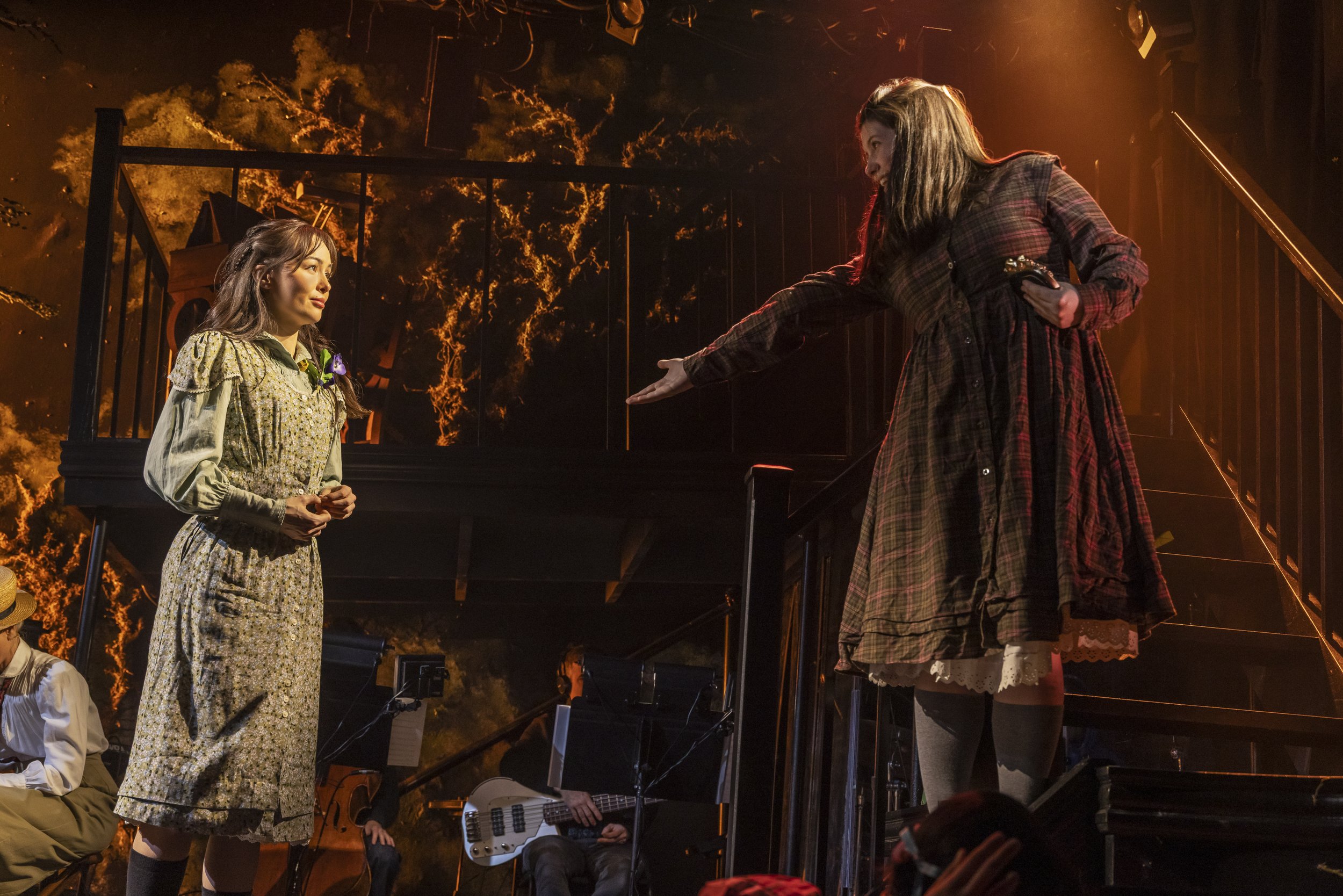
Gillian Han and Sarah Walsh in Picnic at Hanging Rock, playing through January 17. Photo: Matthew Murphy.
It also helped that Gold has been living in New York City since 1998, and has built up a network as a writer and composer, while Bell had moved back to Sydney in 2005. Gold is also serving as one of the producers of this production, which is directed by Portia Krieger with choreography by Mayte Natalio.
Picnic at Hanging Rock is the rare Australian story by Australian writers to enter the musical-theater canon. In crafting the show, the writers focused on ways that musical theater could bring out the book’s themes. “The story is so much about time—deep time versus human time, mechanical time versus nature, the brevity of our lives, the idea that time is not linear, that it’s stacked, and the past, present, and future all happening simultaneously, which is an Australian First Nations perspective of time,” Bell said. “Theater allows you to have past, present, and future existing simultaneously.”
And with these themes, they are also hoping to offer a sense of resolution, without solving the mystery of what happened to the schoolgirls. “In what could be a really dark story about these women disappearing and never being found again, it offers a sort of emotional closure,” Bell said. “There’s no narrative closure, but there’s an emotional closure.”