

The answer is 13, according to experimental theater company The Million Underscores, whose new play The Kick Inside continues their trajectory of reinvention.

The Kick Inside featuring Yuki Kawahisa, Essence Lotus, Tatyana Kot, and Frankie Placidi, running at the HERE Arts Center through November 7. Photo: Jose Miranda.
How to sum up the artistic mission of a company that reinvents itself with every production?
Since its founding in 2013, the experimental troupe The Million Underscores has refined its formal boundaries with each new project: from a looping 20-minute piece that repeated until the final audience member left (Memories of This Atlantis, or No Place, at Mabou Mines in 2016), to dual performances playing out simultaneously on opposite sides of a racquetball court (SsOuLn MlOuOnNa, at Maria Hernandez Park in 2019), to an eight-hour solo performance staged in a storefront window (Not I at Tomato Mouse Gallery in 2023).
The Kick Inside, their world premiere new play at HERE Arts Center through November 7, takes this instinct for reinvention to a new extreme. A mind-bending creation, conceived and directed by the company’s artistic director Nicolás Noreña, the show’s text combines scenes by 13 playwrights—a disparate group including Penny Arcade, Jess Barbagallo, Fiona Templeton, and Nazareth Hassan.
“From the beginning, we’ve been interested in how to reorganize theater with each project,” said Noreña. “We work with the plasticity of sound, the plasticity of space, the plasticity of people’s perceptions—not out of trying to make some kind of illusion, but rather attuning people’s perception to what is there.”
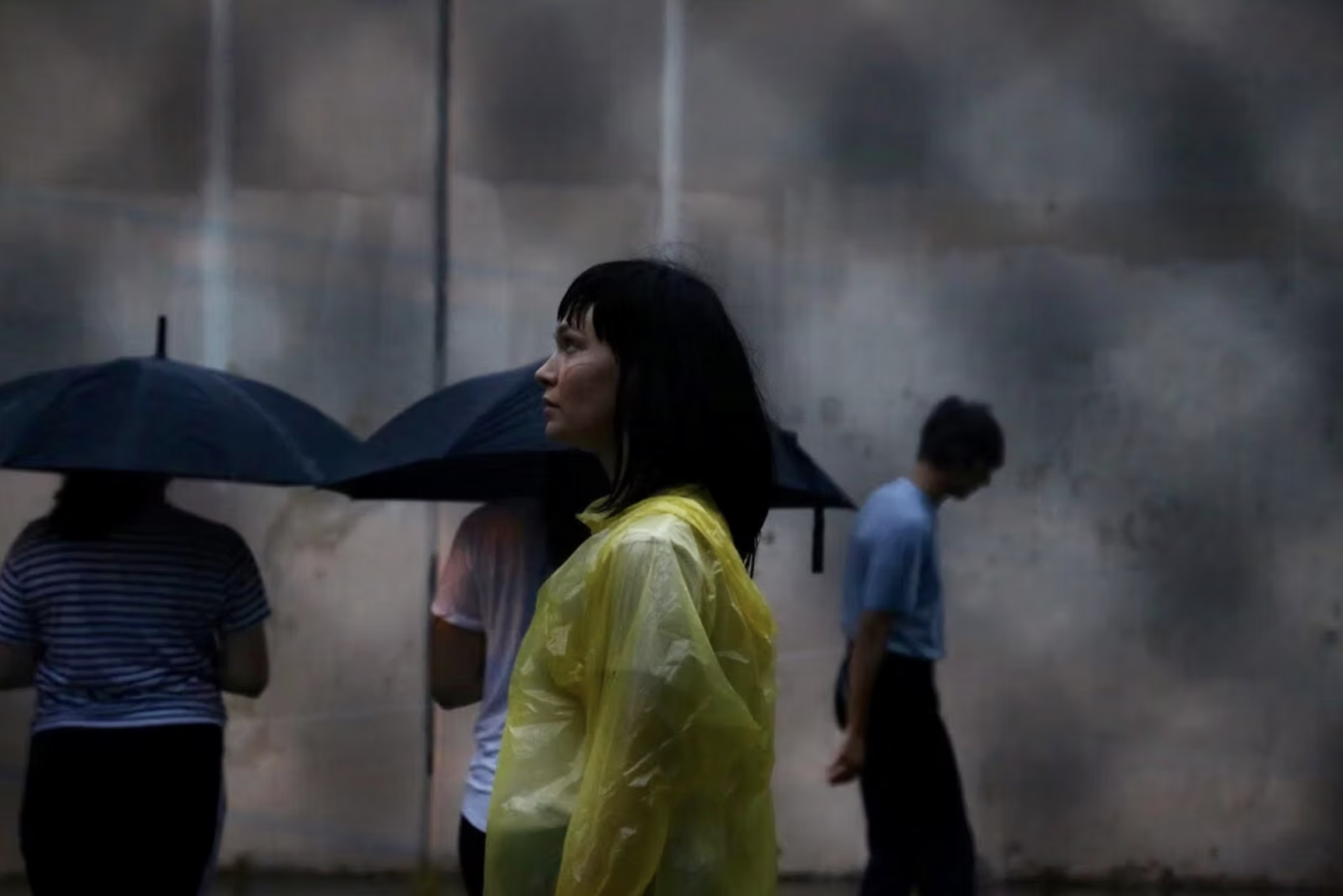
SsOuLn MlOuOnNa took place on a racquetball court in Maria Hernandez Park in Bushwick in August 2019. Photo: Maria de la Torre.
In The Kick Inside, the focus is on language itself. The quasi-protagonist Alenka (Tatyana Kot) drifts through random encounters in a dreamlike “Lost City”—a noirish, fantasy New York of yesteryear. In each new space—a laundromat, a diner, a library—the traditional codes of language are upended. Each playwright attacks the task in an entirely different way—for Hassan’s scene, two employees at a locksmith speak only in garbled proverbs like, “A fixable clock is wrong 7 times a week,” or, “Home is where the heart explodes.”
“Nico and The Million Underscores have a way of working steeped in an attention to the smallest and most tender of details,” said Jesse Alick, co-artistic director at HERE. “Their impulse to welcome this gloriously long list of playwrights into their collective creating lines up so perfectly to how we strive to make HERE a home for as many artists as we can.”
The company was formed when Noreña, his longtime partner and creative collaborator Timothy Scott, and a group of fellow NYU Tisch grads were applying to stage a show at the International New York City Fringe Festival shortly after graduation.
“We needed a company name,” laughed Noreña. “The company was the people who were part of that show [Morning to be Changed from the Morning to the Morning, or Belly of the Whale].”
Billed as “a portrait in 24 hours or 25 frames,” Morning was built of company journals written at different times of day and then layered on top of each other, a fractured journey through many parallel lives. Noreña’s mentor for the project at NYU was experimental theater master Richard Foreman, who remained a pivotal guide in Noreña’s artistic life until his death last year at age 87.
A residency at Mabou Mines led to Memories of This Atlantis, the theatrical fugue that looped until everyone left; next came a pivotal five-year residency at LEIMAY at Cave, a converted garage in Williamsburg. Gathering at Cave three times a week, year-round, gave the Underscores creative space to develop multiple projects.
“That time instilled in us a practice of going to a space and starting to work, and just going with the ideas,” said Noreña. “We could take our time experimenting with the medium.”
A favorite production of Noreña’s from this time was The Third Man, presented for two audience members at a time at Cave in 2018. The piece concerned a narrator falling in love with the character they’re narrating; text played in audience members’ ears through headphones, while mirrors and overhead projections conjured a film noir atmosphere. Following each staging, the team would chat casually with the audience, pick up ideas, then reshape the piece before the next performance.
“It was the dream kind of production, though it didn’t generate money at all,” said Noreña. “It was so pleasant, because that exchange with the audience was so tangible.”
A maturing moment for Million Underscores came in 2019 with 1001SUR, a reimagining of the folktale collection One Thousand and One Nights, staged at Target Margin. A larger production with a cast of 10, it was the first time the Underscores had received arts council funding.
“From then on, we’ve learned to apply for money and to pay people and do things right,” Norena said. “Before that, we were just so young and excited to work together.”
For the intimate pas de deux Those Moveable Pieces, in 2024 at the Bushwick warehouse venue We Are Here, a work inspired by Noreña and Smith’s decade of personal and artistic partnership, the pair moved the audience room to room and reconfigured as they went, shifting around furniture and colliding their bodies in new ways, concluding with an erotic slow dance in the warehouse’s expansive main space.
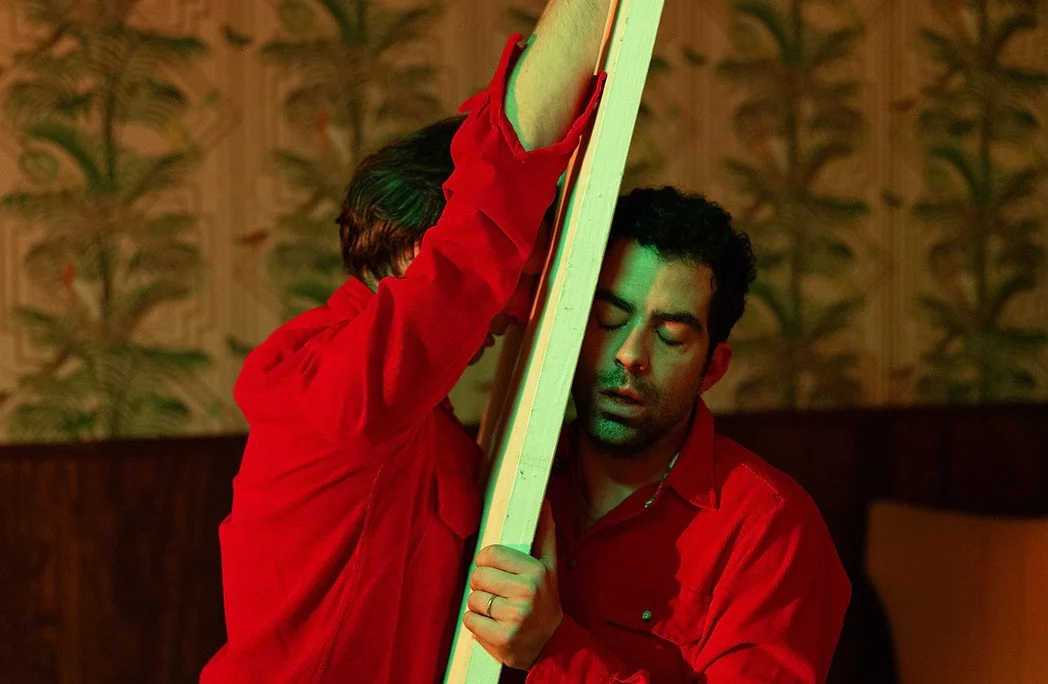
Timothy Scott and Nicolás Noreña in Those Moveable Pieces, a work inspired by their decade-long partnership. Photo courtesy Nicolás Noreña.
“Following and leading, finding each other, clashing against each other, pushing against each other,” said Noreña. “At the heart of it was Tim and I’s relationship working together. It was like our wedding. That was the heart of the piece.”
The heart of Kick Inside, meanwhile, lies in subverting the increasingly flat and predictable nature of our day-to-day language. In every new space Alenka enters, language is dislodged. Each figure she encounters expresses themselves in some new, strange manner. The challenge for Alenka, and by extension the audience, is continually learning to listen in new ways.
“We always hear about machines becoming more human, but we don’t think about the fact that we’re becoming more and more like the machines we’re trying to curb,” said Scott, who is part of the show’s ensemble. “That we’re regurgitating for them, and mimicking what they are saying.”
For Noreña, the idea didn’t begin with the concept of 13 playwrights, but rather a collection of random images. To start, he could see the play’s opening: one woman in a movie theater, crying and crying, as the theater empties out around her.
Noreña wanted an “iconic” fight scene, an intense action sequence at the show’s center. And so the play’s sixth scene, by Hillary Gao, concerns Felix (Felix Teich), a dog who is also a man, violently battling two other dogs to the death, finally ripping out their organs.
And, of course, he was thinking about Kate Bush, and the audacious breakout album The Kick Inside written in Bush’s teenage years, a boundary-pushing work dealing with identity, sexuality, and other strange, dark narrative phenomena.
These fragments were enough to get Noreña development support from the Mercury Store in Gowanus, where he mapped out a 15-scene structure on a long roll of paper, setting out each location. The order of locations remained set in stone—the same roll of paper is now pasted onto the side wall at the HERE mainstage.
After much development, Noreña arrived at the idea of commissioning a different playwright for every scene as the core of his show’s language experiment. The first assignment went to Marvin Just, the 13-year-old son of Kara Feeley and Travis Just, co-artistic directors of the performance group Object Collection.
Another scene went to playwright and performer Jess Barbagallo, who listened to Bush’s track “The Man with the Child in His Eyes,” and decided the child of the song would be an alien living in Alenka’s home. The alien converses freely with Alenka’s house, which also speaks.
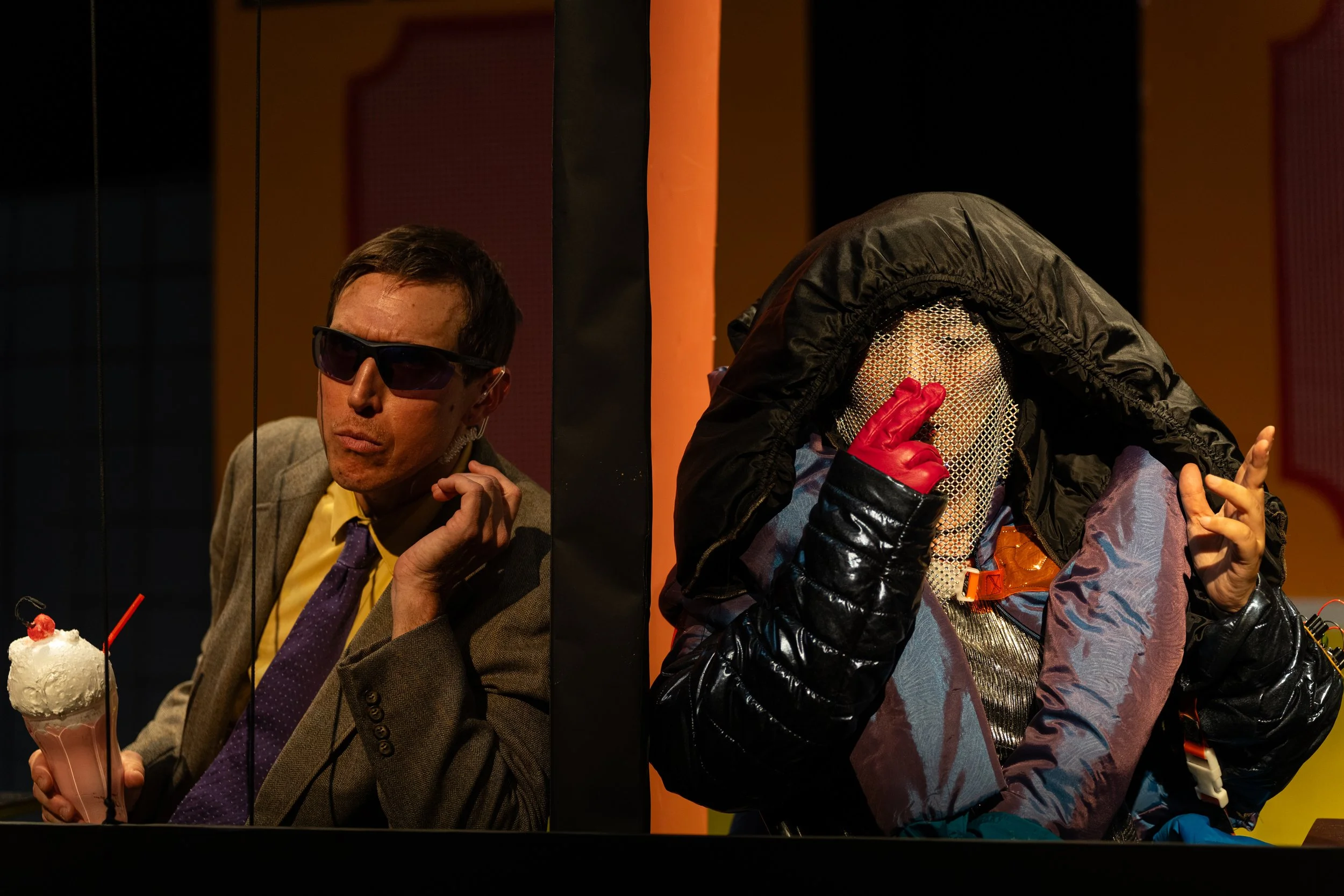
Language is upended in The Kick Inside, featuring Benjamin Forster and Yuki Kawahisa. Photo: Jose Miranda.
“Drama emerged around language and naming,” said Barbagallo. “I began breaking apart how people were speaking to each other into fractured word games that might manifest in actual disputes around who owns language and what it produces.”
“These things are hard to write about,” Barbagallo added, in an understatement. “Maybe you just need to see them.”
Foreman had died by this time, but Noreña still wished to include a text from his mentor. He went to Foreman’s website, on which all of the director’s notebooks are digitized, and picked a link at random.
“And I was like, ‘Thank you, Richard. That’s great,’” said Noreña. “And that is the text that we have for the library scene.”
For the play’s conclusion, Noreña commissioned four playwrights to write four alternate endings. The company read all four together, then voted on which should conclude the story. (The playwright names were kept anonymous.) The winning scene, concerning an alien and an angel reflecting on existence as they lie on a beach, was written by Ethan Fishbane, who had actually left the theater world 11 years ago and now works in hospitality.
The collision of scenes is chaotic and destabilizing, all the more so because Noreña intentionally obscures or distorts with a frame that opens and closes, moving from wide shots, to close-ups, to, for one scene, a waist-down only view of the action. Even in a proscenium space, Noreña can’t help but rewrite the rulebook.
Yet the piece’s core question is always clear, and is even voiced by one character: “Why do we speak?”
“That is the core of this show— dislodging the normal way in which we’re used to listening to language,” said Noreña. “I don’t have an answer to the question of, ‘Why do we speak?’” It is a situation to sit in, and to listen to. But there is no synthesis, and there is no final answer.”