

“Beauty Freak” Gets Political in a Time of Numbness
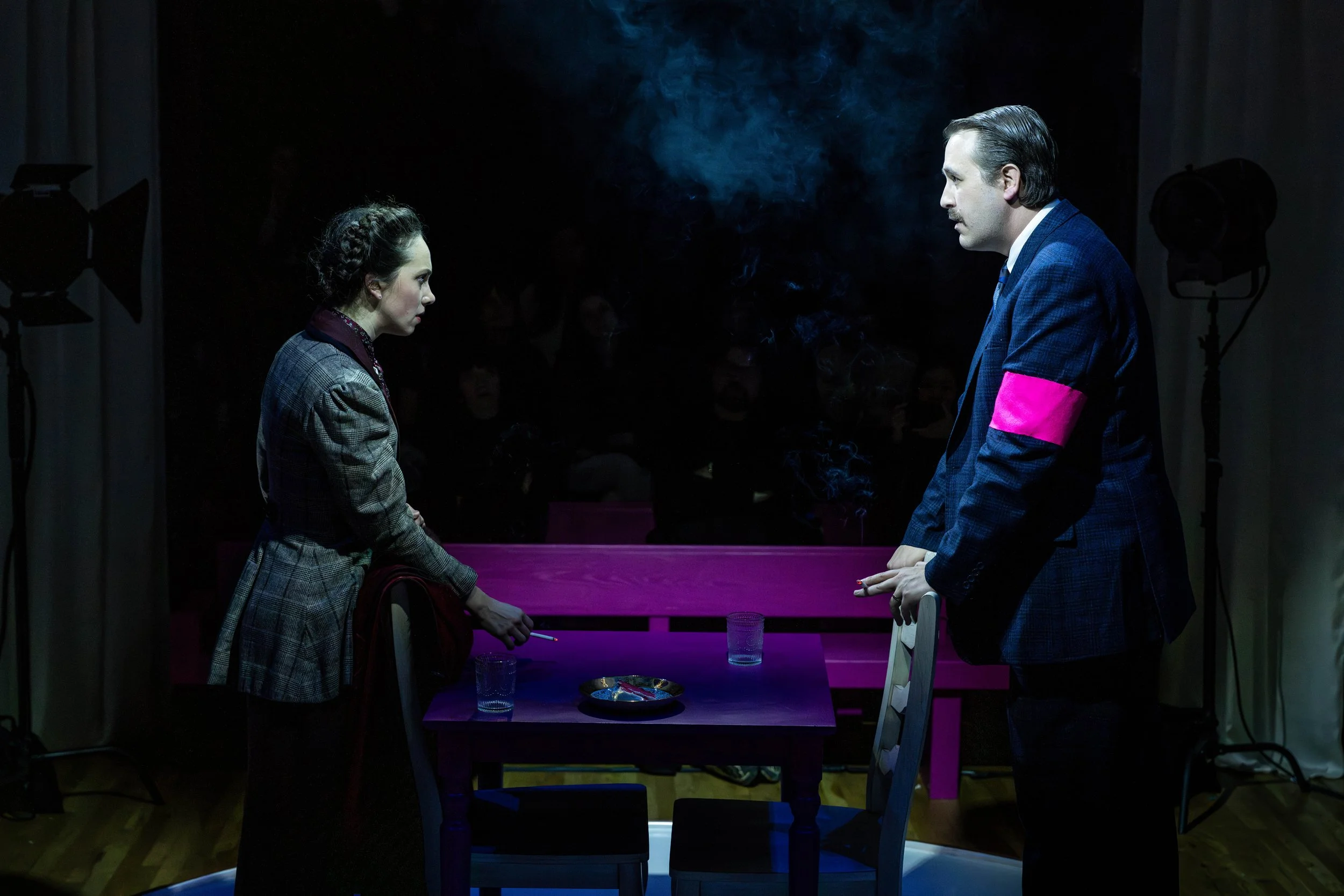
Baize Buzan as Leni Riefenstahl and Sam Hood Adrain as her Nazi party liaison in Beauty Freak, directed by Danilo Gambini, at the cell theatre through May 17. Photo: Alexia Haick.
A pivotal early scene in James Clements’s new play Beauty Freak illuminates, with unsettling clarity, our present-day numbness to everyday horror.
Renowned filmmaker and unrepentant Nazi propagandist Leni Riefenstahl, the subject of Clements’s carefully researched work, recounts a harrowing childhood memory: at the age of seven, she witnessed a young girl struck by a car and killed. Sharing this traumatic memory with Ernst Jaeger, her press agent and close confidante, Leni recalls the child’s agonized cries, and the screams of the girl’s mother. How, she wondered, could God allow such a cruel tragedy?
But then, Leni had an epiphany. “One day in the countryside picking flowers, I realized something,” says Leni. “If bad really was the dominant force in our world, then it could have killed off good centuries, millennia, ago. But the fresh grass, the vibrant flowers, the glorious sky — these were all proof of the inherent goodness of the world.
“Of course, sometimes bad things happen,” she concludes, a guiding philosophy taking form. “But I choose to believe that the true essence of all life is good.”
***
Beauty Freak dramatizes the creation of Riefenstahl’s magnum opus, Olympia, a documentary chronicling the 1936 Olympic Games in Berlin. Clements developed the piece with his investigative company What Will The Neighbors Say?, which he co-founded in 2016 with Sam Hood Adrain. Staged at the cell in Manhattan by director Danilo Gambini, the play reckons unsparingly with the responsibility of artists living and working under authoritarian regimes.
As we are first introduced to Riefenstahl (a magnetic Baize Buzan) she is going toe-to-toe with Joseph Goebbels, Reich Minister of Propaganda in the Nazi Party (a quietly frightening Peter Coleman). Emboldened by the success of her 1935 film Triumph of the Will, a worshipful tribute to Hitler’s leadership that earned her the Führer’s full backing, Leni demands untold resources to realize her expansive vision for Olympia.
Indeed, history does not dispute that Riefenstahl was a groundbreaking artist who pioneered technologies and filmmaking techniques (including the contemporary “tracking shot”) still utilized to this day. Amid that single-minded pursuit of her artistry, Leni closed her eyes to the spread of hatred and tyranny enveloping her country — a willful state of denial that Clements attributes, at least in part, to that same dissociation from everyday horrors that is all too familiar today.
In today’s theater landscape, work as politically confrontational as Beauty Freak can feel like an aberration. Of course, politics can live inside a theatrical piece in many ways: the desperate rage of young women in John Proctor Is the Villain, the crisis of red-pilled male grievance in Angry Alan, the creeping rise of fascism in Crooked Cross.
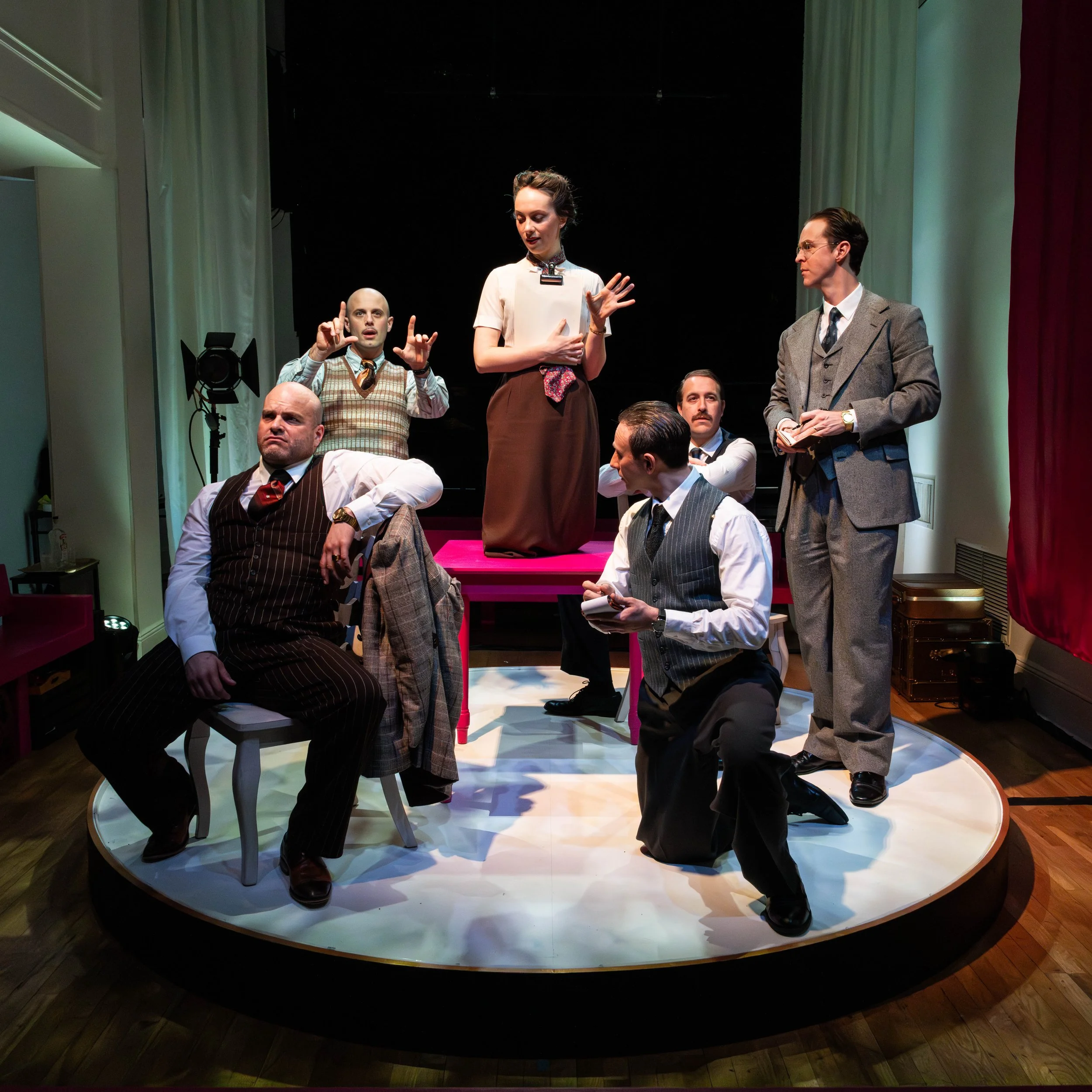
The company of Beauty Freak, a work 10 years in the making. Photo: Alexia Haick.
Yet attending theater under Trump 2.0 can nonetheless feel like a ritual of disconnection from the horrors. Our American era is defined by a stacking up of atrocities. From a needless and bloody war in Iran, to a US-sponsored genocide in Palestine, to immigrant populations disappeared into inhumane detention facilities, to escalating attacks on the rights of women, minority, and transgender populations, to the growing power of psychopathic oligarchs and water-guzzling AI conglomerates — the list goes on, and on.
It becomes more than one can carry around. So we push it away. How could we not?
“We’re already well-versed in how to just keep going,” said Clements. “At a time of extreme political polarization and extremist rhetoric, we are all continuing to just go to work, and go to the gym, and go to bars, and network, and do interviews for our plays.”
Theater could, potentially, offer an antidote. But if Trump’s first term saw big-name shows occasionally taking up that charge, his second has received a quieter response. The reasons scarcely need explanation — exhaustion, a feeling of powerlessness, fear of alienating audiences who are seeking escape. Is the average theatergoer looking to spend 100 minutes considering their own similarity to Leni Riefenstahl?
Artists are not exactly champing at the bit to tackle Trump, whose one-dimensionality can perhaps only be met with heavy-handedness. When Tony Kushner, among our greatest living playwrights, took a stab in 2019 with a revised version of his 1991 play A Bright Room Called Day, he did not strain for subtlety: the existing narrator, Zillah, a visitor to 1930s Berlin from the Reagan-era 1980s, was joined by Kushner himself visiting from the Trump era with additional warnings.
I loved it, precisely for its unapologetic didacticism. Just as I loved my introduction to the work of What Will The Neighbors Say? at last fall’s At the Barricades, a piece co-written by Clements and Adrain. Set outside Madrid in 1937, Barricades explored the motivations of six international volunteers in the Spanish Civil War, hailing variously from the United States, Spain, and Scotland, but united by the shared cause of beating back the spread of fascism.
Barricades was agitprop theater, a direct call to action. By presenting the story of six foreigners putting their lives on the line for a battle not their own, the play pointedly asked: What are you doing? That opened Clements and Adrain up to critiques of drawing parallels that didn’t always line up neatly — indeed, both versions of Kushner’s Bright Room were criticallylambasted for this very reason (among others).
Yet demanding precise one-to-one comparisons can have the effect, ultimately, of shutting down pointed political work altogether, since the goal is rarely attainable. Last year, Torrey Townsend’s deliberately excruciating new work Jewish Plot baked this problem into its dramaturgy. What begins as a finely wrought, removed dissection of Jewish identity devolved into a self-flagellating monologue about the impossibility of the task, as the playwright lost his mind.
Could my own desire for more didactic theater be its own kind of self-flagellation? Seeing a lot of theater in Trump’s second term has meant constant dissociation from any number of brutal realities, many of which I feel powerless to change. Certainly the work can keep those realities in the room, rather than wishing them away. But there is no inherent virtue in merely shaming your audience. What comes after the shame?
***
Beauty Freak lands somewhere in-between these conflicting lands of political didacticism and a quieter narrative suggestion. The complicity of Leni Reifenstahl is a warning, yes, but also an unsolvable mystery.
Did Leni genuinely believe, as she states many times in the play, that she was purely an artist and in no way political? Did she believe that Hitler’s anti-Semitic language was just “rabble rousing,” not to be taken literally? Or that a hateful segment of Hitler’s followers were merely “corrupting” his message of growth, production, and national pride?
“I don’t know if she was lying to herself, or if she genuinely doesn’t feel she did anything wrong,” said Clements.
“I don’t think we have the luxury of time to disconnect and disassociate. Now is the moment to think critically about what you are consuming and who is creating it — is it AI, is it double-sourced? Who knows the media you’re consuming?”
Indeed, Beauty Freak does not pretend to offer any answers. And Clements isn’t looking to suggest that the average audience member’s complicity is equivalent to that of Leni Riefenstahl. He actually set the play aside multiple times over the past 10 years, uncertain of putting an audience through traumatic material. Initially spurred to investigate Reifenstahl by dual events of 2016 — the first election of President Trump and the successful “Brexit” campaign in the UK, both driven by rampant falsehoods — he kept returning to the story precisely because of this central idea of disconnecting ourselves from horror perpetrated in our name.
“I don’t think we have the luxury of time to disconnect and disassociate,” said Clements. “Now is the moment to think critically about what you are consuming and who is creating it — is it AI, is it double-sourced? Who knows the media you’re consuming?
“I know everyone’s tired, but if we let go now, it could be really catastrophic.”
Inherent goodness will not triumph on its own, whatever message Leni’s strange youthful epiphany might have imparted. And while Beauty Freak cannot resolve the dilemma of political art, it pushes us to meet the mounting horrors head-on, subtlety be damned. Whatever you do, don’t look away.