

It’s a Play! It’s an Event! It’s a Regular People Production
Inside the new creative studio rethinking how shows get made and marketed Off-Broadway, with one rule in mind: make theater cool.
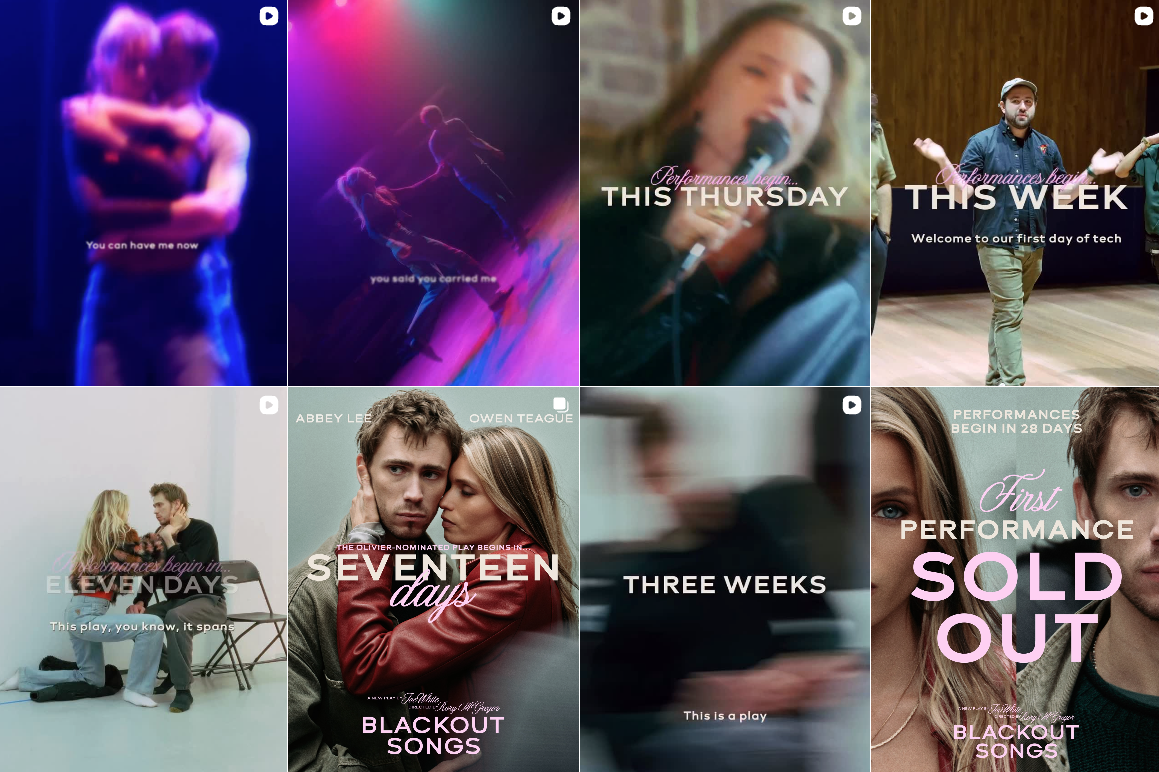
An example of Regular People’s marketing campaign for Joe White’s play Blackout Songs, as seen on their Instagram @reg_ppl.
When does a theatrical experience begin? Is it when an actor first steps on stage? When you walk into the theater and are handed a program? When you purchase your ticket? Or is it, as the new producing and marketing company Regular People posits, when you first become aware of a show, either through a press release, social media, or even word of mouth?
Regular People co-founders and CEOs Andrew Patino and Jacob Stuckelman believe that an audience member’s experience begins long before they set foot in a theater — and they want to master how to control the narrative.
Officially launched in October 2025, Regular People is a creative studio with a bold new take on producing theater. On a Regular People production, three responsibilities that would ordinarily be outsourced to separate agencies — producing, marketing, and general management — are all executed under one roof. This gives the company plenty of advantages in an often resource-starved industry. Communication is streamlined, with approvals being made within the rehearsal room, instead of having to go through another office half a city away and back again. Costs are cut, with all the necessary talent operating on a single team. And, crucially, brand cohesion is built into the foundation of every project.
Currently, the Regular People team is working on its third production overall and first since its official launch: Blackout Songs, an Olivier-nominated play making its US premiere at MCC’s Susan & Ronald Frankel Theater through February 28. But the company’s story began years ago, when Patino and Stuckelman first met.
Early in his post-grad career, Patino asked Stuckelman out on a networking date to discuss their aspirations for the theater industry. They relay the story during a break from tech rehearsal, a few days out from the first preview of Blackout Songs, both sporting custom all-access passes for the show made for the entire production team. “I just emailed Jacob and was like, ‘I like what you’re doing. Should we get a drink?’” Patino says. “And then we got a drink, and then didn’t talk for four years.”
But in 2024, a theater project brought them back into each other’s orbits: Stuckelman invited Patino to be a producing partner on the London production of Samantha Hurley’s I’m Gonna Marry You Tobey Maguire. By then, Stuckelman was well-established as a general manager, working both independently and under BOND Theatrical, while Patino had started his own marketing company, courting clients from both inside and outside the world of theater. Their complementary skillsets set Patino’s brain in motion.
“I basically said to him offhandedly, ‘Wouldn’t it be really cool if we did everything in-house, because the two of us could do everything together?’” Patino says. After seeing each other’s work on Tobey Maguire, that hypothetical felt much more tangible. “We got back, and it wasn’t a question of, ‘Why would we do this?’ It was like, ‘How would we do this?’”
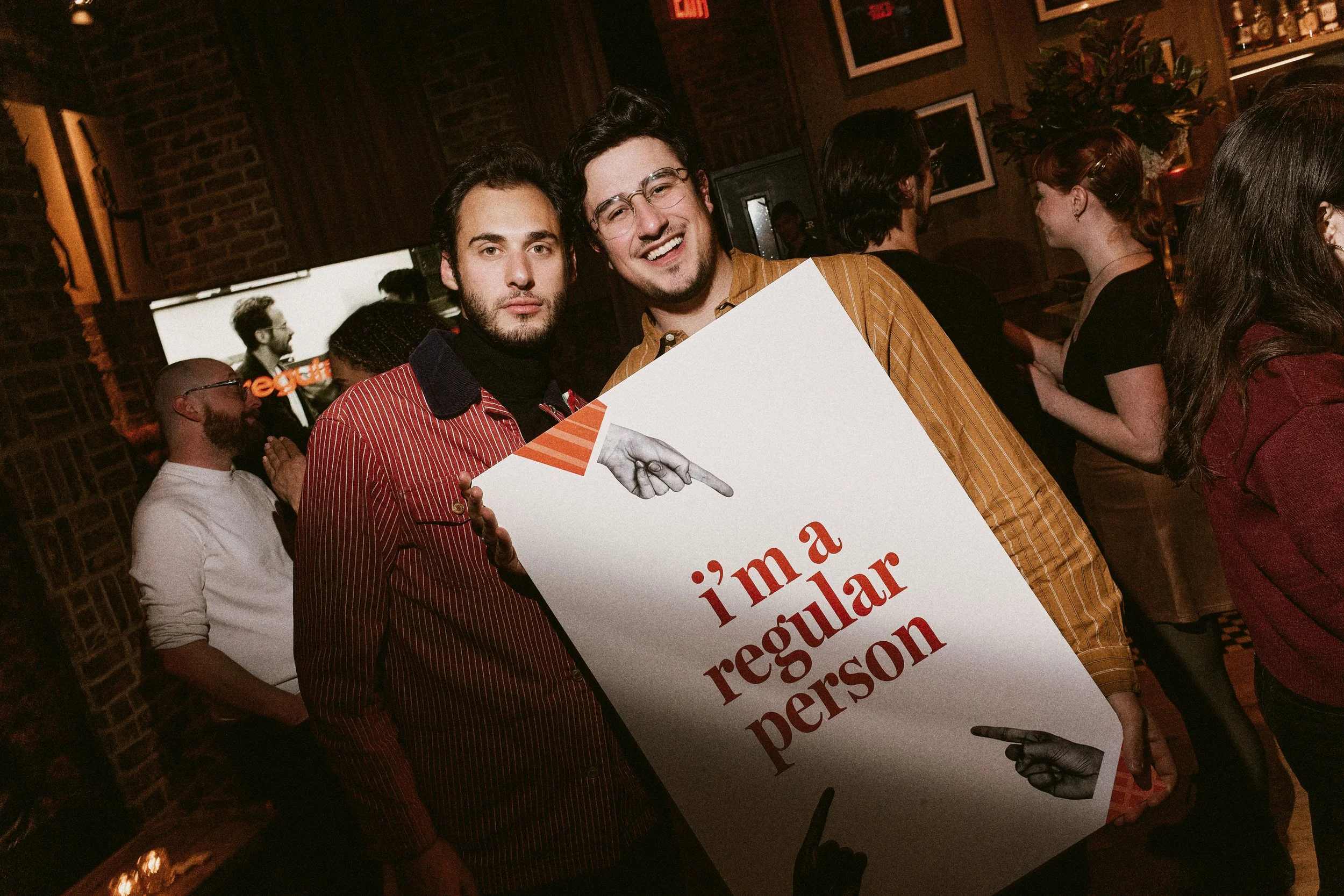
Regular People co-founders Jacob Stuckelman and Andrew Patino at the company’s launch party in January 2026. Photo: Emilio Madrid.
They quickly hatched the model for their creative studio and selected their first project, a production of Ken Urban’s new play Danger and Opportunity at East Village Basement. Obie- and Drama Desk–winning director Jack Serio would stage the project in the intimate 45-seat venue for only 16 performances beginning in March 2025. The show’s limited run and small scale acted as a test case for Patino and Stuckelman’s model. It worked.
After a sold-out run and extension, Danger and Opportunity garnered two special Drama Desk Awards and (perhaps most importantly) buzz about the then-unnamed company behind it all. The marketing was striking, elevated, and decidedly modern. The graphics and website felt professional, especially coming from a brand in its infancy.
Expectations were high for Patino and Stuckelman’s second venture, the premiere of Bubba Weiler’s Well, I’ll Let You Go at the Space at Irondale, again directed by Serio. The play, which tells the story of a widow unpacking the legacy her husband left behind, featured a bigger cast (including Off-Broadway favorites Quincy Tyler Bernstine, Emily Davis, Michael Chernus, and Constance Shulman), a longer run, and a more ambitious space to fill. The show was well-reviewed, named a New York Times Critic’s Pick, and recouped its initial investment by the end of its extended summer run.
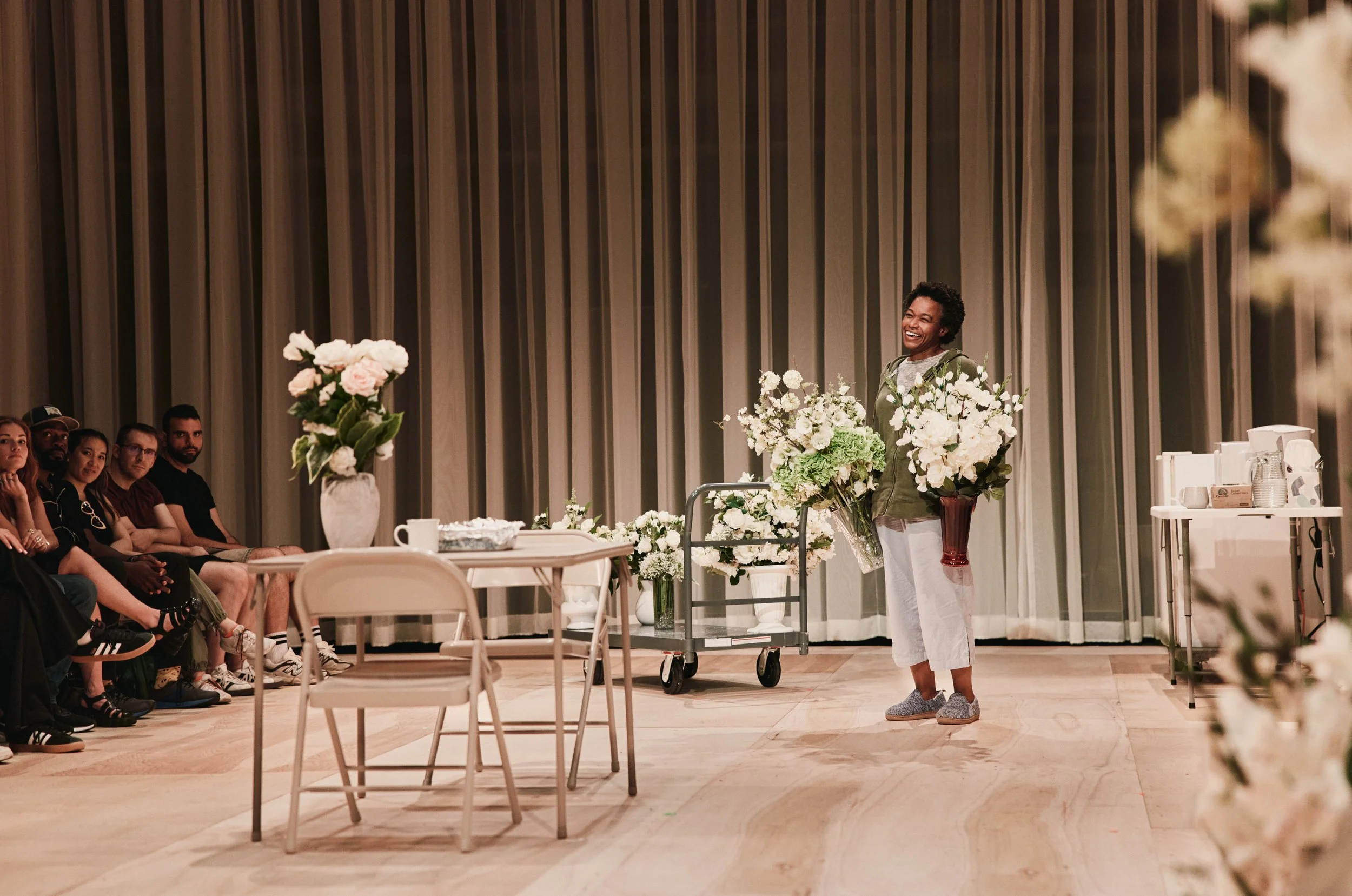
Quincy Tyler Bernstine in Bubba Weiler’s Well, I’ll Let You Go at The Space at Irondale, the second production by Regular People. Photo: Emilio Madrid.
What they had intended to be an immediate launch for their brand instead took six months, as Patino, Stuckelman, and their growing team had to make several important decisions, starting with their name. Regular People wasn’t their first idea. The marketing for Danger and Opportunity heavily featured cherries: could Cherry work as a name for the company? Stuckelman suggested that since they were all about delivering on product, they could call themselves Delivery Service, but other team members shut it down. Patino suggested the name Regular People, a tongue-in-cheek reference to his and Stuckelman’s passion for the company.
“The silly part about it is that Jacob and I are crazy. Like, we’re crazy people. Not in a way that we’re lunatics, but why do we care so much about doing theater and playing pretend for a living?” he says. “The way we stress about details and how much we talk about this, we were always joking that we’re crazy people, and that was where I got the idea of, ‘Oh, we’re just regular people.’”
Beyond its original ironic inspiration, the Regular People team has adopted its name as a signifier of its target audience, the artists it works with, and the stories it tells. They want their work to reflect the depth and breadth of all people, particularly those whose struggles are shamed or ignored by society.
Take Blackout Songs, which centers on a years-long love affair between Him and Her, two strangers wrestling with addiction who meet at an Alcoholics Anonymous meeting. Director Rory McGregor pitched the production to Stuckelman, who found the script “devastatingly beautiful.”
“I honestly am more interested in taking these niche stories that are artistically viable and making them commercial, rather than the reverse: taking something that is hyper commercial and trying to find artistic viability in it.”
“There’s a real hole in the marketplace right now of producers taking chances on new work and new plays about dense, dark subject matter,” Stuckelman explains. “I honestly am more interested in taking these niche stories that are artistically viable and making them commercial, rather than the reverse: taking something that is hyper commercial and trying to find artistic viability in it.”
Regular People’s first three productions are wide-ranging in terms of cast size, themes, and staging. Though they all “excavate the human experience,” as Stuckelman puts it — from messy sexuality in Danger and Opportunity to grief in Well, I’ll Let You Go and addiction in Blackout Songs — he and Patino also stress that any show could be a Regular People show. They don’t want to box themselves in regarding subject matter, theatrical form, or other limitations.
What, then, do their shows have in common? For starters, each Regular People production gives off the impression that it’s a once-in-a-lifetime event — and that’s entirely by design. “I always talk about this idea about why people our age are buying $1,000 tickets to go see Beyoncé and Lady Gaga,” Stuckelman says. “And the simple answer is, well, it’s fucking Beyoncé or Lady Gaga. But if you take them out of the equation, it’s the idea, ‘If I miss this event, I’m never going to experience anything like it in my life ever again.’”
Making theater an event — or “eventizing” — is at the core of Regular People’s design and marketing strategies. Patino believes their dedication to consistent, intentional branding that “cuts through the noise” is a key factor to their early success. “The audience’s journey begins when they see your media for the first time,” he says. That includes shooting bespoke photography for every Regular People production, and implementing it everywhere from press releases to Instagram ads to a custom ticketing platform. (For its two recent shoots, Regular People has worked with photographer Emilio Madrid.)
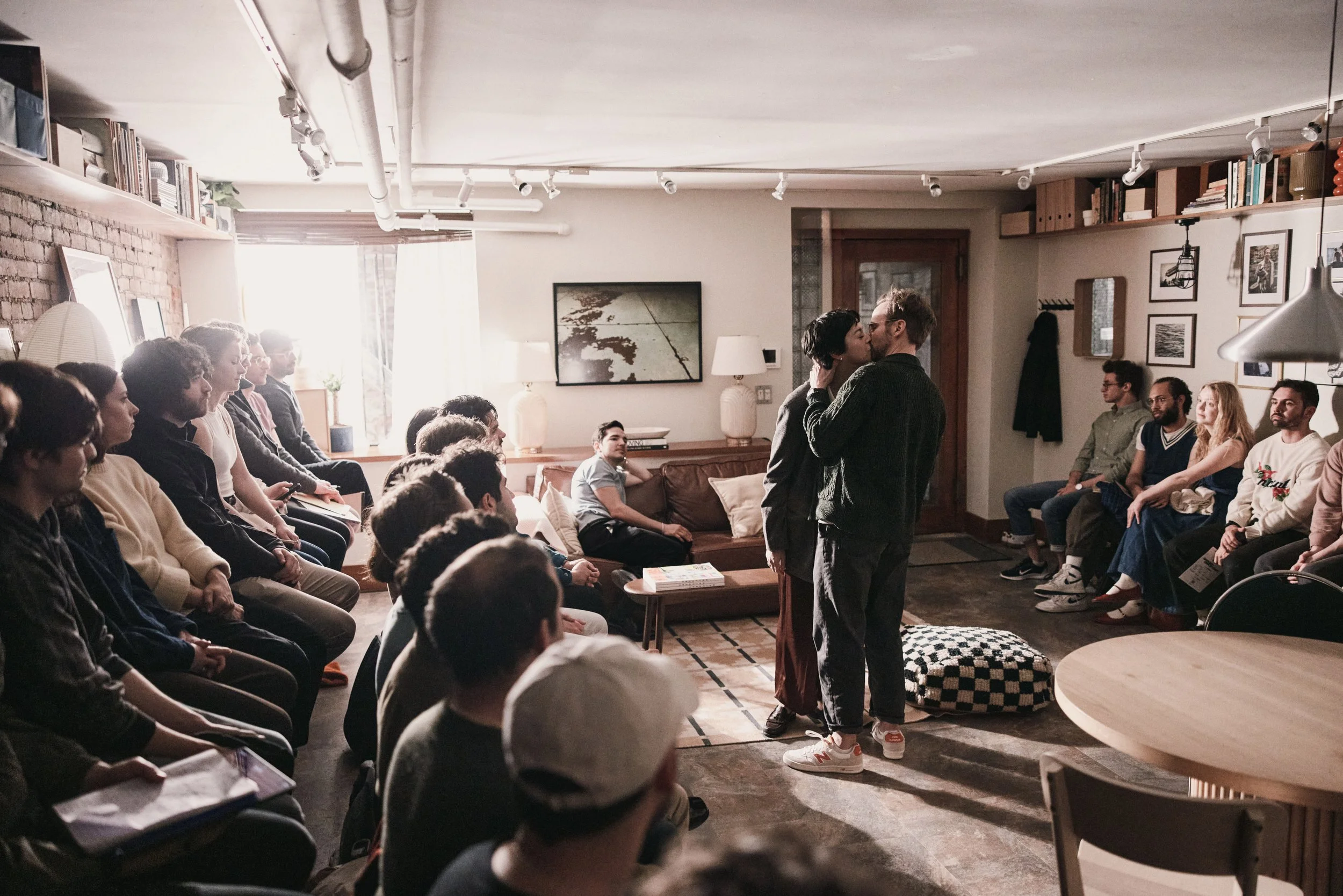
Regular People’s inaugural production featured Juan Castano, Julia Chan, and Ryan Spahn in Ken Urban’s Danger & Opportunity, directed by Jack Serio at East Village Basement. Photo: Emilio Madrid.
Though Patino is Regular People’s de facto head of marketing, Gwen Mileti, another of Regular People’s founding members, serves as head of design and spearheads the company’s eye-catching treatments. Patino and Mileti met a decade ago while attending Sacred Heart University in Connecticut, and after graduating worked together at the same start-up.
“He spent the entire time there talking about how he wanted to be doing this,” recalls Mileti. “And I spent the entire time there talking about how I wanted to move to England and become a rare book restorer.”
“And then I was like, ‘Why don’t you not do that?’” Patino adds with a laugh.
Instead, Patino and Mileti remained frequent collaborators, and when the idea for Regular People first formed, Mileti was quickly brought into the fold. Like Patino and Stuckelman, she prioritizes the voice of the artists in her work.
“I always like to give the caveat that I’m a designer, but I’m also a writer, and my degree is in English and creative writing. So I’m very, very, very passionate about storytelling,” she says. “Obviously marketing is important, and what sells sells. But at the same time, I love being able to honor an artist and their original intention with the project.”
Mileti and Patino’s design process for a project starts by meeting with the writer and director of the show to better understand their visions. “We’re artists first in the way that we look at marketing,” Patino says. “They told their story, and our design should translate as much of that as we can to pull people in and hook them into the work.”
For Blackout Songs, meeting with McGregor and playwright Joe White gave Mileti and Patino a sense of the play’s inherent fluidity. The characters move through time like liquid, blacking in and out of fragmented moments over a decade. That inspiration led to a photo and video shoot in which the show’s two characters, played in this production by screen actors Abbey Lee and Owen Teague in their New York City stage debuts, stand as the only constants in a sea of blurry figures in motion. That shoot represents the show across its advertising, digital and social media, and anywhere else potential audience members might encounter the production.
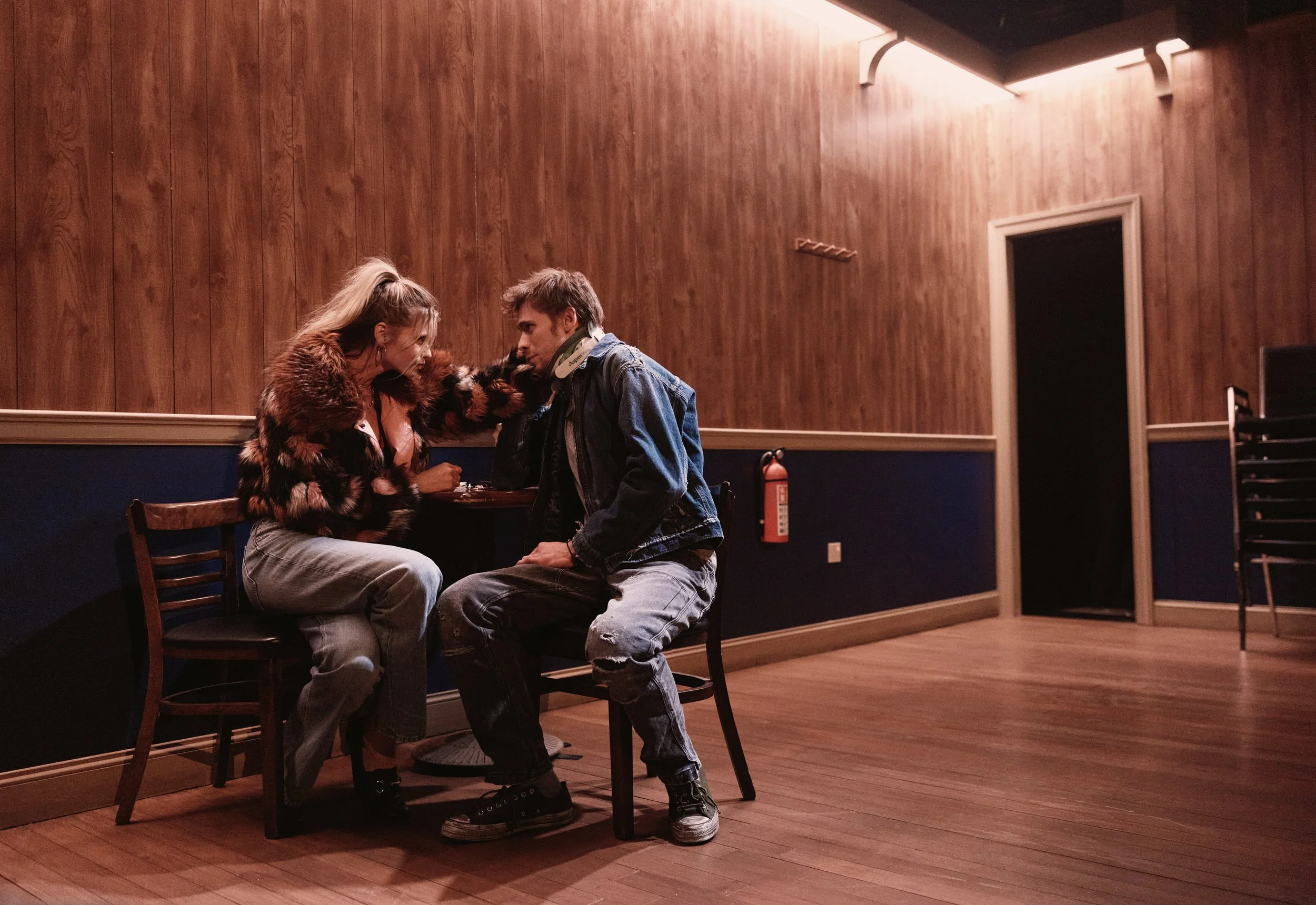
Abbey Lee and Owen Teague in Joe White’s Blackout Songs, directed by Rory McGregor at MCC’s Susan & Ronald Frankel Theater. Photo: Emilio Madrid.
But strategies, meetings, and design philosophies aside, at Regular People, one rule triumphs over the rest. “If I was gonna boil it down to the simplest of terms, it actually just needs to be cool,” Patino says. “We have to make theater cool again.”
Mileti has a metric for making sure her designs succeed: “I look at things and I’m like, ‘But would I want a sticker with that on it? Or would I want a hat with that on it?’” she says.
“We just got our Blackout Songs hats,” Patino adds. “That’s actually the only reason we’re doing any of this, is to get a hat.”
Patino ensures that Regular People and its shows stay stylistically integrated on social media, too. You won’t catch their casts doing TikTok dances or hopping on trends. Instead, they promote their shows with videos highlighting creatives at work: lighting designer Stacey Derosier finalizing the show’s plot, costumer Avery Reed giving her initial design presentation to the actors, and movement consultant Sarah Parker breaking down her philosophy on expressing the play’s emotions, to name a few.
“If I was gonna boil it down to the simplest of terms, it actually just needs to be cool. We have to make theater cool again.”
“We’ve really just put the work first, and have made sure that every single piece of media that we put out for all of our shows is on brand,” he says. “How can we get people to be invested in the process? Because that’s why theater is cool today: it is because all of these people are working on something as a unit.”
Beyond Blackout Songs, the Regular People team is staying quiet about future endeavors. At launch, they announced a few upcoming projects, including a stage adaptation of Lore Segal’s memoir Other People’s Houses and Joey Contreras’s new musical In Pieces, and Stuckelman says they also have three or four new plays in the pipeline for productions later this year. Regular People aims to produce at least one show every season, in addition to working on its outside marketing and design projects, which include other theatrical productions. (Recent marketing clients include Samuel D. Hunter’s Clarkston on London’s West End, Julio Torres’s Color Theories at Performance Space New York, and Beau the Musical at St. Luke’s Theatre.) “But I always say,” Stuckelman offers, “we are focused on what’s right in front of us, and not trying to get too far ahead.”
Right now, what’s in front of them is a six-week run for Blackout Songs, one that Stuckelman hopes will reach and affect audiences in a similar way to their past productions. He recalls slipping into Well, I’ll Let You Go every night during bows to watch the crowd: “I would see people walk out of the theater holding each other and crying and being incredibly emotional,” he says. “And it’s a healthy reminder that this is why we do what we do. Money aside, success aside, it’s about telling stories about people’s shared experiences.”