

Milo Cramer on Getting Swept Away with “No Singing in the Navy”
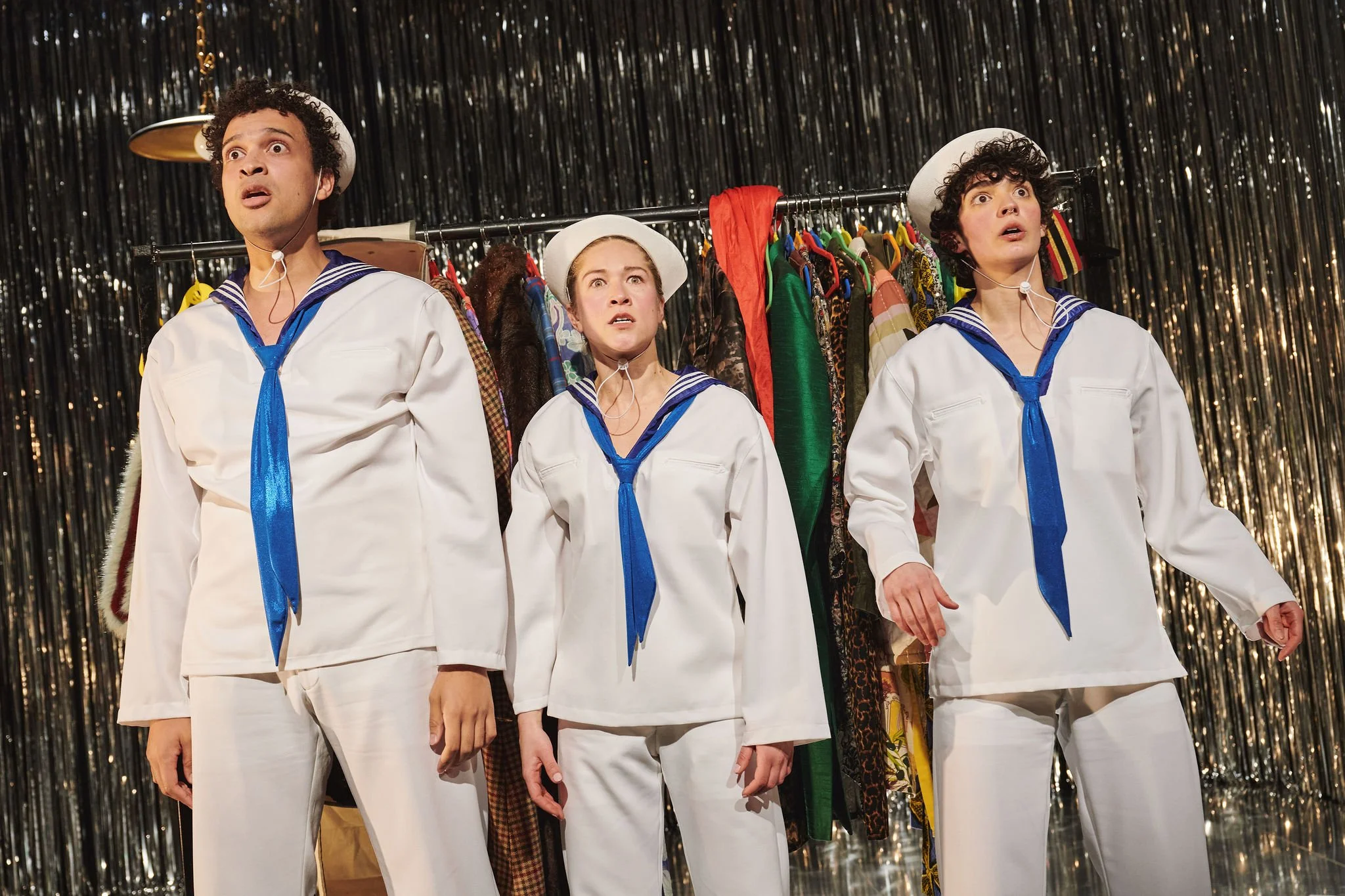
Elliot Sagay, Bailey Lee, and Ellen Nikbakht are three sailors on shore leave in No Singing in the Navy, written by Milo Cramer and directed by Aysan Celik, now at Playwrights Horizons. Photo: Valerie Terranova.
Would you ever recommend to someone that they go and see a painting at the museum because it’s “about” something? Would you ever say, “Go see the Kandinsky at the Guggenheim, it’s about Christian eschatology and the psychic power of abstraction”? The question of whether or not an artwork ought to be about something is not for me to attempt to answer here, but it did hover over my recent conversation with Milo Cramer, writer of the new show No Singing in the Navy, now open at Playwrights Horizons.
No Singing in the Navy plays with tropes from mid-century American musicals, following three silly sailors on 24-hour shore leave in the Big City, before being shipped off to war and certain death. And it’s funny!
“The show is trying to be a capital-A Artwork,” Cramer, 36, tells me, “using the vocabulary of these older musicals to talk about complicity and joie de vivre and existential despair today. So things like ‘send-up’ or ‘parody’ — it’s been hard for me to find the language, to figure out how to completely frame the show in terms of, like, marketing.”
The show snares abstractions — about existential dread, comedy, friendship, theater — like butterflies in a net, never definitively pinning any one down. Since the show has opened, several reviews have found fault with the musical for its inconclusive perspective on the topics that it raises.
“I mean, the play does not observe perfect narrative causality, and it doesn’t really unpack in a legible way American Imperialism or a specific capital-T Theme,” Cramer readily admits. “I thought it was just a really interesting cloud of ideas surrounding old musicals, America today, America back then, and then only having 24 hours as this existential situation.”
Cramer likens No Singing’s combination of complex ideas and playfulness to Promenade, an absurd, experimental musical from 1965 by María Irene Fornés about two escaped prisoners navigating the world of the haves and have-nots.
“[Promenade] is a lighthearted, playful, philosophical musical that both takes itself seriously and doesn’t take itself seriously. I’m going for something similar in that themes are in the air, but we have a levity about it,” Cramer says. “The play is often making these kind of big statements, but simultaneously making fun of itself in a way that I find quite charming and true to my experience of life.”
No Singing was born out of Cramer’s experience in the MFA playwriting program at University of California San Diego, a school whose campus is a twenty-minute drive from the largest United States naval base on the West Coast and the second-largest surface-ship naval base in the world. While the dissonance between the fighter jets swooping overhead and trios of servicemen in cute, squeaky-starched uniforms certainly brought Anchors Aweigh (1945) and On the Town (1944) to mind, Cramer really used the genre as a way to escape making a memoir.

Milo Cramer wrote and starred in the Obie Award–winning School Pictures at Playwrights Horizons in 2023. Photo: Chelcie Parry.
“My mom was like, ‘You can’t write about me ever again.’ My brother was like, ‘You better not put anything I said in the play,’” Cramer recalls. “The sailors became a way to talk about the world and ourselves without getting bogged down by the literal.”
Cramer says “ourselves” because they developed this play for, and in close collaboration with, the actors Bailey Lee, Ellen Nikbakht, and Elliot Sagay who star in No Singing as Sailors 1, 2, and 3, respectively. Cramer met and became close friends with the actors while at UCSD, and wanted to create a work that honored their talents.
“By inhabiting this archetype [of the sailor] we get to see both the archetype and their individual take on it,” Cramer explains. “It was like discovering a vocabulary that was shared with these amazing performers who each bring their unique sensibility.”
The show finds solid ground in its cast, and the physical chemistry between the three performers truly is a shared language. Take, for example, the mock fight between Sailor 1 and 3 during the song “Where Does Self-Worth Come From?” From the stage direction “they chase each other,” Lee and Nikbakht developed a set choreography that is at once goofy and graceful, rolling with each stage punch. All three actors move with a delightful, wiggly rubberiness, reminiscent of a fun-house mirror or Koko the Clown from Betty Boop.
“It’s amazing, when those performers are so fearlessly in their bodies and their voices. I just think that’s very powerful and very healing even just to witness and be around.”
With a stage populated only by a single piano and a rack of costumes (scenic design by Krit Robinson), the spare production provides a playground for the cast to act out not only their silly sailor antics, but also to adopt other roles. Some of the biggest laughs in the show come from Nikbakht’s agonized sea captain and Sagay’s nightgowned Lighthouse Lady. In doubling the roles, Cramer created a comedic kaleidoscope for each performer to show off their multifaceted chops.
“They’ve been really brave and bold. And I find their unhinged commitment to pretty weird bits incredibly punk rock, special and cool, and it reminds me of what I liked about theater as a child,” Cramer says.
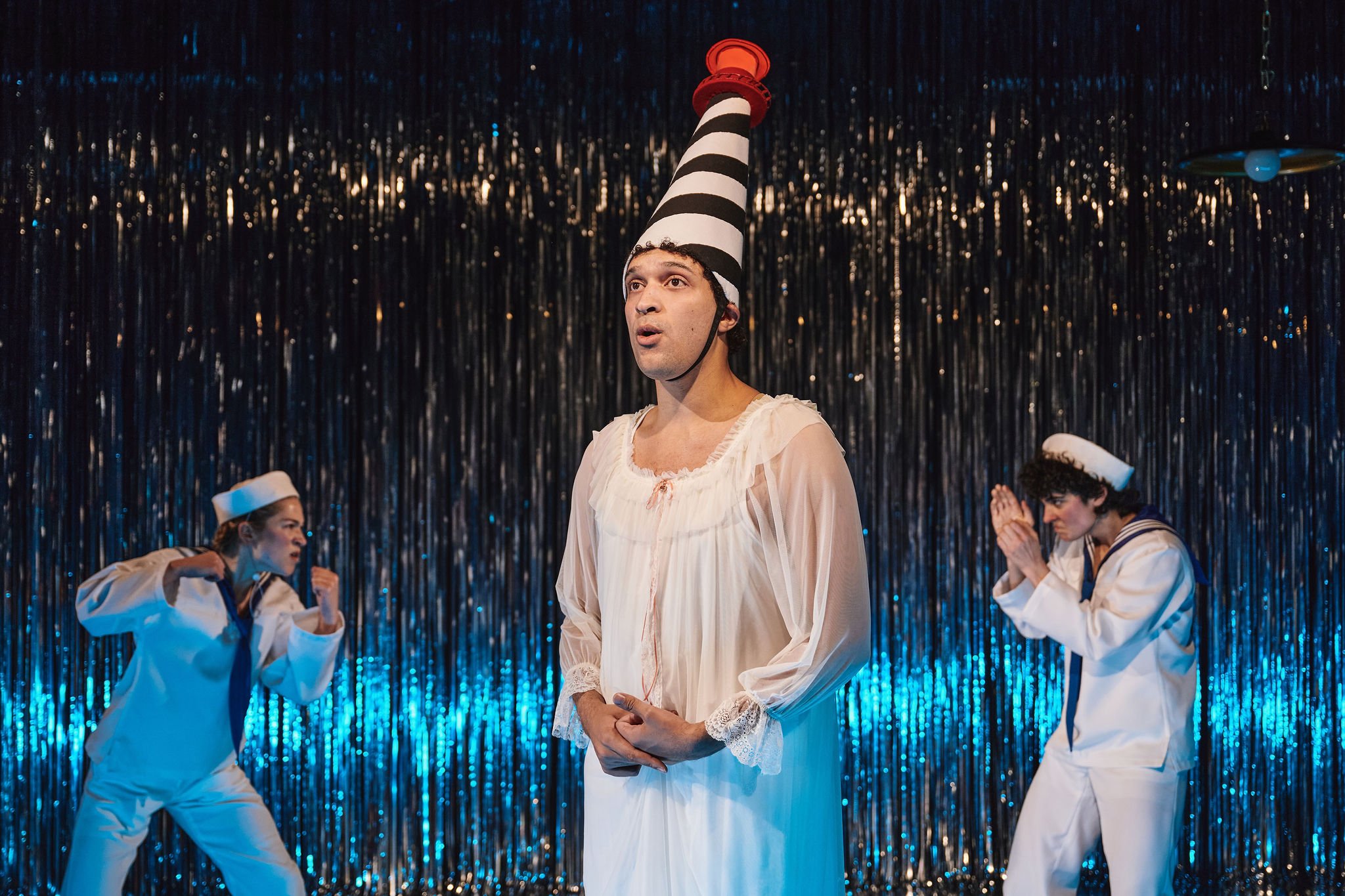
Elliot’s Sagay as the Lighthouse Lady, flanked by Bailey Lee and Ellen Nikbakht, in No Singing in the Navy. Photo: Valerie Terranova.
While Cramer humbly alleges that they are an amateur who knows nothing about musicals (though they won an Obie Award for their solo musical School Pictures in 2023), their love for musical theater is evident. When I asked them to elaborate on their statement in the show’s playbill that musical theater is “undeniable” and “destroys shame,” they shared that they are someone who feels a lot of shame just in their daily life, moving about the world.
“It’s amazing, when those performers are so fearlessly in their bodies and their voices. I just think that’s very powerful and very healing even just to witness and be around.”
For Cramer, No Singing in the Navy is a love letter to the shamelessness of musical theater and the bravery of its participants.
“Some people might find it cringe or untasteful, but I find myself very swept away by the whole thing. I loved every moment of making it, and that’s what I’m trying to share.”