

“Canciones” and the Songs We Take with Us
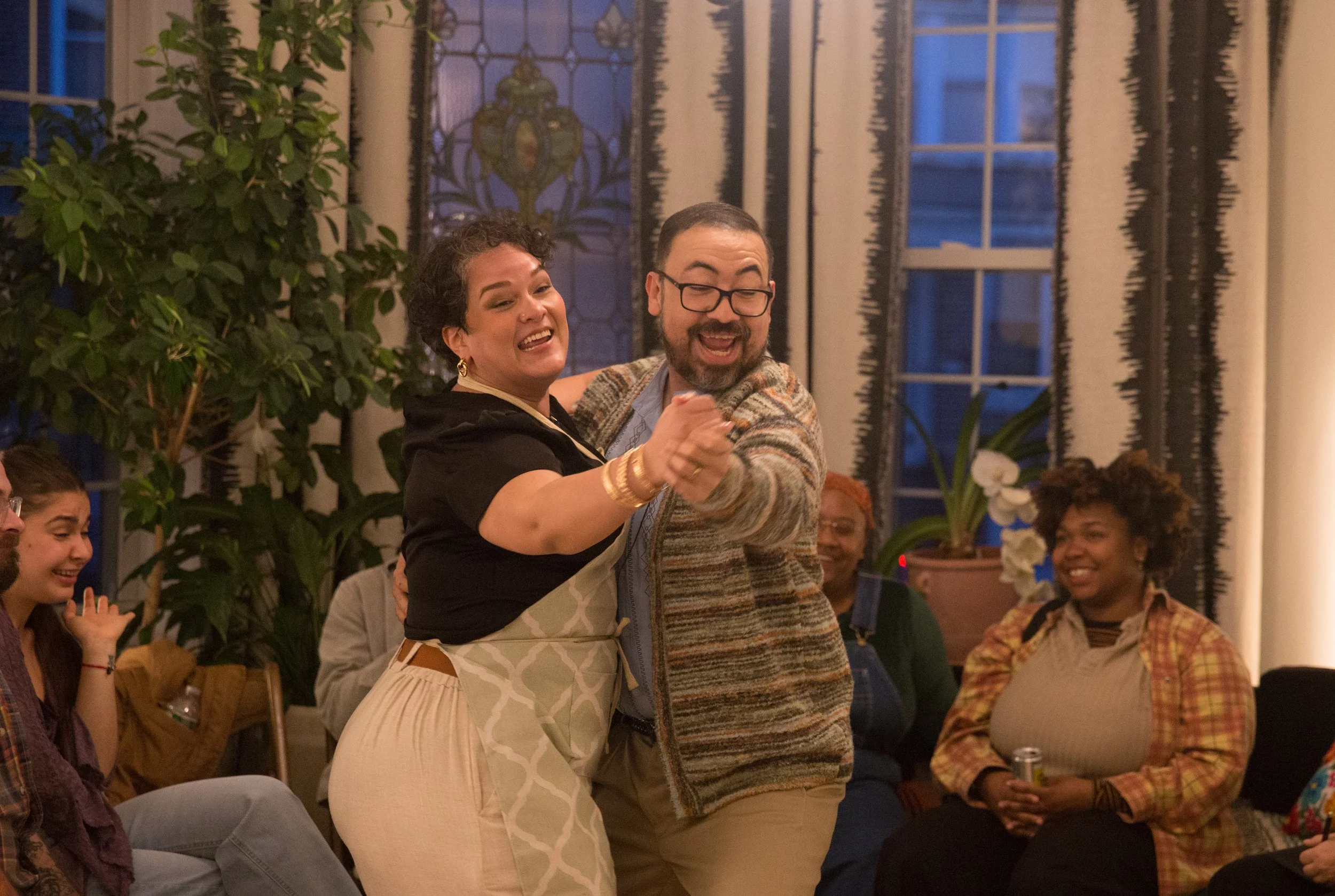
Ely (Cristina Contreras) and Julio (Chino Ramos) dance it out in Canciones, now playing through May 24. Photo: Jody Christopherson.
La Azucena y la Cecilia
Lloran, lloran sin consuelo
Malagueña Salerosa
Ya se fue su pregonero
After a week well spent with my family, who flew from Colombia to celebrate love and reunion, I asked myself once again: Does living in New York City, far away from all the people who raised me and love me, actually make sense?
This question has been chasing me for three years. I had the choice to either stay or leave — some immigrants don’t even have that. But there is a common ground for all of us: we continuously hesitate between home and elsewhere. Staying where we have put down roots, where we feel a sense of belonging, where our loved ones and support network are. Or leaving, many miles away, to follow a dream that might give us some purpose in this short existence.
On a spring evening in a cozy living room in the heart of Flatbush, Brooklyn, I watched a character named Nina wrestle with that same question. She asked herself: “Should I leave and follow my dream of becoming a singer? Or should I stay and support the Guerreros, my community, my family?”
The immigrant dilemma is often framed as a conflict between following a dream abroad and maintaining a sense of belonging. However, Canciones, a site-specific theatrical experience now playing in a Flatbush apartment until May 24, shows us that a dream can actually be another expression of belonging. For us immigrants, it is hard to find a place where the entire family can gather. Some family members are in our home country, others are in our destination country, and some living in the United States are scared to go out and meet other people because of immigration raids and detentions.
Canciones breaks through that fear, at least for its two-hour running time.
“Here theater is thought of as community, as a place of gathering, of convivio — as the word in Spanish says,” Julián Mesri, the music director and arranger of the production, says. “You’re all kind of sharing life together. The audience gets to not just experience theater, but become part of a community, become part of a family, whether or not they are related to them.”
Canciones is produced through a collaboration between Radical Evolution, Latinx Playwrights Circle, the Sol Project, and Boundless Theatre Company. It is a mix of immersive party, acoustic mariachi jam, and family reunion. The production is inspired by the seminal 1987 Canciones de mi Padre album by Linda Ronstadt. During the performance, the audience can move freely through the house, sit in the living room with the actors, have drinks and tamales, and even gossip with the Guerrero family.
Canciones is the story of a Mexican-American family carrying an unhealed trauma. Uncle Eddie left for war, and the family never heard from him again; eventually they were notified by two soldiers of his death. Eddie was a musician and had carried the family’s musical heritage for years. After he disappeared, the family developed a belief: the one who leaves is a traitor to the family. The one who leaves is also choosing not to continue the fragile musical heritage that this family has carefully passed down through generations — symbolized by a charro suit, the iconic attire worn by mariachi musicians and deeply intertwined with ranchera music and Mexican cultural identity.
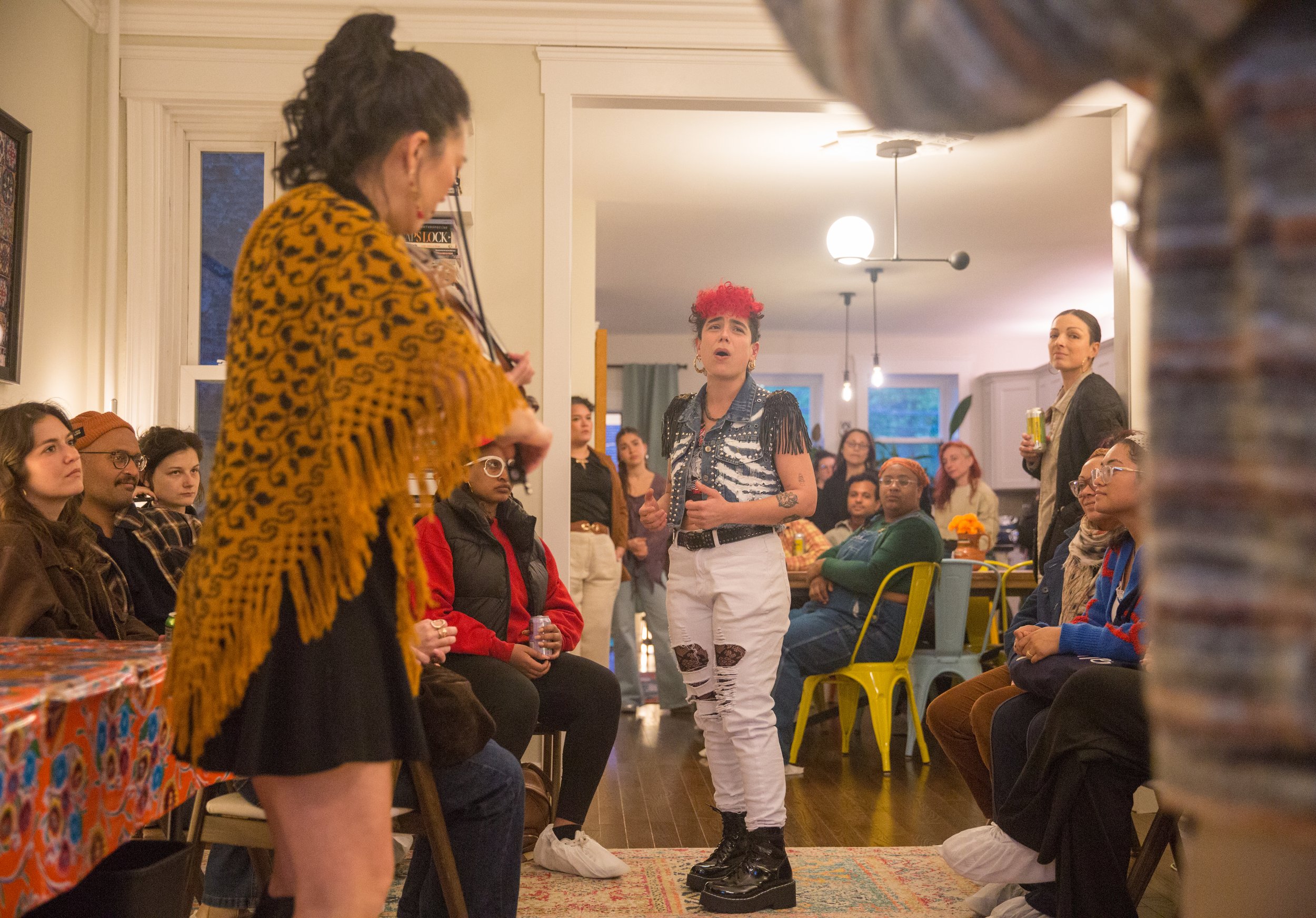
Jenn (EJ Zimmerman) and Kati (Sara Ornelas) immersed among the audience in the Brooklyn living room. Photo: Jody Christopherson.
Kati (Sara Ornelas) is a Guerrero aunt who also left, shortly after Eddie’s death, pursuing her dream of becoming a professional musician on the West Coast. She inherited the family’s charro. When she moved, instead of playing huapangos and rancheras, she started to perform English-language pop and rock music. Her family resents her, believing she acted selfishly by leaving after Eddie died rather than staying in New York. Her reputation has only reinforced their beliefs about those who leave.
During the reunion, the family members argue constantly, like every other family. They hurt each other’s feelings. But someone always steps in to offer support. I even felt, as part of the audience, that I could walk over and encourage Nina, for example, to sing when she was confused and hurting after arguing with her mother.
Nina (Mayelah Barrera), the youngest member of the family, dreams of becoming a great singer. She wants recognition, but also fears that leaving her family would deepen their collective wounds of abandonment. She does not want the same reputation Aunt Kati has within the family, but recognizes that moving to Los Angeles could expand her possibilities for success.
This impossible tension reaches its peak when Nina argues with her parents and processes her feelings by singing “Por un amor,” a classic Mexican ranchera about deep heartache, hopeless despair, and the lingering pain of lost love.
“Mariachi music allows us to express highs and lows,” Rebecca Martínez, the director of Canciones, says. “There is a yearning, there is a longing, there is a celebration, poetry, meditation. And using it as the connective device to share celebration and joy and grief together as a community.”
When the family conflict reaches its highest point, Aunt Kati says something that dissolves the immigrant dilemma: “Nunca se me ha olvidado. Nunca he dejado de cantar por los nuestros. I still sing the songs we sang together [with Eddie]. And even when I sing a song written by a British songwriter, it’s still me. So it’s still us. But maybe I need to get back to the root for a little bit. Maybe we all need to do that every once in a while.”
“Mariachi music allows us to express highs and lows. There is a yearning, there is a longing, there is a celebration, poetry, meditation.”
At the end of the day, her passion for music comes from multiple generations of Guerreros. One can never erase their past, or where one comes from. Kati may have left to follow her dream, but she carries her community, wherever she goes.
Nina, on the other hand, decides — after inheriting her family’s charro suit — that she wants to stay in her hometown and support her family instead of moving to LA. At first, it seems like she is making the opposite choice from Aunt Kati. But staying with her community can also be part of a dream: the dream of succeeding alongside her loved ones, of singing with the people she loves close by.
And, in the end, the best way to celebrate each other’s company, honor the pain, and finally revisit an old wound is through a party. A collective anthem. A celebration of belonging to a lineage, a story, a community that can learn, suffer, laugh, and sing together.
Ay ... que rechula es la fiesta
La fiesta charra, fiesta del sol.
— “La Charreada”