

John Early Lets the Mystery In
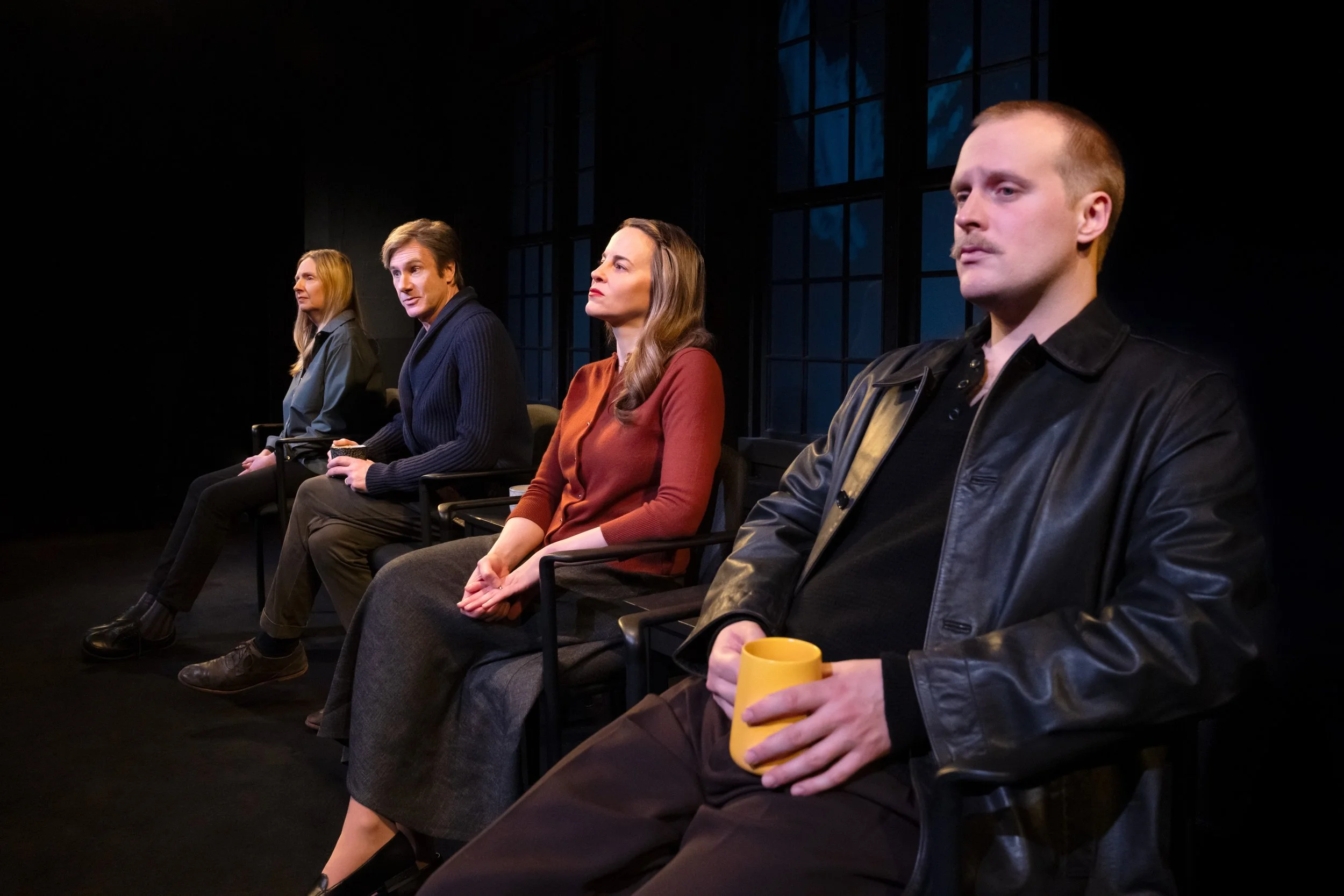
Hope Davis, Josh Hamilton, Maria Dizzia, and John Early in What We Did Before Our Moth Days, a new play by Wallace Shawn at Greenwich House Theater. Photo: Julieta Cervantes.
John Early is feeling exposed. Like a raw nerve or a neck divested of its scarf, he’s open, sensitive, attuned. He’s been feeling this way ever since he started working on the role of Tim, a young man dealing with the death of his father in What We Did Before Our Moth Days, Wallace Shawn’s new play, now running at Greenwich House Theater.
Three hours long and consisting almost entirely of monologues, delivered by each character while seated and clutching cups of tea, What We Did Before Our Moth Days marks Early’s professional stage debut. The play is decidedly quieter than the projects for which Early is known, such as playing Elliot in the TV series Search Party or covering Donna Summer’s “I Feel Love” in his stand-up comedy special.
When we spoke on a recent afternoon, a few hours before the evening curtain, he was simultaneously excited and serene. He’s past the point of running his lines ahead of each show, and now prepares for his performance by reading a book, orienting his brain in a more literary pattern to fit the mood of Shawn’s script.
He owns that recently, on his walks to the theater, he has found himself listening to “Erotica” by Madonna. “It couldn’t be more tonally different.” Early pauses. “Though, Tim is very horny. I thought it was a totally insane thing to listen to, but it actually makes a lot of sense now that we talk about it.”
He’s been seeing connections to the play everywhere, from Madonna’s ’90s lyrics to The Human Stain by Philip Roth. Early attributes this to Shawn’s ability to write from his unconscious mind.
“It’s a very hard thing to do right now. We live in this era of mass voluntary, involuntary, mutual surveillance,” he explains. “That’s why it’s so important to be around people who are older, who haven’t been as malformed by the internet.”
Moth Days was written by the 82-year-old Shawn and directed by his frequent collaborator, André Gregory, who is now 91. I ask Early, who has maintained a friendship with the playwright since he mounted a revival of Marie and Bruce at JACK in 2018, about what it’s been like to work with people from a different generation.
“They understand that making art and making theater is fundamentally mysterious. They don’t claim to know anything about what we are doing. They’re in no rush to prove that they’re the authorities over these characters, over the way we should stage the play, over the way we should rehearse it,” he says. “At the beginning of the process, I would ask, ‘Well, is Tim serious when he says this one thing?’ and Wally would be like ‘I don't know.’ It’s so amazing because what he’s written is so precise but he also understands that it came out of his unconscious mind.”
For Early, this humility and interpretive flexibility is a respite from a culture that has no patience with ambiguity and demands that everyone deliver their “take” with total certainty. It’s Early’s nature to be nonjudgmental, a quality that was allowed to flourish under Gregory’s receptive direction and Shawn’s humanistic script.
“They understand that making art and making theater is fundamentally mysterious. They don’t claim to know anything about what we are doing. They’re in no rush to prove that they’re the authorities over these characters, over the way we should stage the play, over the way we should rehearse it.”
“Sometimes, when people come up to me after the play, I feel like they feel the need to express their disapproval of Tim,” Early says. “I’m like, ‘You know it’s a play, right?’ But I think that actually shows its power: despite these characters’ troubling actions, their humanity is very alluring. I find Tim to actually be totally lovable, you know, even though he does some vile things.”
The brilliance of Early’s performance arrives in drawing the humor out of Tim. The character is troubled and tormented. He’s perverse. Yet he regards the events of his own life with a bemused distance, as if trying to recall a bizarre dream or recount the details of a clown show that got confusingly sexual.
“It would have been a mistake to come in and —” Early slouches his shoulders and mimes pulling a hoodie over his head, glaring out from underneath it, “— be dark. To telegraph to the audience that this character is dark and does bad things.”
During rehearsals, Gregory never broached the subject of Tim’s deviance with Early. In fact, there was little discussion of the character at all. “It was never us looking objectively at Tim, talking about him, figuring him out. That’s what’s so genius about the way André works, you just end up being totally inside the character.”
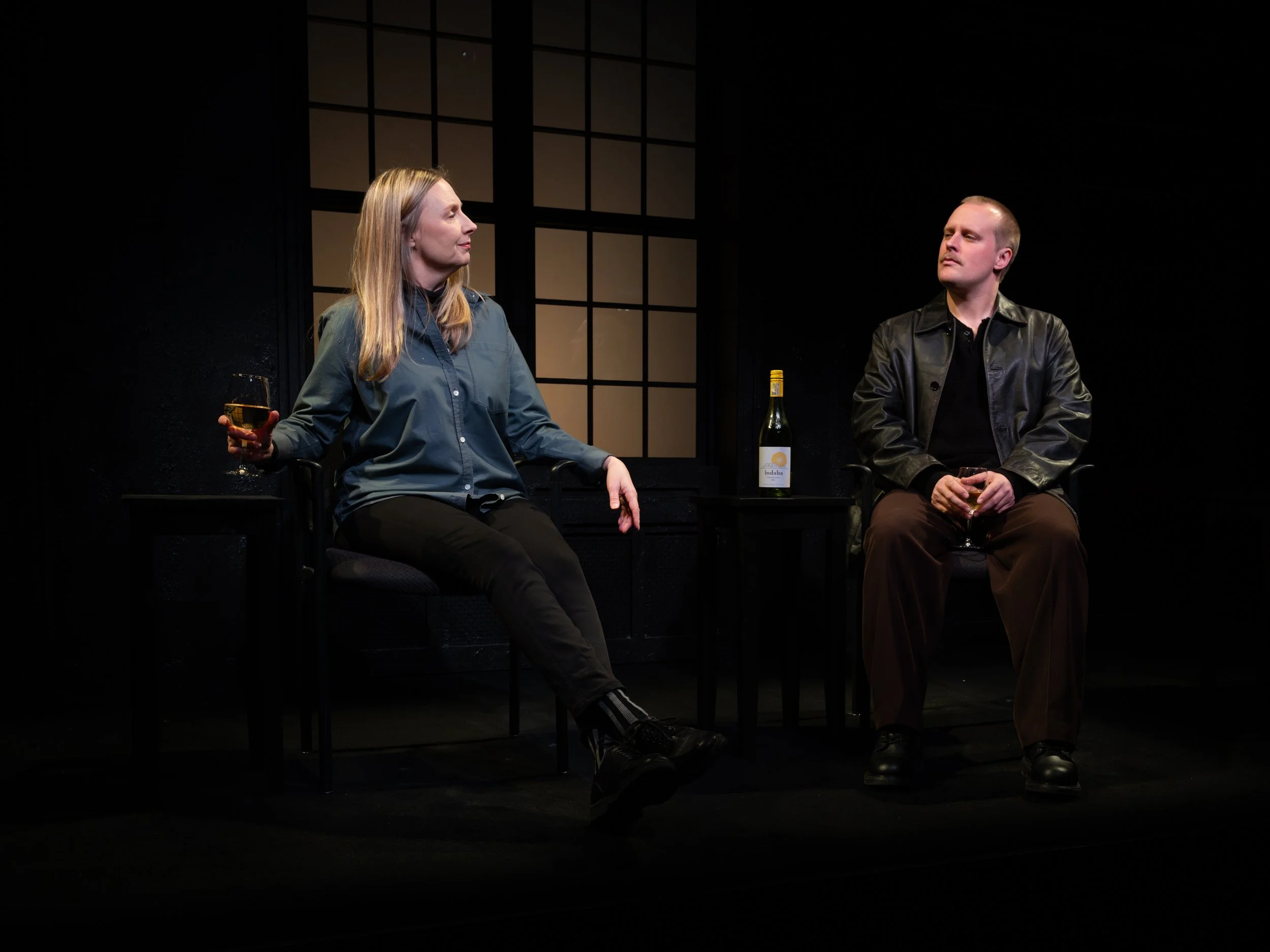
Hope Davis and John Early in What We Did Before Our Moth Days. Photo: Luis Manuel Diaz.
To hear Early describe how his character developed resembles an immaculate conception — or cooking a stew over a low, slow flame.
“Wally and André have created this process where you simply just show up to rehearsal, and you stand out of the way of the play, and you just do the play, and you just do it over and over and over and over again. And then, before you know it, something emerges, some sort of behavior, some sort of feeling. It’s miraculous.”
In the fall of 2024, Early arrived at Gregory’s apartment for his very first rehearsal. He found Gregory, Shawn, and assistant director Lucas Kane sitting in one set of chairs. He and his co-star Josh Hamilton were to sit in a pair of chairs a mere three feet away.
“Here are these two theater legends, who have done these very experimental productions. I didn’t know if they were going to have me rolling around on the floor or what. I was like, ‘Is this going to be terrifying?’ But I was willing to withstand any terror for them.”
They drank tea and talked for a while, and, in their presence, Early felt his heart rate settle down.
When it came time to read his monologue, Gregory reminded him, “‘John, you know, we’re your scene partners. You can direct it to us,’” he recalls. “So I just looked into their beautiful faces and their eyes and started doing it. It was totally thrilling.”
The rehearsals that followed deviated very little from what Early experienced on that first day. Even the lunch order was a sacred constant — everyone ordered either salmon Niçoise or chicken salad, every day. As the demands of professional theater were layered into the production — mics, lighting, costumes, a stage — the goal was to maintain the level of intimacy they had achieved in Gregory’s apartment.
The year and a half of rehearsals were not continual. The point of such a long rehearsal period was to take breaks, allowing one’s character to gestate, or simmer on the back burner.
During one such break, Early filmed and edited Maddie’s Secret, his directorial debut about a food influencer with an eating disorder. The film, in which he also stars as the eponymous Maddie, opened at Toronto International Film Festival this past September and premieres next month at Lincoln Center. I ask him how his experience with Moth Days impacted the making of Maddie’s Secret. “It’s nothing I could quantify or even define, but I just feel like a better actor. I feel like I can let people look at me.”
And directing? “I learned to stay out of the way and I stopped trying to prove at all times that I know what I’m talking about. I was less concerned with making it clear to everyone that I’m the one in charge, you know? That’s very André. He just lets things happen.”
Early hopes that this play will impact actors and writers beyond himself.
“I'm seeing the effect that this play has on young people’s faces. They’re shocked. They didn’t know that this was possible — this kind of writing and the simplicity of the staging, the delicate nuance in all of it. I really hope that it inspires people to make more nuanced, deep, novelistic things. And then maybe I’ll get to read those things and act in those things. I don’t know. I don’t know.”
There’s hope in the mystery.