

Marshall Pailet Is Just Trying to Create Delight in the Darkness

Ethan Slater and Marshall Pailet are co-writers of Marcel on the Train, a new play about the French mime Marcel Marceau, running at Classic Stage Company. Photo: Emilio Madrid.
When Ethan Slater approached director Marshall Pailet about writing a play together about the French mime Marcel Marceau, Pailet was a bit busy.
It was 2021, in the middle of the COVID-19 pandemic, and Pailet had just welcomed his first child into the world — in fact, he was still at the hospital with his wife and newborn son when Slater called him. It also happened to be the week after hospitals began allowing partners back into the delivery room.
As Pailet settled into life as a new dad, he and Slater — whose artistic relationship dates back to 2015, when Slater starred in Pailet’s musical Who’s Your Baghdaddy? Or How I Started the Iraq War — began working on Slater’s idea: a fictionalized snapshot of one of the greatest mimes of all time, Marcel Marceau. They would co-write the script and Slater would star as the title character, while Pailet would direct. The idea became the new play Marcel on the Train, now in previews at Classic Stage Company, and running through March 22.
Instead of trying to cover Marceau’s prolific mime career, the co-writers focused on the days before his stardom — a period spent smuggling Jewish children out of occupied France during World War II. “We started writing the show in the dead of COVID. It was a dark period for us. It was a dark period for the whole world. In the writing of this, we were seeing ourselves out of a pretty profound darkness,” Pailet says.
The story that emerged sets Marceau’s heroics — aided by the use of his physical comedy talents — against a backdrop of unspeakable horror. He was saving lives amid the Holocaust by keeping children quiet and entertained while sneaking them to safety.
“Once upon a time, there was this very, very young man who had to try to be a creator of delight and positivity on this train through the Holocaust when they’re being hunted by Nazis,” explained Pailet. “He was sculpted as a human and as an artist in an incredible darkness.” In order to express the gravity of the story, he and Slater threw themselves into learning about Marceau’s career — and the echoes of trauma within it.
“We were looking for little moments of humanity and delight inside this structure that we knew would be filled with horror and tension and suspense.”
Pailet had studied both Marceau and mime while in school, but not in great depth. “We had to do a lot of research, both on the specific story of these train rides and on Marceau’s craft and artistry,” he says. What they discovered was how relatable Marceau felt to audiences, even when they had never gone through what was being depicted.
As Marceau mimes ice-skating or catching butterflies or attending a high-society event in one of his many well-known routines, “you can hear the audience laughing and the laugh is almost one of recognition,” says Pailet. “You are laughing along because you’re like, ‘Oh my God, I totally get that.’ When Marceau talks about it, he’s like, ‘We all know what it feels like to have a butterfly die in our hands.’ But then I think about it and I’m like, ‘Actually, I don’t think a butterfly has ever died in my hands. I actually don’t think I relate to that at all.’ But there’s something about the way that he draws you in with delight. The stories are so specific, and then something tragic happens, and even if you’ve never experienced it, you are feeling it with him.”

Wicked film star and Tony Award nominee Ethan Slater steps into the shoes of Marcel Marceau in Marcel on the Train. Photo: Emilio Madrid.
That juxtaposition central to Marceau’s art is the linchpin of Marcel on the Train. “Finding delight in the horror and horror in the delight feels intrinsic to who Marceau was,” says Pailet. “We were looking for little moments of humanity and delight inside this structure that we knew would be filled with horror and tension and suspense.”
It’s a practice Pailet has turned to repeatedly throughout his career. Pailet’s resume is stocked with war stories, including the World War I musical Private Jones and Who’s Your Baghdaddy?. It’s also filled with children’s media. In the early days of his career, Pailet wrote for properties including VeggieTales, The Magic School Bus, and Shrek. And though the child characters in Marcel on the Train are played by adults — the play has a cast of six — capturing that childlike sensibility was important to Pailet.
Familiarity with entertainment for young audiences also helped inform Pailet’s approach to the miming sequences throughout Marcel on the Train. “It’s possible that an early career immersion in Shrek and Magic School Bus and stuff like that helped train me to be a good director of mime,” he says. “Oftentimes, when I’m working with actors who don’t have a physical storytelling background, I’ll be like, ‘Go watch some Tom and Jerry.’ You always know exactly what that mouse and that cat are feeling. They never say a single line of dialogue, but you can communicate the entirety of an emotional experience with your physicality.”
Marcel on the Train must rely on these emotions, rather than plot, to drive the narrative forward. Because the story is based on historical events, the audience comes in knowing that Marceau’s endeavors were successful, and that he lived a long life after the Holocaust. “We wanted pretty early on in the journey of the show to tell the audience that everyone lives,” says Pailet. “So the dramatic question isn’t so much will they live, but it’s how will they live with it?” Roughly eighty years after the Holocaust and five years after the duo began writing this play, the relevance of that question remains, as society grapples with how to act in the face of myriad crises — in Minnesota, in Israel and Palestine, in Ukraine, and more.
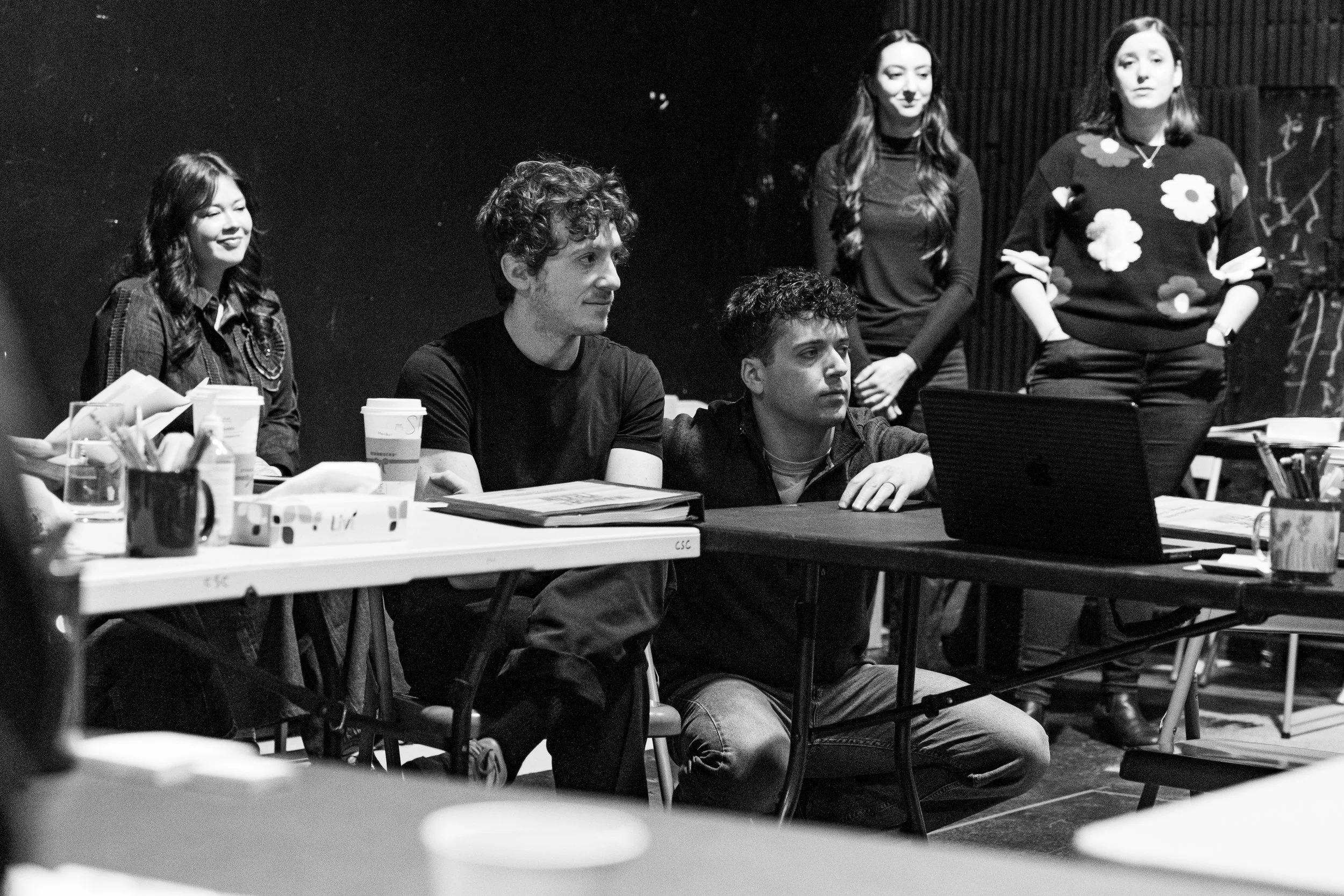
Slater and Pailet in rehearsals for the Marcel on the Train at Classic Stage Company. Photo: Andrew Patino/Regular People.
“Sometimes in the distance between when you write a thing and when it actually gets produced, it can become less relevant,” says Pailet. “The thing that interested you in the first place is no longer as interesting. The world has moved on. I don’t think that that’s the case here. I think that it has gotten much more relevant and there is a different kind of very threatening darkness, and we feel the presence of that every day.”
Those stressors have directly impacted the show, both in tone and in execution. “When we’re in the rehearsal room, we are laughing, we are having fun, we are feeling joy, but that is joy that is living on top of a kind of existential sadness that we’re all feeling,” says Pailet.
And so his aim is that Marcel on the Train serves not as a distraction from the heaviness of the real world, but as a sort of roadmap for how to live within it. “I hope that audiences leave this show feeling a sense of hope because I have no doubt that they will have spent a good portion of their day feeling senses of existential dread and sadness,” he says. “I want us to maybe be a layer of hope on top of that.” Marceau spent his life illuminating the beauty in the darkness, and Marcel on the Train seeks to do the same.