

Thornton Wilder’s Unfinished Play About Choosing a Life in the Arts

Candy Buckley plays Bernice and many other characters in Thornton Wilder’s The Emporium at Classic Stage Company, adapted and completed by Kirk Lynn and directed by Rob Melrose. Photo: Marc J. Franklin.
When I saw a recent performance of the newly completed The Emporium, Thornton Wilder’s unfinished allegorical play about an orphan who as a young man tries to work in a fabled department store, I wasn’t allowed to see the entire play. You may be thinking, but didn’t the writer Kirk Lynn finish the play for its New York Off-Broadway premiere at Classic Stage Company?
Yes, Lynn did complete the play based on Wilder’s scenes and notes, and even wrote the prologue, which comes at the start of the second act, based on Wilder’s sketched-out idea for it. But at each performance, the audience votes during the intermission (by putting either a blue chip or a green chip in a box) on whether they prefer to see the prologue performed or not. My audience voted “no,” despite my “yes” vote.
“I think you have a remarkably bold audience when they don’t want the prologue,” Lynn said during a phone interview a few days after the performance I attended. The prologue spells out the play’s themes, so the question of whether to include it or not becomes about whether audiences want such explicit telegraphing or if they prefer to work out the play’s ideas themselves.
The idea of how to incorporate the prologue into The Emporium came together at the world premiere production at the Alley in Houston two years ago, and continues during the New York run, through June 7, directed by the Alley artistic director Rob Melrose.
The Emporium department store could represent many things, but the prologue states that it’s emblematic of a life in the arts, and that Craigie’s, the rival department store, is the steady day job, a place that’s all commerce and no artistry. For Lynn, the Emporium also represents one’s right path in life, or anything one longs for.
Wilder had big ideas for The Emporium, which he began writing in the late 1940s, and one was that he wanted to write a play that was structured like a loop (not unlike the movie Groundhog Day): One has to keep trying over and over to get a job at the Emporium, or to attain some really hard-to-reach dream, until it finally works out. “Wilder is obsessed in his journals of writing a play that works as a perfect circle,” Lynn explained. “And in some entries, he’s even like, you could start at scene four and work your way back around, or start at scene seven and work your way back around. I don’t think most audiences would go for that. But that’s one of his obsessions.”
Wilder drew from Kafka’s final unfinished novel The Castle, about an enigmatic castle of bureaucrats that the protagonist, only known as K, tries to gain access to, and from Horatio Alger’s rags-to-riches stories. Even the protagonist from Wilder’s own 1935 novel Heaven’s My Destination, George Brush, is in the soup.

Laurencia (Cassia Thompson) obtains an enviable position working at The Emporium. Photo: Marc J. Franklin.
The Emporium is an Everyman story that also critiques the very place the hero is trying to reach. “It’s not like the Emporium is perfect,” Lynn said. “They use up all your life and then when you can’t serve it anymore, they throw you away. And then after you die, they put you on a memorial. [Wilder] can balance things so wonderfully and see multiple sides of an issue. He doesn’t dismiss the idea that most of us have to work at Craigie’s at one point or another in our lives.”
A novelist, playwright, screenwriter, and one of the founders of Rude Mechs theater collective in Austin, Texas, Lynn began his journey with Wilder after seeing the 2009 David Cromer production of Our Town at the Barrow Street theater. “I had this light bulb go off in my head: How is Thornton Wilder at once known for making well-made stories and also I think of him as so experimental that we haven’t caught up to him yet?” Lynn said. “And after that thought I was like, I’m just gonna read everything by Wilder.”
“So why was Thornton Wilder unable to finish the play? There are many reasons why artists abandon a project, and Kirk Lynn speculates on everything from his being distracted by non-writing projects to fear that the script would not be on par with his Pulitzer Prize–winning plays. ”
And he did then read all of Wilder’s full-length plays, short plays, novels, letters, and the biographies. The last book he opened was The Journals of Thornton Wilder, 1939–1961, which contains two scenes of The Emporium as well as a section of notes called “Notes Toward ‘The Emporium.’” That led him in 2018 to Yale University’s Beinecke Rare Books & Manuscript Library, where the Thornton Wilder papers are housed.
There are over 200 boxes of materials in the Thornton Wilder papers, which include incomplete manuscripts of The Emporium and unpublished notes on the play from Wilder’s journals. As Lynn combed through everything he saw patterns within the scenes. “It was this crazy moment where first there’s a volume of like 360 handwritten pages, and then as you go through them, there’s nine discrete scenes,” he described. “It doesn’t flow from beginning to end in what’s in the Beinecke, but it’s all drafted in some way.”
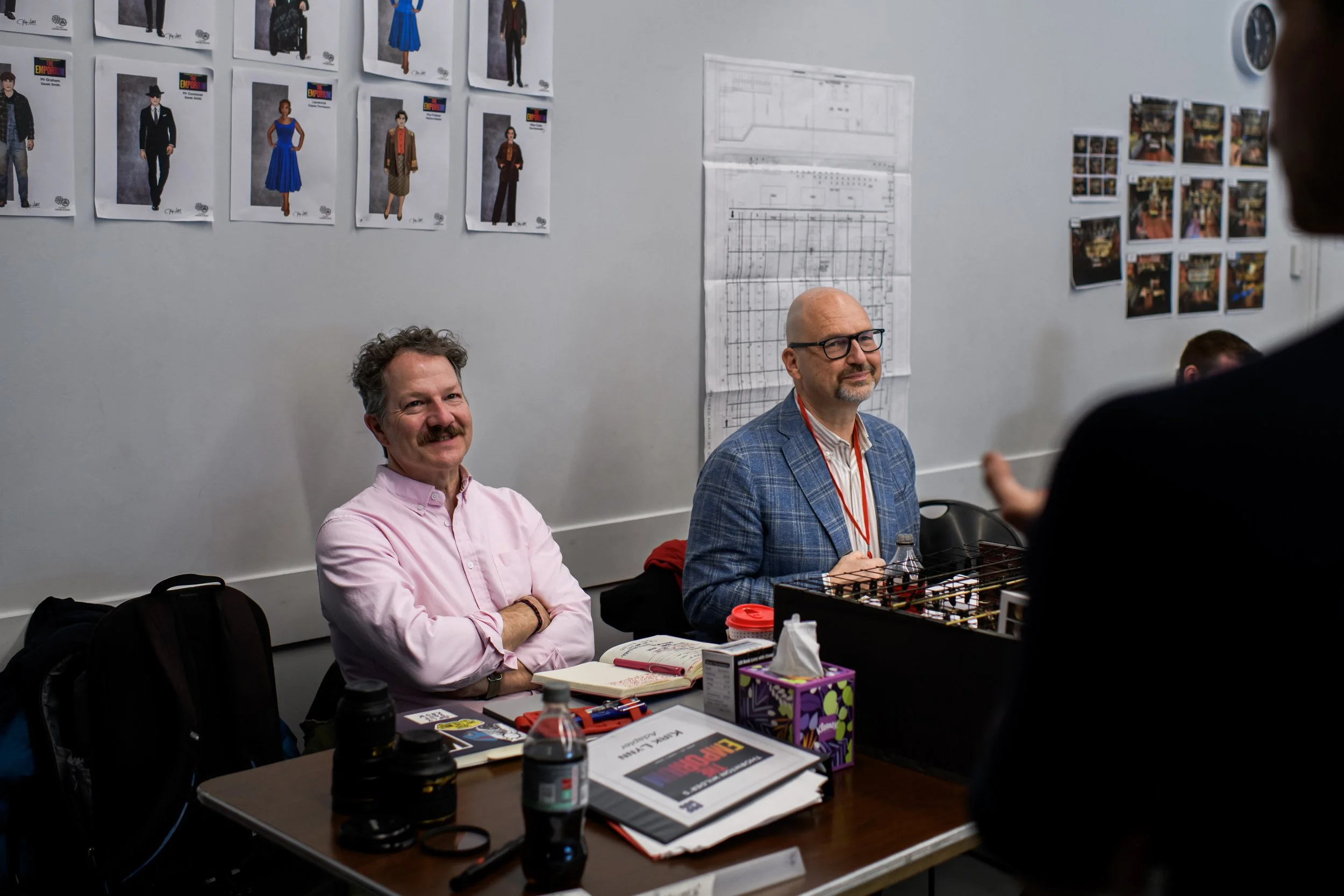
Seen here in rehearsal at Classic Stage Company, Kirk Lynn (left) adapted Wilder’s notes and manuscripts to complete The Emporium, which premiered at the Alley Theatre in Houston, directed by Rob Melrose (right). Photo: Allison Stock.
Lynn then talked to his agent about wanting to complete the play, and the Wilder estate didn’t say “no.” Lynn put together readings of Wilder’s scenes without any additions to show that the play was worth being completed, and from there the project moved forward with encouragement from the estate. Thornton Wilder’s nephew, Tappan Wilder, who until recently was the estate’s literary executor, encouraged Lynn to think of the process as a collaboration with Thornton Wilder. “Most estates are not like that,” Lynn said. “It was so generous of the estate to let the work continue to live and grow and change.”
Lynn experienced this synergy when he took an idea from Wilder about having the department store retiree characters on stage and enhanced it so that they became the board of directors of the Emporium. “That was where I felt like, oh my god I’m collaborating with Thornton Wilder,” Lynn said. “He set up a puzzle and then I got to solve it.”
So why was Wilder unable to finish the play? There are many reasons why artists abandon a project, and Lynn speculates on everything from his being distracted by non-writing projects to fear that the script would not be on par with his Pulitzer Prize–winning plays. Wilder returned to writing novels in his later years, and Lynn also wonders if Wilder found novels easier to write. “With novels, it’s not a live performance, so the reader can set it down, can pick it up, can flip ahead. It’s a lot more forgiving of a genre.”
For whatever reason, Wilder could not find his way out of, or perhaps into, The Emporium. But fortunately Lynn has done the work to bring Wilder’s ideas to the stage so that audiences can experience what Wilder envisioned and can feel that, despite everything, a life in the arts is worth the struggle. Is that too on the nose? I will always vote “yes” on spelling out themes.